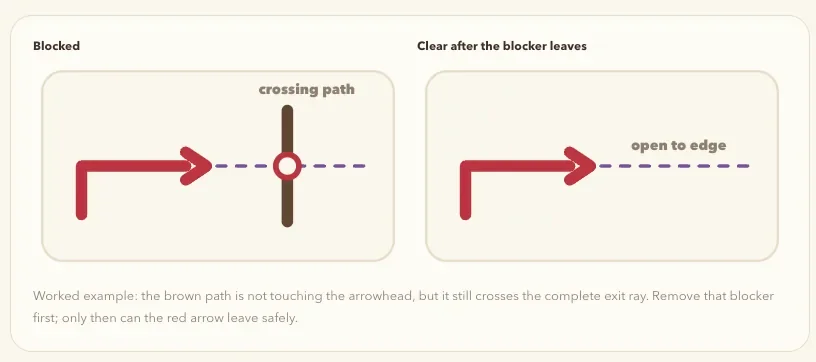
Arrow Puzzle turns a simple instruction—remove every arrow from the board—into a strict exercise in scanning full lines of sight. At first glance, a path looks clear whenever an empty space sits directly beside its arrowhead. In practice, an arrowhead's final direction only grants a safe exit if its straight ray remains completely unblocked all the way to the boundary edge. A path that bends across that exit line five cells or ten cells away will block the escape just as effectively as a piece sitting right in front of it.
This distinction between immediate clearance and full exit rays drives the entire challenge designed by creator @hongzhang. Selecting an arrow whose ray is obstructed does not clear the piece or reorganize the board. Instead, it docks a life and leaves every path exactly where it was, penalizing wild guesses and forcing players to trace every crossing line before committing to a click.
 3 Game Screenshots
Reading the Board and Navigating Blocker Chains
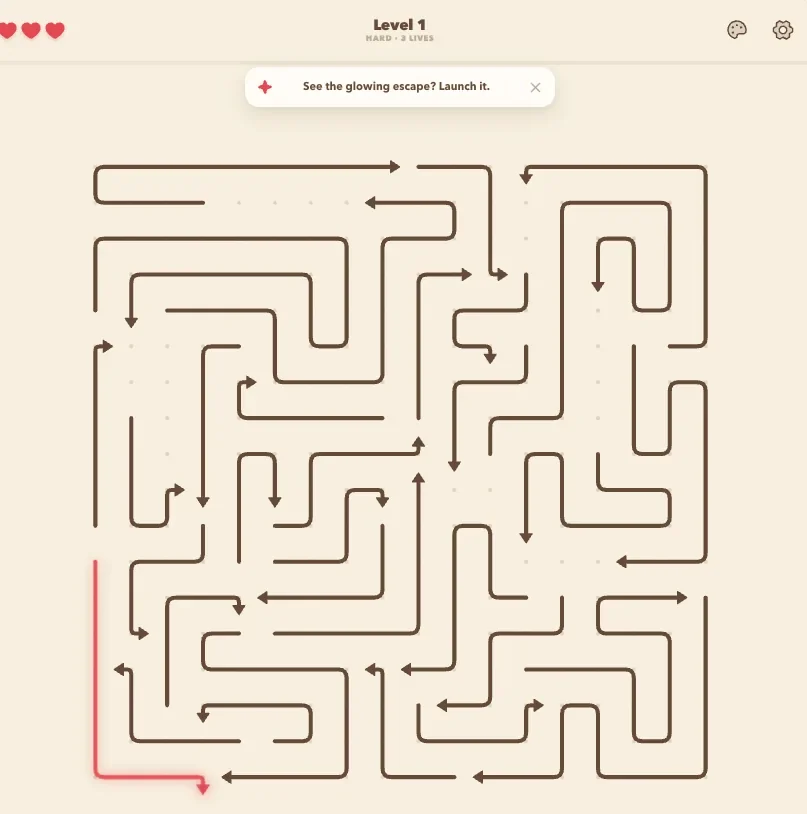
The Journey mode opens on Level 1 with an 18×18 Hard grid housing 32 interlocking paths and a buffer of three lives. To help players learn how dependency chains work, the first three legal moves glow in sequence. Clicking these guided paths advances progress from 0/32 to 3/32 while demonstrating how removing a single piece alters the remaining open rays. Once that initial three-move sequence finishes, the glowing highlights disappear, leaving the player to trace every dependency independently. Testing a blocked path at this stage immediately reduces the life count from three to two, establishing the penalty structure that runs throughout the game.
Because paths wind and bend several times across the board before reaching their arrowheads, visual alignment can be deceptive. An arrowhead might rest right beside a line that belongs to a completely different piece, or a long path might loop through three different quadrants before ending in a ray that points off the board. Resolving a dense board requires systematically working backward from an arrowhead, scanning its entire straight exit ray to the outer border, and identifying any crossing segment. That crossing segment becomes the next link in a blocker chain that must be resolved first. Removing one safe arrow frequently opens up a new escape ray elsewhere, but it rarely triggers an automatic chain reaction that clears the board without further analysis.
Journey Mode Structure and Daily Challenge Constraints
The main Journey campaign spans 50 deterministic levels split into two distinct tiers: 30 Hard boards followed by 20 Nightmare boards. As progression continues, grid dimensions expand from the starting 18×18 layout up to 22×22, accompanied by varying board silhouettes including standard rectangles, rounded borders, diamonds, and irregular blob shapes. These boundary shapes directly alter puzzle logic because an exit ray's total distance depends on exactly where the playable area ends. Despite the larger grids, later stages maintain strict bottlenecks; Level 50, a 22×22 Nightmare rectangle containing 48 paths, begins with only one safe move available. Completing Level 50 displays an "All 50 levels cleared" result prompt along with an option to replay that final board. There are no character narrative endings, storyline conclusions, or hidden secondary modes beyond this main sequence.
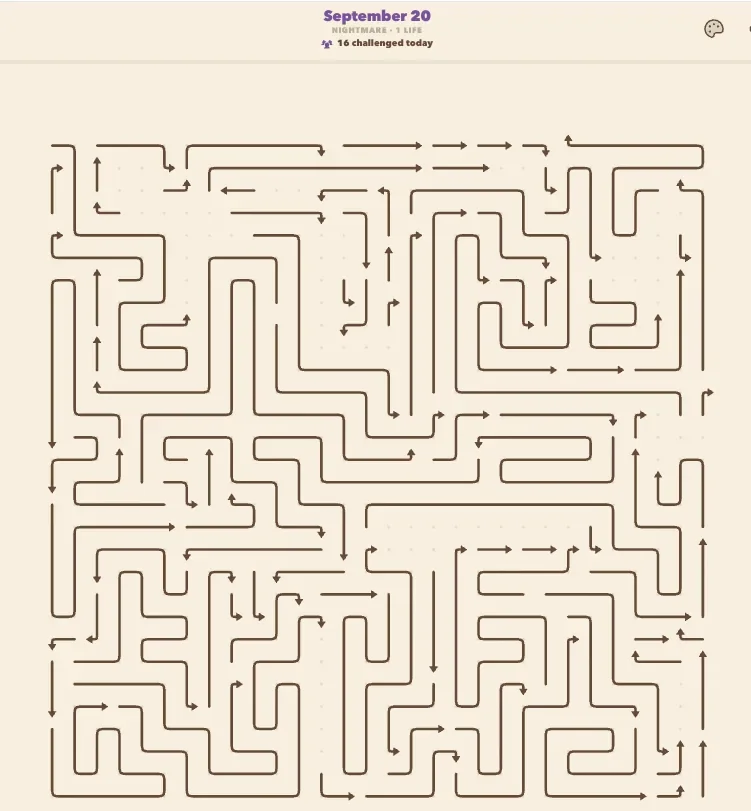
For players seeking stricter conditions, the Daily Challenge applies the exact same exit-ray mechanics to a single board generated for the current UTC date. Unlike Journey mode, which allows a few mistakes across its three-life allowance, the Daily board enforces a strict one-life limit. In testing, picking a single blocked arrow in Daily mode instantly triggers an "Out of lives" pop-up explaining that the challenge ends after one error, with restarts reintroducing the exact same UTC board arrangement. This format shifts the emphasis toward total verification before clicking, rewarding those who systematically map out dependencies across the grid. On platforms like Fortcade, where browser puzzles emphasize clean execution without account barriers, this daily test focuses entirely on testing pure observation rather than speed or trial and error.
Interface, Controls, and Visual Presentation
Interaction is straightforward, relying on direct clicks or taps to select pieces. To help manage dense 22×22 Nightmare grids, the responsive interface includes drag controls for shifting the board view, pinch or zoom inputs for close inspection, and a reset button to re-center the entire puzzle. Progress, completed level indices, preference choices, and daily streak counts save directly to the local browser rather than an online user account. The default portrait layout keeps key information—such as remaining lives, current level title, color palette options, and general settings—visible without horizontal clipping.
Visually, the game utilizes a warm cream background paired with dark brown paths, coral highlights, and muted purple accents. Toggle options permit muting sound effects, enabling reduced motion, or cycling through alternative color palettes to improve readability on complex boards. Because there are no animated characters, power-ups, or collectible items, the visual focus remains entirely on tracking lines. While this minimalist presentation keeps the screen clean, tracking dozens of overlapping brown lines on dense Nightmare boards can eventually lead to visual fatigue, particularly when trying to distinguish which winding segment belongs to a specific arrowhead.
Ultimately, Arrow Puzzle delivers its best moments by committing fully to its core observation rule. By ensuring every puzzle is deterministic and punishing unverified guesses with lost lives, it turns simple line-tracing into a methodical logic test. While the fundamental loop does not introduce new tools or mechanical gimmicks across its 50 levels, the tight execution and demanding Daily Challenge make it a solid option for players who enjoy careful spatial deduction.