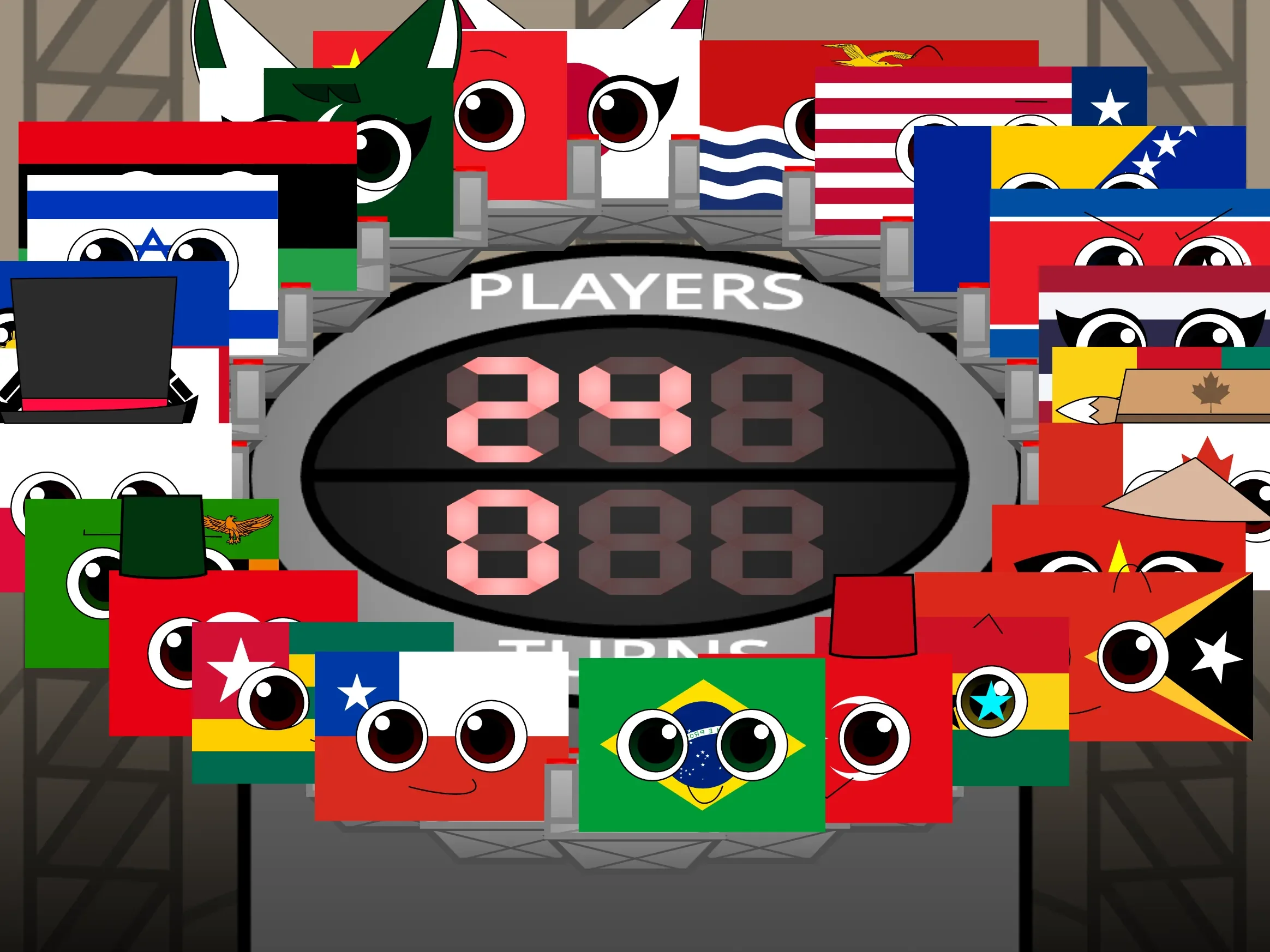
Twenty-four flag characters sit around a mechanical circle inside a dark industrial frame, each facing an individual button and waiting to see who will be dropped from the arena. Some choose to activate their buttons while others remain still, raising a counter that determines how far the whole ring will rotate before locking into place. In Ay in tick drop but Country Flag Band, created by @MrSun126, watching this automated loop unfold delivers surprising suspense, even though the viewer has no direct control over which country pushes its button or falls into the abyss.
The game's opening screen presents the question, "Press the button, or not?"—a query meant entirely for the on-screen automated contestants rather than the human player. There are no keyboard commands, timing challenges, or strategic inputs to execute. Hovering the mouse pointer over a flag displays that nation's name to clarify crowded positions, and clicking Scratch's green flag restarts the full simulation. Beyond these simple inputs, the experience functions as a spectator elimination show where randomized choices, rotation counts, and seating arrangements dictate every outcome.
 3 Game Screenshots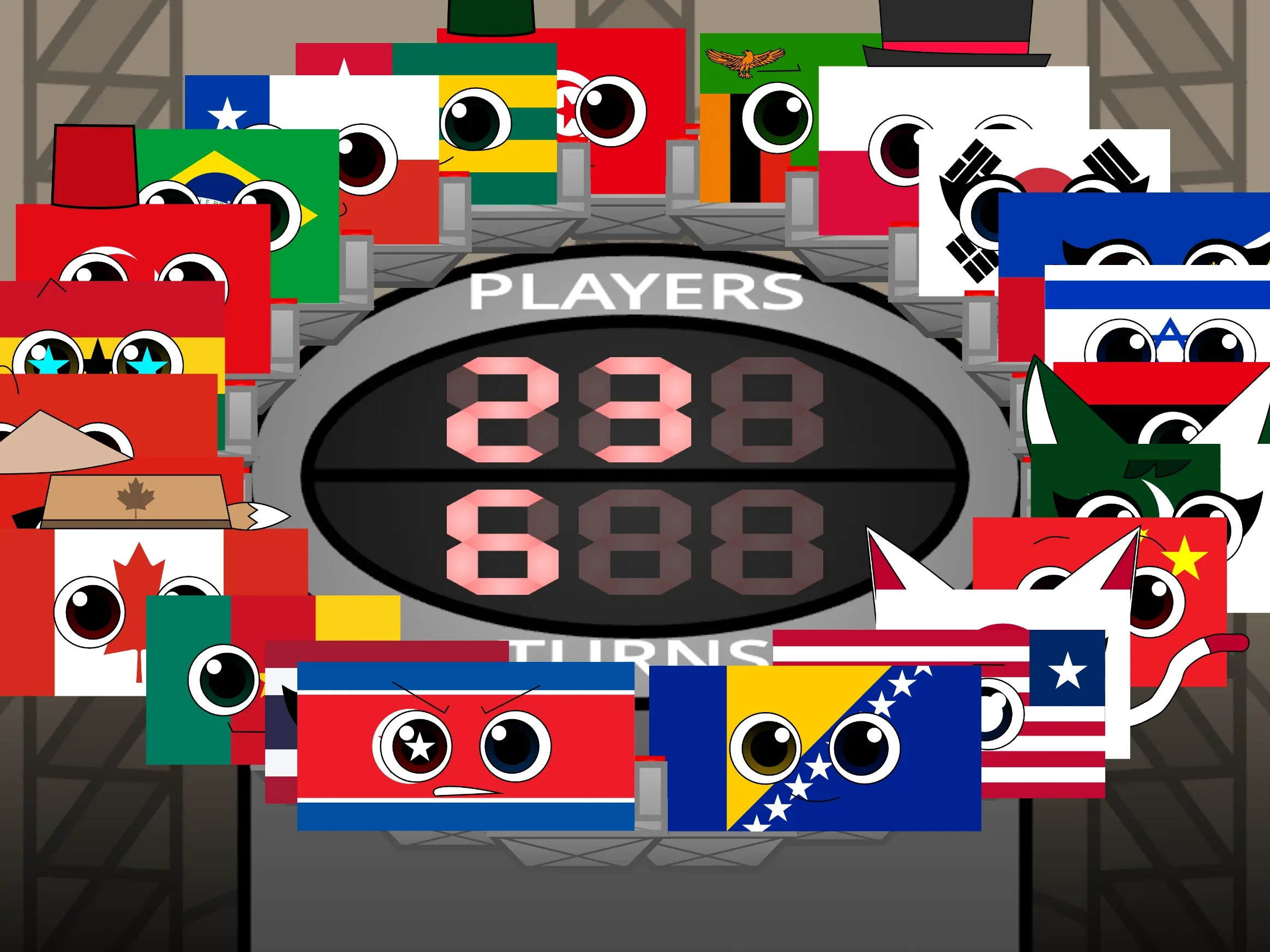
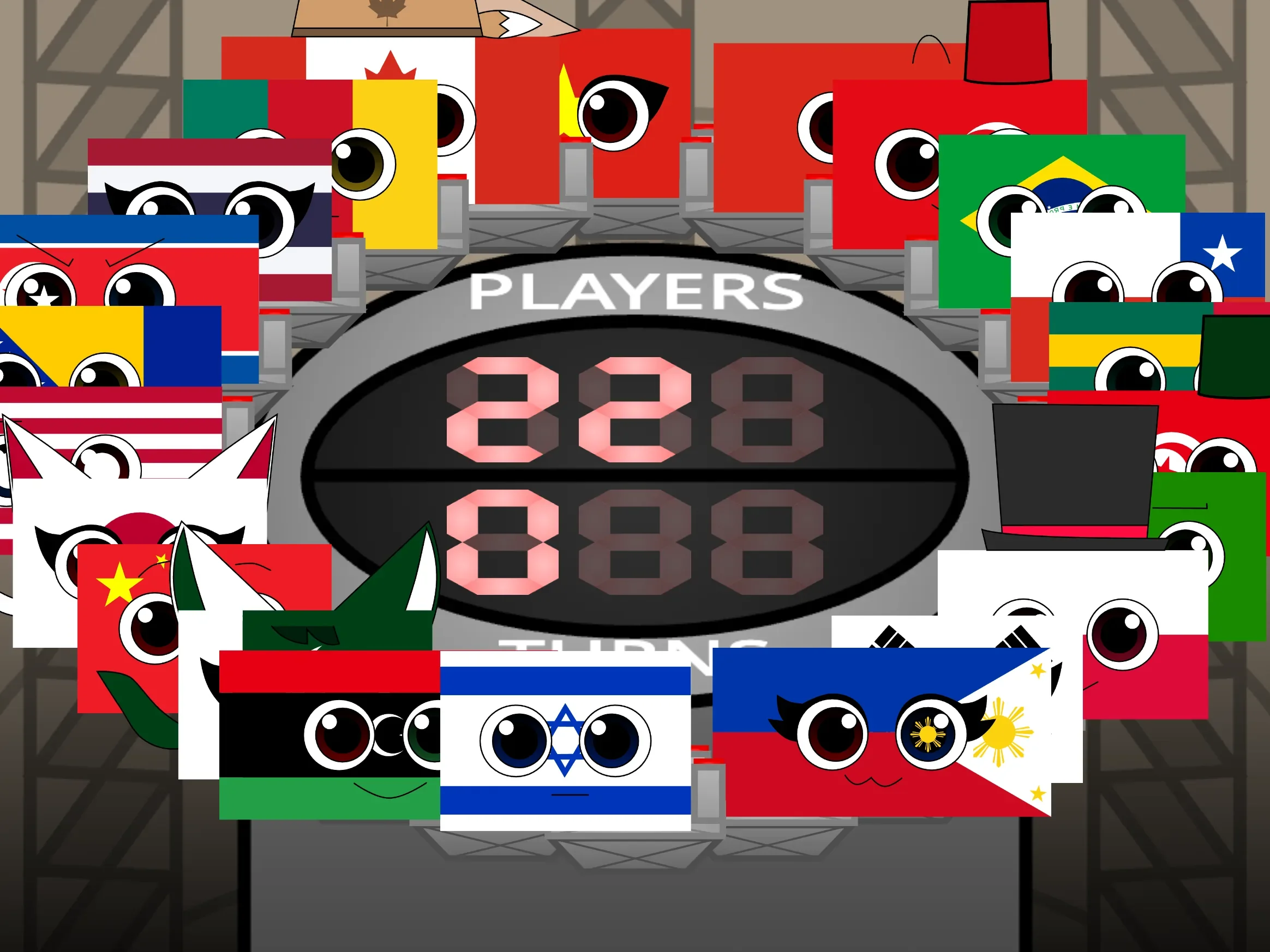
Mechanized Elimination and the Rotating Ring
Each simulation begins by distributing twenty-four country characters randomly around a central oval scoreboard. The roster features Ghana, Zambia, Vietnam, Pakistan, Poland, Israel, Japan, Kiribati, North Korea, South Korea, Liberia, Libya, Brazil, Bosnia and Herzegovina, Cameroon, Thailand, Timor-Leste, Togo, Tunisia, Türkiye, Canada, China, Chile, and the Philippines. At the start of every round, each surviving nation makes an independent, automated decision to press its button. These activations happen sequentially rather than simultaneously, pushing the lower TURNS counter up by one for every press.
Once all decisions conclude, the TURNS counter counts down as the entire ring rotates by that precise number of positions. When the counter reaches zero, whichever country stops in the final position at the bottom of the line becomes the round's victim. The condemned contestant displays a worried expression, rattles against the frame with metallic and crunching sound effects, and tumbles out of sight. The upper PLAYERS counter drops by one, the remaining cast adjusts around the ring, and the next elimination cycle immediately begins.
Crowded Seats and Distinctive Country Casts
Because every country is forced into the competition at once, the early rounds suffer from visual congestion. Large flag sprites overlap heavily around the outer circle, sometimes obscuring neighboring contestants or partially covering the central counter. Canada wears a maple-leaf cap, Vietnam wears a conical hat, Tunisia dons a fez, and Pakistan appears as a pointed, animal-like character. These small physical details and varied mouth expressions give the cast distinct visual traits, but identifying specific nations remains tricky until several competitors fall.
As the player roster thins into the low teens and single digits, the layout dynamic changes significantly. The remaining seats expand to fill the circle, opening clear sightlines across the central scoreboard and turning the automated rotation into a legible sequence. Viewers tracking individual favorites on Fortcade can easily follow how a sudden batch of button presses moves a specific country out of the fatal drop zone or pushes an unsuspecting neighbor into the elimination slot.
Dynamic Soundtracks and Escalating Pitch
The audio design plays an unusually active role in driving the pace of each tournament run. Instead of looping a single background track, the simulation draws from an extensive music selection, beginning with a randomized intro cue before picking one of more than twenty possible competition themes. A Now Playing bar at the bottom of the display tracks the current song selection throughout the match.
As the total count on the upper PLAYERS display decreases, the music's pitch gradually shifts upward. During the initial twenty-four player crowd, this pitch escalation remains subtle, but by the time only five or six countries remain, the higher tone creates a sharper sense of urgency. Clear audio cues—including button clicks, teleports, impacts, worried gasps, and heavy falling sounds—mark each mechanical step of the rotation.
Spectator Suspense and Structural Limits
Every round eliminates exactly one character, regardless of how many buttons were pressed. If no countries activate their buttons or if the total rotation count lands back on the same relative order, the outcome is still fixed: whichever contestant occupies the final slot drops out. This absolute rule keeps the pacing predictable, but it also highlights the complete absence of comeback mechanics, skill checks, or safety votes.
When only two countries remain in the ring, a single final rotation instantly determines the victor. The regular competition track cuts out, the winning flag adopts a celebratory pose, and a random victory jingle triggers alongside falling confetti effects before transitioning into dedicated results music. A completed run might end with Tunisia or Brazil standing as the sole survivor, but because initial seating, button choices, and rotation totals are re-randomized every time, no outcome is predetermined.
While the hands-off structure limits replay depth for players seeking active mechanical challenges, the combination of expressive character design, dynamic musical pitch shifts, and dynamic ring reorganization gives this spectator tournament a surprisingly clear narrative arc from crowded opening to tense final showdown.



![AY in Noggin's RL, GL Game Redux [ 40 Players ] game cover](https://fortcade.com/wp-content/uploads/2026/10/ay-in-noggin-s-rl-gl-game-redux-40-players-225x300.webp)