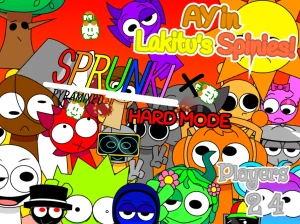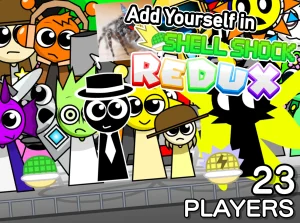
AY in Barrel Bridge 2 x Sprunki PRYAMIXED is a free browser-based survival simulation in which 24 AI-controlled characters crowd onto a narrow bridge while barrels roll toward them from the right. Every contestant tries to jump at the correct moment, but one mistimed dodge can send them flying into the water—or lava—below.
Despite the “24 Players” setup, this is not an online multiplayer game, and you do not directly control a contestant. The fun comes from watching the match unfold, choosing a favorite character, predicting the winner, and reacting when an apparent front-runner gets knocked out by a single barrel.
That makes it closer to a compact elimination show than a traditional platformer. Matches are easy to understand, unpredictable enough to replay, and short enough for a quick browser break. The idea is simple, but the combination of a crowded bridge, distinct character reactions, changing barrels, and randomized results gives it more personality than the premise initially suggests.
 3 Game Screenshots

Quick Facts
| Feature | Details |
|---|---|
| Genre | Automatic survival and elimination simulation |
| Contestants | 24 AI-controlled characters |
| Multiplayer | No online or local competitive multiplayer |
| Main objective | Watch until one contestant remains |
| Direct controls | None during the match |
| Player interaction | Start the game, hover over characters to see names, restart for another result |
| Match length | Usually around 3–6 minutes, depending on eliminations |
| End conditions | One winner or a draw if everyone is eliminated |
| Platforms | Desktop browser recommended; playable on mobile browsers |
| Best for | Sprunki fans, casual players, and viewers who enjoy randomized simulations |
What Kind of Game Is AY in Barrel Bridge 2 x Sprunki PRYAMIXED?
At its heart, this is a last-character-standing survival game. Twenty-four contestants drop onto the same bridge, music begins, and barrels start rolling across the screen. The characters automatically attempt to jump over each obstacle. Anyone struck by a barrel may be launched off the bridge and eliminated.
A counter in the corner displays how many contestants remain, so the objective is always clear. The early part of a match is chaotic because so many characters overlap. As the field becomes smaller, the action turns easier to follow—and often more suspenseful. Once only two contestants remain, every incoming barrel feels like a potential finale.
The game does not ask for platforming skill or strategic decisions. Instead, it offers the pleasure of watching a randomized contest. You can support Oren, Durple, Wenda, Simon, Mr. Fun Computer, Mr. Tree, or whichever character catches your attention, but their survival ultimately depends on the simulation.
This hands-off format will not suit everyone. Players looking for precise movement, upgrades, or competitive multiplayer will find little to master. Players who enjoy marble races, character tournaments, elimination videos, or “who will survive?” games are much closer to its intended audience.
How to Play and Controls
The controls are deliberately minimal because the contestants move and jump on their own.
| Action | Control | Purpose |
|---|---|---|
| Start the game | Green flag or Play button | Begins a new survival match |
| Identify a contestant | Hover the mouse over a character | Displays that character’s name |
| Watch the match | No input required | Characters automatically avoid barrels |
| Play again | Restart the project | Creates another randomized match |
There are no movement keys, jump button, attacks, or special abilities for the player. Once a round begins, your role is to watch the contestants and follow the changing survivor count.
This makes the game immediately accessible. There is almost nothing to learn, and the barrel warnings clearly communicate when danger is approaching. However, the absence of direct control is also its biggest dividing line. It should be approached as an interactive spectacle rather than a conventional action game.
Desktop browsers offer the clearest experience because the mouse-hover name display makes it easier to follow individual contestants. The game can still be watched on a mobile browser, but identifying overlapping characters is less convenient without a persistent cursor, and there are no dedicated touch controls.
Match Structure, Objectives, and Endings
Each match follows a straightforward elimination format.
First, the 24 contestants arrive on the bridge. Barrels then begin entering from the right and rolling toward the left. Before an obstacle appears, a yellow danger symbol flashes three times alongside an alarm sound. This warning gives the audience time to focus on the bridge and anticipate the next collision.
The delay between barrels varies, which prevents the rhythm from becoming completely mechanical. Sometimes the bridge has a short moment to settle; at other times, the next warning appears before the previous chaos has fully cleared.
Characters attempt to jump when a barrel approaches, but their reactions are not perfectly reliable. Some contestants clear several obstacles in a row, while others mistime what looks like an easy jump. A direct hit sends the victim upward before they fall from the bridge and disappear beneath the stage.
The round continues until fewer than two contestants remain:
If one character survives, the game announces that contestant as the winner with a victory pose, celebratory audio, and confetti.
If the final contestants are eliminated together, the match ends in a draw with its own result screen and music.
There is no campaign progression, save system, ranking table, or persistent reward. Finishing a match is mainly an invitation to restart and see whether a different character wins.
Barrel Types and Map Variations
The game includes three visually distinct barrel types, and they do not all move at the same speed.
| Barrel | Behavior | Player-facing effect |
|---|---|---|
| Normal barrel | Medium speed | Establishes the standard timing |
| Light barrel | Fastest | Creates sudden, difficult-to-read eliminations |
| Heavy barrel | Slowest | Looks easier to avoid but can disrupt a character’s jump timing |
This modest variation helps the core loop. If every barrel moved identically, the simulation would quickly feel solved, even without player control. The faster light barrel produces the most abrupt surprises, while the heavy barrel can be deceptive because contestants may jump too early or land in an awkward position.
Matches can also begin on one of four visual backgrounds. These include bright water-themed bridges and more threatening lava-themed variants. The map does not turn the game into a different mode, but it changes the mood and the elimination effects. Falling into blue water feels slapstick; falling toward red lava gives the same event a more dramatic edge.
The referenced gameplay footage shows two complete matches. The first takes place over bright blue water and develops into a lengthy final confrontation between Pinki and Mr. Tree, with Mr. Tree eventually winning. The second uses a red lava setting and moves faster, ending with Mr. Fun Computer as the last survivor.
That difference illustrates an important quality of the game: identical rules can produce noticeably different pacing. One round may eliminate half the bridge quickly, while another can slow down when the final contestants repeatedly survive.
Characters and Replayability
The crowded roster is a major part of the appeal. Recognizable figures such as Oren, Raddy, Clukr, Fun Bot, Vineria, Gray, Brud, Garnold, OWACKX, Sky, Durple, Simon, Tunner, Wenda, Jevin, Mr. Black, Mr. Tree, and Mr. Fun Computer appear together.
They are not merely static tokens. Contestants have separate visual states for standing, jumping, falling, being eliminated, and celebrating a victory. Individual sound effects and reactions add extra character when someone is hit or wins.
Because so many contestants occupy a limited space, the opening minutes can be visually messy. It is not always easy to see exactly who jumped, who was struck, or who has already fallen. Hovering over a character helps, but tracking one favorite in the initial crowd still requires attention.
The situation improves as eliminations accumulate. Once the match reaches its final four or five contestants, each jump becomes readable and personal. A character who has quietly survived since the opening can suddenly feel like the hero of the round.
Replayability comes from this uncertainty rather than from unlockable content. A previous winner receives no advantage in the next match, and a contestant eliminated immediately can survive until the finale after a restart. It is especially entertaining when several people each choose a favorite before starting the simulation.
The Most Memorable Parts
The Triple Warning Before Each Barrel
The flashing yellow warning and alarm create a tiny ritual before every attack. Players know what is coming, but not who will fail. It turns a basic obstacle into a recurring moment of anticipation.
Watching a Favorite Survive Against the Odds
Once you choose a contestant, random movement starts feeling strangely personal. A successful jump becomes a small victory, while an unexpected hit can be genuinely funny or frustrating. The game benefits from how quickly viewers invent their own loyalties.
Sudden Multi-Character Eliminations
The crowded opening creates the possibility of several contestants being caught in the same incident. One barrel can transform a busy bridge into a much quieter arena within seconds. These group eliminations are chaotic, but they also give each round its biggest bursts of energy.
The Final Two Can Become a Duel
When only two contestants remain, the simulation changes tone. The clutter disappears, the survivor counter becomes impossible to ignore, and every warning may decide the winner. Long final duels can be suspenseful, although they can also expose the repetitive nature of the central mechanic.
Proper Winner and Draw Presentations
The game does not simply stop when the simulation finishes. Winners receive a pose, voice or music cue, large result text, and confetti. A simultaneous final elimination produces a separate draw sequence. These details give each match a satisfying endpoint.
Visuals, Music, and Atmosphere
The presentation follows the colorful, exaggerated style associated with Sprunki fan creations. Characters use bold silhouettes and expressive poses, while the bridge provides a simple stage that keeps attention on the contestants and incoming hazards.
Animation is functional rather than elaborate, but the important actions are easy to recognize. Jumping, being launched, falling, and celebrating all have separate visual feedback. Water splashes, lava effects, alarms, and knockout sounds make eliminations clearer.
Music contributes more variety than the basic rules might suggest. Matches can draw from a sizeable collection of energetic battle and boss-style tracks, giving different rounds slightly different moods. Victory and draw sequences also use dedicated music rather than continuing the standard match soundtrack.
The interface is appropriately restrained. The survivor counter communicates the most important information, and the danger indicator is difficult to miss. The largest readability problem comes from overlapping contestants, not from the UI itself.
Pros and Cons
Pros
Immediately understandable: The last-survivor format requires almost no explanation.
A lively 24-character spectacle: The crowded bridge creates funny collisions and unexpected eliminations.
Clear danger feedback: Flashing warnings and alarm sounds make incoming barrels easy to notice.
Different barrel speeds add uncertainty: Light, normal, and heavy barrels prevent every encounter from having identical timing.
Randomized matches encourage replays: Winners and elimination orders can change substantially after restarting.
Strong spectator value: It works particularly well when friends choose characters and predict the result.
Cons
No direct character control: Players seeking a platformer or skill-based action game may feel detached.
The core loop is repetitive: Every round is ultimately built around jumping over incoming barrels.
Early matches can be hard to read: Twenty-four overlapping characters make individual contestants difficult to track.
Late rounds may drag: Two successful survivors can continue avoiding barrels for several minutes.
No long-term progression: There are no unlocks, saved statistics, tournaments, or persistent rankings.
Mobile identification is less convenient: The hover-based name display works more naturally with a mouse.
Who Should Play It?
AY in Barrel Bridge 2 x Sprunki PRYAMIXED is a good fit for:
Sprunki and PRYAMIXED fans who enjoy seeing familiar characters placed in unusual challenges.
Players who like automatic simulations, elimination tournaments, and randomized survival games.
Friends who want to choose contestants and compete through predictions rather than direct controls.
Casual browser-game players looking for a short experience that requires no tutorial.
Viewers who enjoy unpredictable, occasionally ridiculous outcomes.
It is less suitable for players who expect direct platforming controls, online multiplayer, strategic character abilities, story progression, or a deep competitive system.
Ratings
| Category | Rating | Summary |
|---|---|---|
| Gameplay Design | ★★★☆☆ | Simple and effective, though mechanically narrow |
| Spectator Entertainment | ★★★★☆ | Fun to watch, especially with favorite characters |
| Controls | ★★★☆☆ | Extremely accessible, but almost entirely hands-off |
| Content Variety | ★★★☆☆ | Several maps, barrel types, characters, and result sequences |
| Visuals and Audio | ★★★★☆ | Expressive reactions and energetic music support the chaos |
| Replayability | ★★★★☆ | Random winners make restarting surprisingly tempting |
| Overall Experience | ★★★★☆ | A charming lightweight survival simulation for the right audience |
Final Verdict
AY in Barrel Bridge 2 x Sprunki PRYAMIXED turns a very simple question—“Who can stay on the bridge?”—into a colorful miniature elimination show. Its greatest strength is not mechanical depth but the tension created by watching 24 recognizable contestants gradually become one final survivor.
The warning system, different barrel speeds, changing backgrounds, character reactions, and celebratory endings give the simulation enough texture to remain entertaining across several restarts. It is particularly enjoyable when players choose favorites and treat the match like an unpredictable tournament.
Its biggest limitation is equally clear: you are watching the action rather than controlling it. The core barrel-dodging loop can become repetitive, and an unusually capable final pair may keep a match running longer than expected.
As a free browser game for a short break, however, it understands its role. Open it, choose a contestant, and watch the bridge turn into chaos. Sometimes that is all a lightweight party simulation needs to do well.