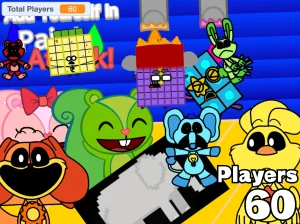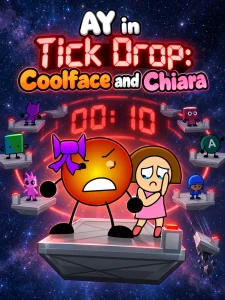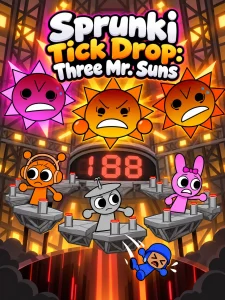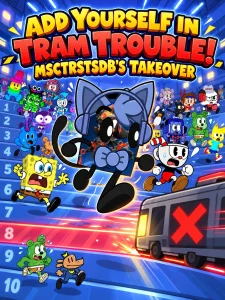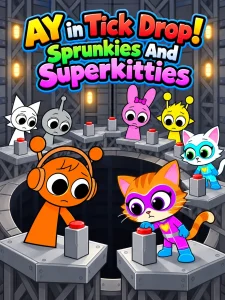
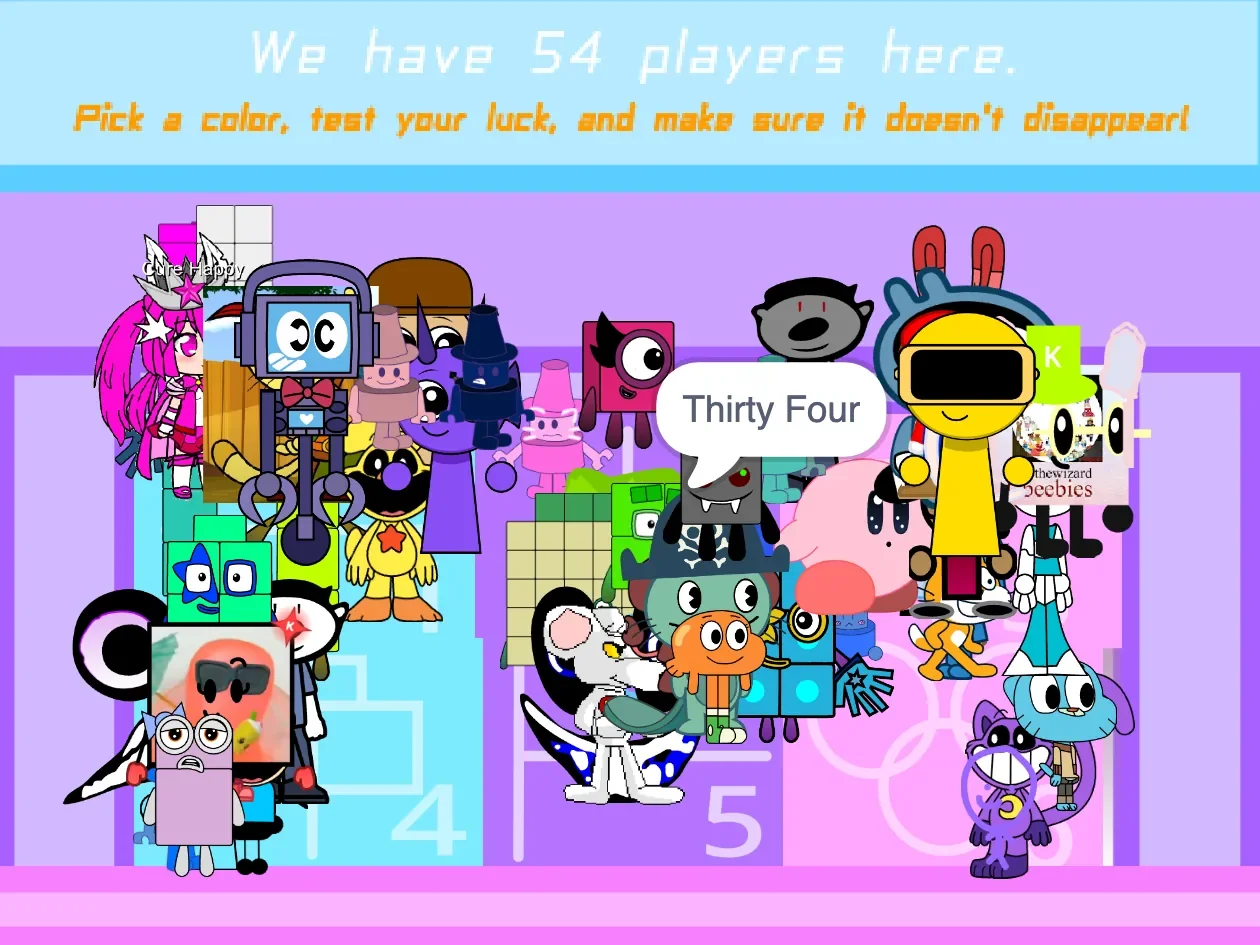
Fifty-four contestants crowd onto six numbered platform tiles while a ten-second timer ticks down to zero. Suddenly, platform six flashes, drops away, and eight characters plunge into the void below, immediately dropping the counter from 54 to 46. In AY In Color My Verison Of Fate!, survival relies entirely on where automated characters wander before a color disappears. Despite the project title advertising 59 players, the live HUD tracks a 54-player starting pool, creating an immediate, crowded simulation driven entirely by randomized platform drops and scripted character pathfinding.
Created by @leoprincipe04, the project operates as an animated crossover battle royale rather than a manual action title. Player interaction begins and ends with clicking the green flag. Once active, contestants navigate the bright purple and pastel-pink stage without direct player control. The basic round structure repeats in strict five-step cycles: contestants walk between the six numbered panels, a text box displays a 10-second countdown, the game selects a random color tile to eliminate, warning effects flash alongside sound cues, and any character standing on that tile falls off the board.
 3 Game Screenshots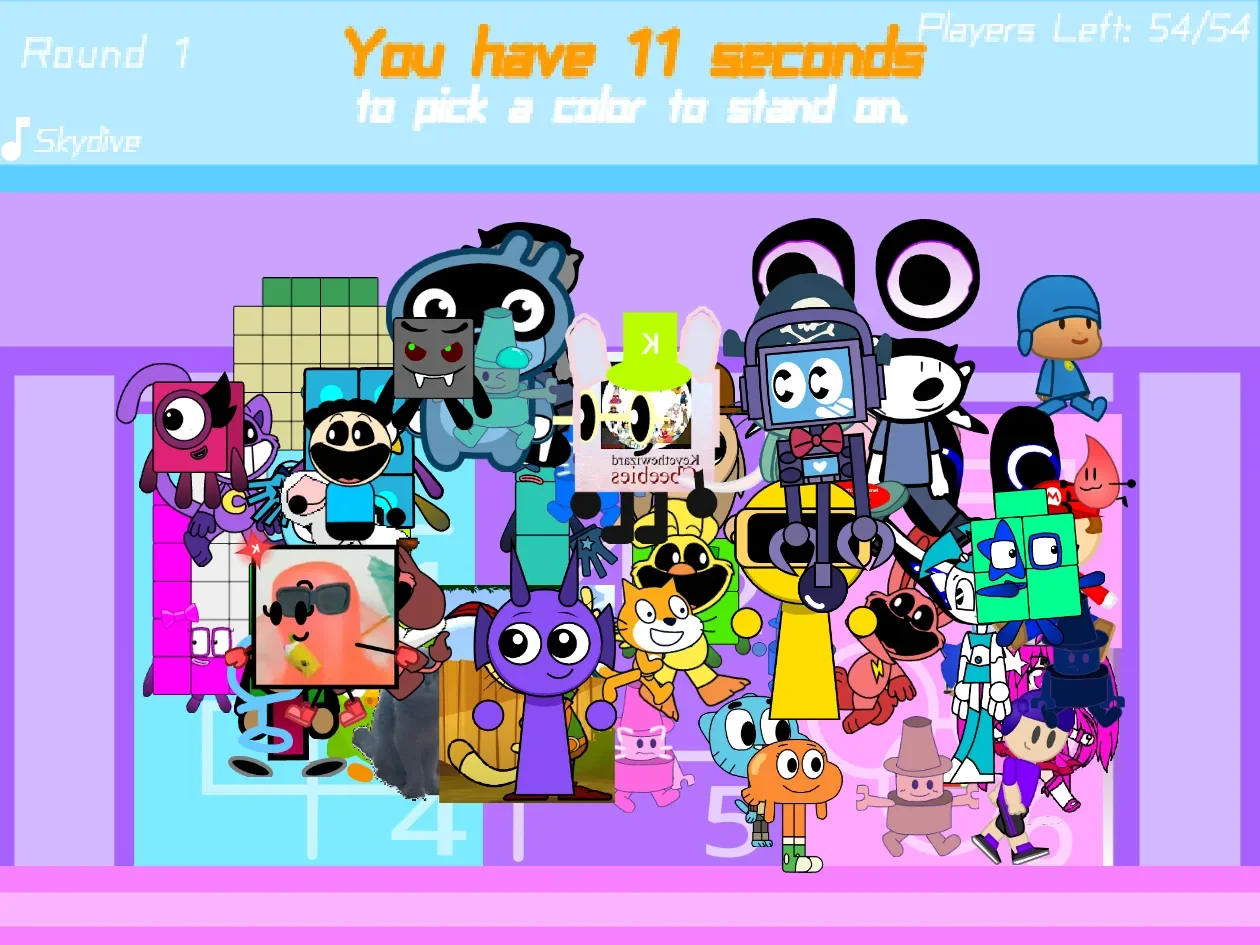
The Mechanics of a 54-Contestant Elimination Arena
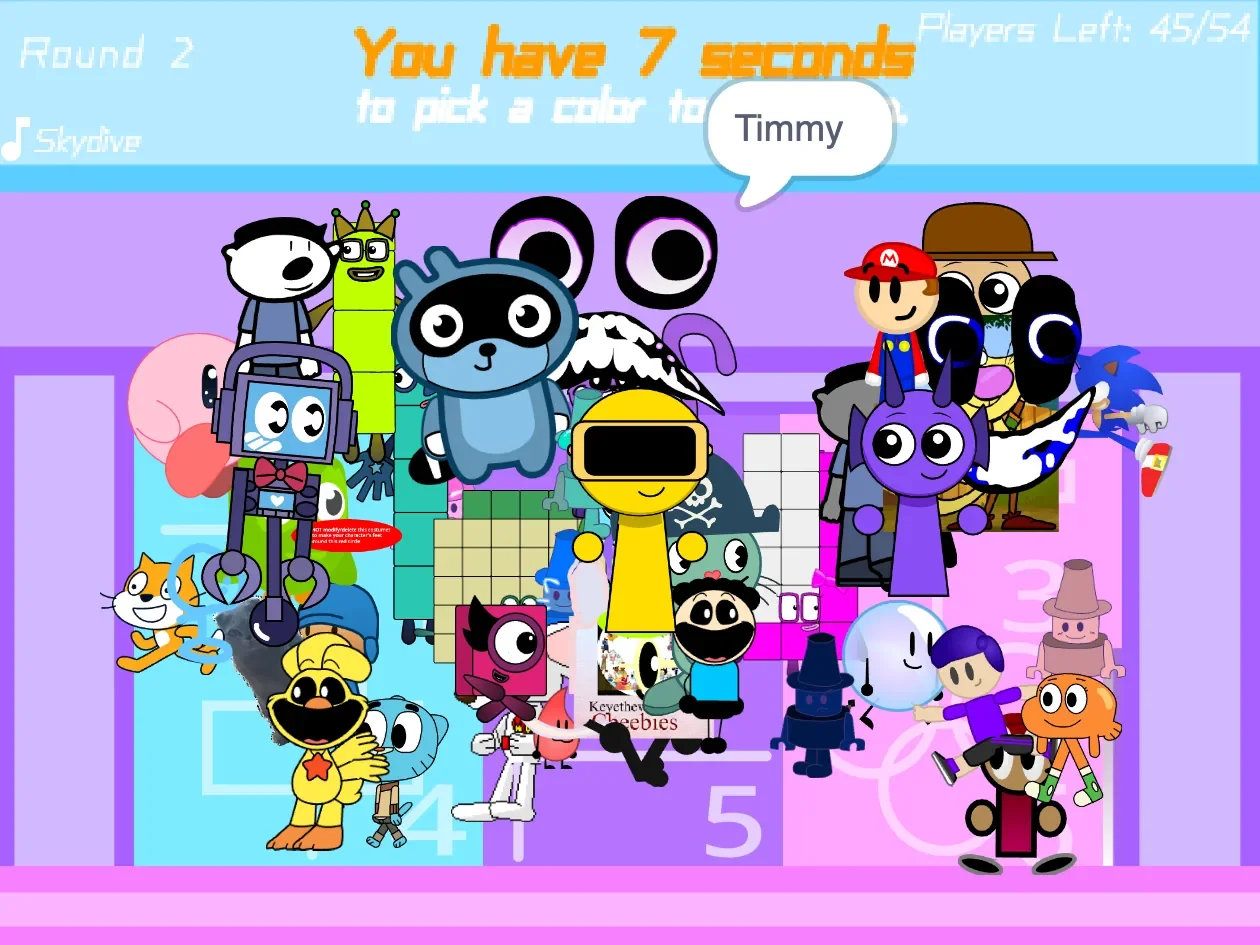
The core rhythm relies on brief moments of passive suspense built around platform numbers 1 through 6. Because movement is automated, contestants drift back and forth across the board throughout the choice phase. When the countdown expires, the selected color tile vanishes. In the opening round of a recorded run, platform 6 was eliminated, instantly taking out eight contestants and reducing the active roster to 46. The HUD updates instantly to reflect both the current count and the starting total, keeping track of the thinning herd as subsequent 10-second intervals play out.
Because multiple characters can cluster onto a single panel, a single unlucky draw can remove large groups at once. Conversely, rounds where contestants distribute evenly across all six tiles lead to gradual attrition. The rules also allow for scenarios where two or three colors disappear in a single cycle, accelerating eliminations and forcing the remaining pool into tighter spaces.
Without direct joystick or keyboard inputs, players do not steer a specific hero away from danger. Instead, the enjoyment comes from watching randomized pathfinding dictate who stands on solid ground and who falls away. This automated setup shifts the experience toward that of a simulated game show or spectator event, where viewer engagement comes from tracking individual favorites within the crowded arena.
Roster Overlap, Visual Clutter, and Stage Presentation
The main attraction is the extensive crossover roster. Sprunki characters share the stage with recognizable figures like Mario, Kirby, Scratch Cat, Pocoyo, Jenny Wakeman, Cure Happy, Sonic, Gumball, Darwin, stick figures, and numerous original creations such as Russell, Randy, Alex, Fandroid, Garnold, Sky, Durple, and Bubble. Each contestant brings distinct visual assets to the stage, including custom walking-frame counts, idle poses, shocked expressions during platform drops, and specialized victory animations.
However, housing over fifty characters on six platforms creates notable readability issues. Large character costumes and expansive speech bubbles frequently overlap neighboring panels, hiding the floor numbers underneath. During early rounds, when the arena is at full capacity, telling exactly which tile a character occupies requires close inspection. Speech bubbles identifying contestants often block the platform edges, making it difficult to predict which characters will survive a drop until the visual warning cues trigger.
The stage presentation mimics a televised party-game broadcast. An interface element displays track titles such as "On The Team" during active rounds, supported by a full library of sound effects for countdowns, platform switches, referee whistles, falling drops, and result screens. The high-contrast stage art uses bright purple and pastel-pink tones to separate the playable field from the surrounding backdrop, though the sheer density of the sprite layer remains the primary source of visual noise.
From Automated Rounds to the Confetti Winner Screen
As the match progresses through successive elimination rounds, the arena gradually clears out. What begins as a dense wall of sprites shrinks into isolated clusters of survivors scattered across the remaining platforms. On Fortcade, observing these final moments highlights how effectively the project transitions from crowded groups to focused individual showdowns.
Near the end of a full run, only a handful of contestants remain on the board. In one documented playthrough, the character Kijobal survived every random tile elimination to claim the solo victory. When a single contestant remains, the project transitions into a dedicated winner state. The surviving character is moved to the center of the stage, a large "WINNER!" graphic displays across the screen, and confetti cascades over the arena while specialized celebration jingles play.
The game engine also accounts for alternate outcomes. If a final platform drop eliminates all remaining contestants simultaneously, or if multiple characters survive without a clear single victor, the project routes to dedicated "Winners" or "Draw" screens. These distinct ending states ensure that every run reaches a formal conclusion, regardless of how the randomized drop calculations resolve in the final seconds.
Remix Architecture and Sprite Guidelines
Beyond its role as an automated show, the project contains built-in structural instructions for project remixing and sprite additions. Text documentation inside the project outlines rules for adding new contestants using a standardized template sprite. Editors are instructed to duplicate the character template, replace every costume except for the technical "Screen-Cheat" and "GuideFloor" assets, import custom "Voice" sound clips, and update the project title and thumbnail to reflect the new character count.
The project relies on @-Rex-'s Pen Text Engine++ to render on-screen text labels and custom interface fonts, requiring remixers to maintain credit in derivative versions. The project notes also specify rules against modifying character scales to extreme tiny or giant sizes to protect visual clarity, while setting guidelines against deleting existing assets unless data limits demand it. Certain listed users—including @BarryFans, @Redshell3, @whatsmydiamond, @Twin138956Scratch, @Kyle3912Again, @Burgnew_On_A_Laptop, and @OisinFan62—are noted within the code documentation as authorized contributors with specific exemption privileges.
Ultimately, AY In Color My Verison Of Fate! delivers an automated spectator experience anchored by its massive character collage. Its key appeal lies in the tension of the 10-second countdown, the sudden visual drop of disappearing platforms, and the unpredictable pathfinding that determines which crossover character takes the final confetti-covered victory stage.