Two contestants step onto separate red and blue stations under an open blue sky, a seven-second timer begins ticking down, and the contestant who presses their station button more times drops a heavy hammer on the opponent. In AY in Hammer Bash! Redux 23 Players, created by @ManuVictoriaRezende, this rapid button-mashing mechanic forms the foundation of a 23-character elimination tournament where every match strips away lives until only a single survivor remains.
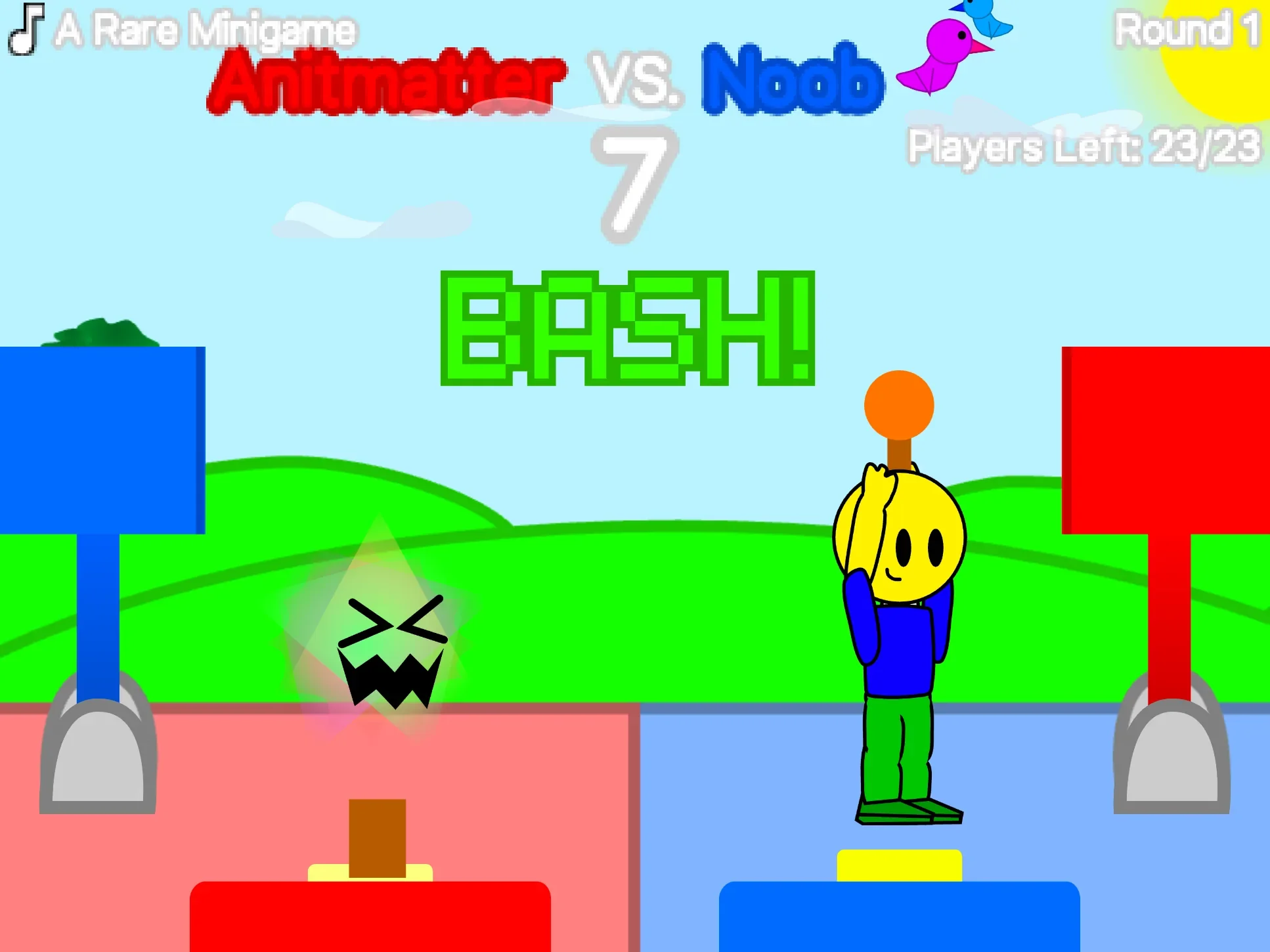
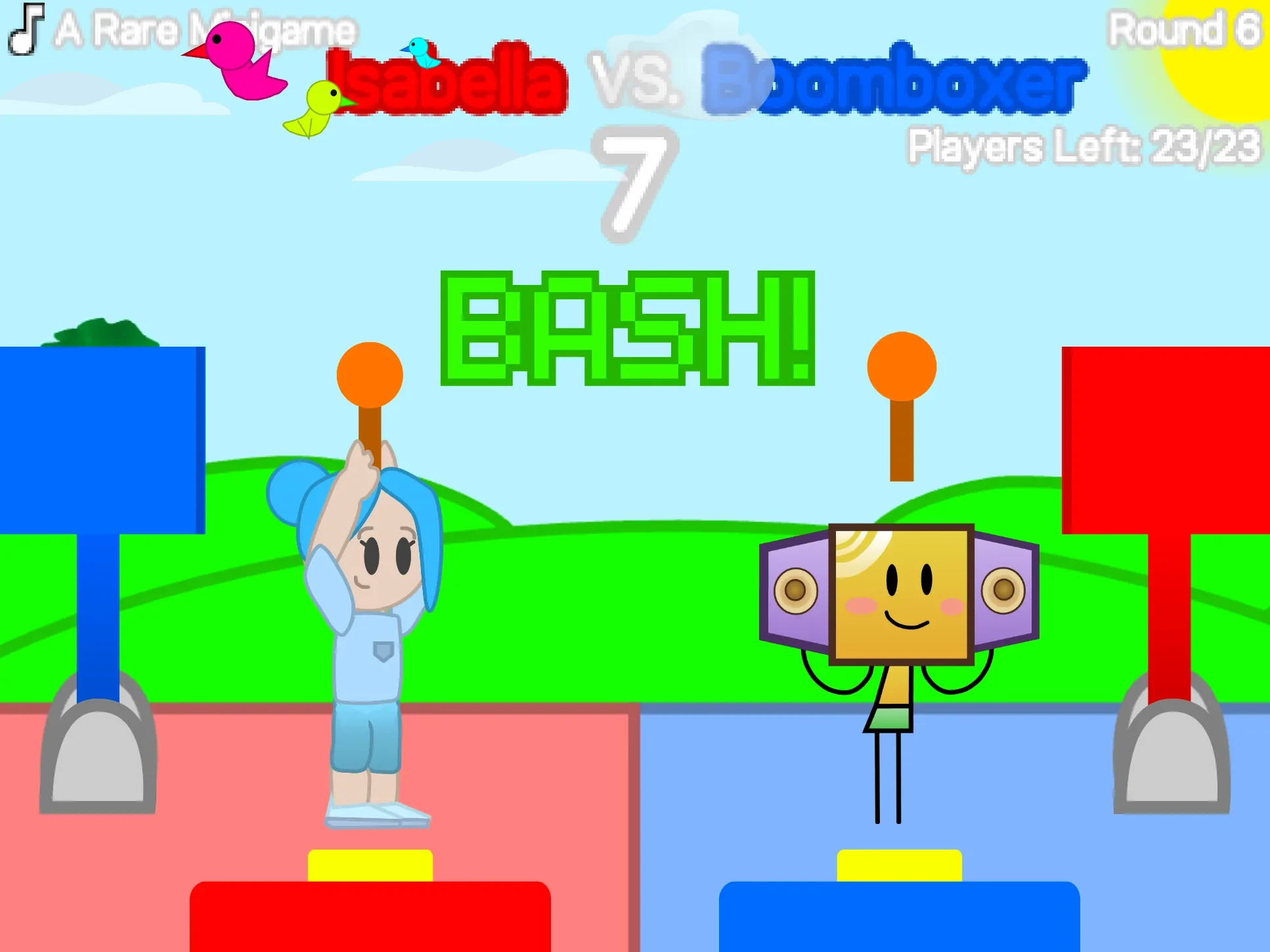
The match loop relies on immediate visual prompts and strict timing. Each round opens with a matchup preview screen displaying the round number, the remaining player count, and the names of the two randomly selected competitors—such as Isabella facing Seth, Luigi competing against Anitmatter, or Koops battling Zeke. Once the matchup screen clears, a green "BASH!" display text appears above two large colored station platforms equipped with levers and buttons. Players have exactly seven seconds to hit their button as many times as possible before the screen signals "Time's Up!".
In tested browser sessions, the Space key is the verified input for driving the primary hammer station. Pressing Space repeatedly swings the hammer and adds directly to the top scoreboard display. Observed match scores vary significantly depending on input speed; some intense rounds finish with scores as high as 23 to 25, while slower rounds conclude with totals around 5 to 6. Winning does not require reaching a predetermined target score, but rather securing a higher numerical total than the opposing contestant when the seven seconds expire.
 3 Game Screenshots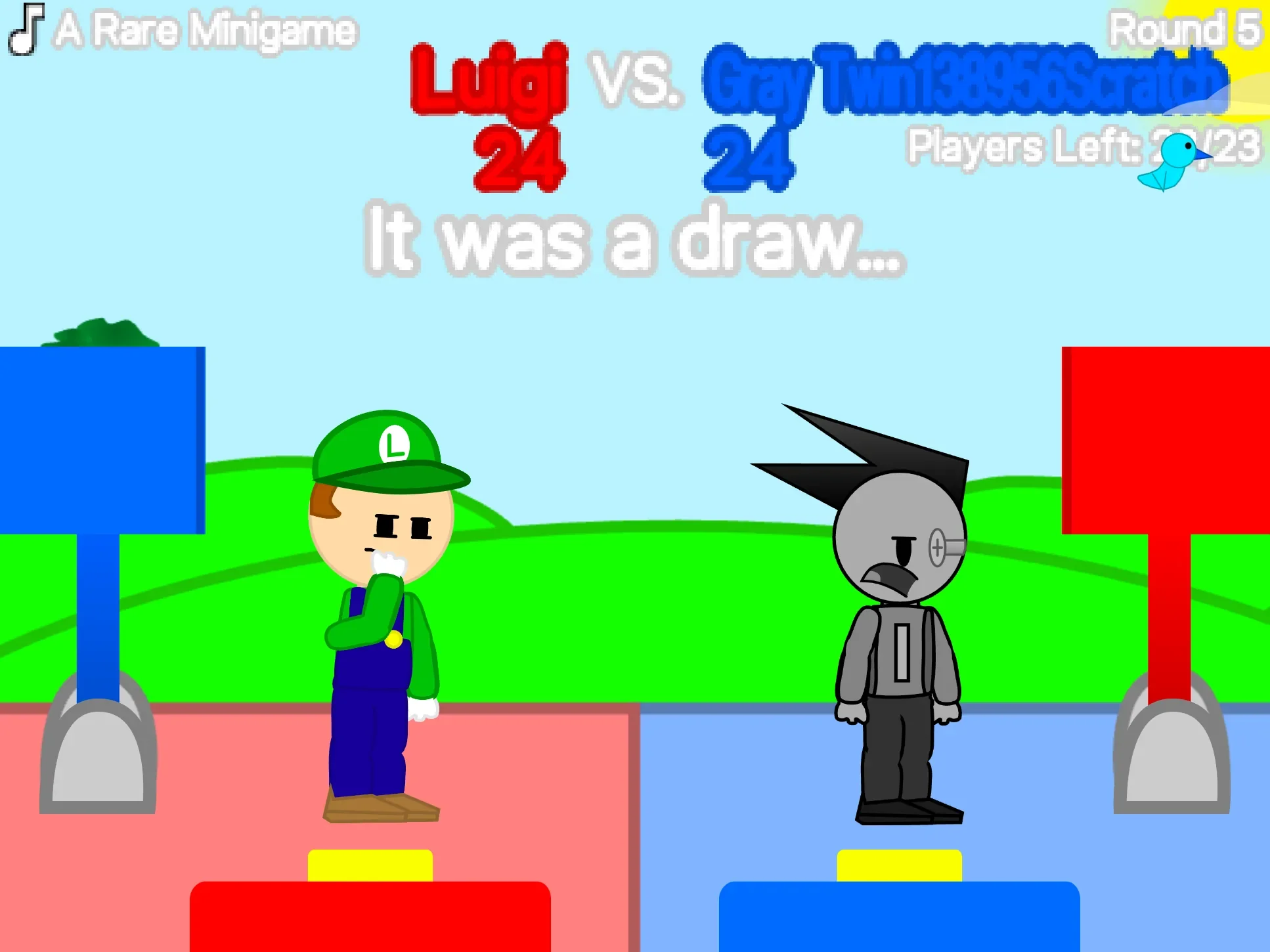
While the game page indicates that two players compete on the stations, the normal interface fails to explicitly document a second key binding for local two-player support. Without a clear second keyboard mapping made obvious in the standard layout, the experience functions practically as a single-player button-mashing speed trial against an automated opponent.
| Action | Input | Result |
|---|---|---|
| Start the tournament | Green flag | Initiates the 23-player elimination contest |
| Bash with verified player station | Space | Operates the hammer and increases the round score |
Tournament Structure and the 23-Character Roster
The tournament framework transforms brief seven-second matches into a persistent elimination bracket. Competitors begin the tournament with a global tally display reading "Players Left: 23/23". Every contestant starts with two lives. When a character loses a match, they are squished by the hammer and lose one life. Suffering two total defeats results in permanent elimination, causing the remaining player counter to drop to "22/23" and continuing downward as subsequent rounds resolve.
The game features an eclectic roster of 23 active character identities drawn from Scratch original creations, fan characters, object-show designs, and recognizable figures. The lineup includes Scratch Cat, Randy, Alex, Isabella, Zeke, Mario, Luigi, Noob, Mr. Poofers, Chorus Kid, Album, Anitmatter, Koops, Boomboxer, Blocky, Pen, Seth, and multiple Twin138956Scratch variants.
Rather than using static sprites, each of the 23 contestants contains a dedicated range of visual poses. Characters feature specific visual states for standing on the station, holding the hammer, celebrating a match victory, reacting to a draw, displaying despair upon taking damage, and being fully squished under the hammer. This visual variety ensures that losing a round creates immediate visual feedback rather than merely altering numerical variables on the scoreboard.
Beyond standard victories and defeats, the tournament system accommodates draw conditions when both contestants end seven seconds with identical score totals. Matches feature formal countdown screens, winner announcements, celebratory confetti bursts, and an automated final victory sequence once the 23-player field collapses down to a single remaining survivor.
Visual Presentation, Audio Systems, and Arena Environment
Matches take place against a static outdoor backdrop composed of rolling green hills, a bright blue sky, scattered clouds, and flying birds. The central stage area is split into distinct red and blue competition zones, complete with massive animated hammer levers and prominent button mechanisms. Large display text rendered above the stage communicates state changes clearly, broadcasting "BASH!", "Time's Up!", contestant names, and live score totals throughout each seven-second contest.
The technical architecture relies on the Pen Text Engine++, developed by @-Rex-, to generate crisp text rendering for match statistics, titles, and timer displays. This text engine operates alongside an extensive sound library that includes multiple background music tracks, customized character voice clips, heavy hammer impact sound effects, ticking countdown cues, draw jingles, get-ready alerts, victory fanfares, and distinct elimination audio triggers.
On platforms like Fortcade, where web-based minigames prioritize fast accessibility, the contrast between elaborate audio-visual feedback and a single recurring backdrop becomes clear. Because every match takes place within the exact same hill backdrop, the game relies entirely on randomized character matchups, dynamic animation states, and shifting score totals to preserve momentum across a complete 23-player tournament run.
Code Architecture, Remix Rules, and Customization Systems
Beneath the button-mashing gameplay lies a structured code architecture built to facilitate community modifications and character additions. The project includes a dedicated "Player Template" sprite designed for duplication. Creators looking to add custom characters must duplicate this template and replace every costume except for two key utility sprites: the "Screen-Cheat" costume and the "Hitbox" costume, which maintain collision and display logic across custom builds.
In addition to sprite swapping, the remix framework allows full customization of character sound clips. Modders replace default "Voice" audio files with custom voice tracks, adjust internal character name variables, and optionally upload custom thumbnail artwork, extra background music tracks, winner jingles, draw audio, and get-ready sound cues.
Project creation is governed by an explicit set of rules embedded directly in the project documentation:
- Rule 1: Do not ruin the project (with explicit exceptions granted to creator @BarryFans).
- Rule 2: Follow Community Guidelines strictly.
- Rule 3: Maintain proper character scaling; tiny or giant character sprites are forbidden as they impair visual clarity during matches.
- Rule 4: Do not delete existing project assets unless resolving remix data limits or fixing character scaling violations from Rule 3.
- Rule 5: Do not steal original characters (OCs) for inclusion.
- Rule 6: Do not modify underlying code structures unless possessive of advanced technical understanding.
- Rule 7: Always provide proper attribution for the text renderer using the required copy-paste credit string referencing @-Rex- and the Pen Text Engine++ project repository.
The project outlines specific rules authority levels, identifying a select group of approved creators—including @Redshell3, @whatsmydiamond, @BarryFans, @laithkablan234, @ZYellow, @Twin138956Scratch, @Kyle3912Again, @Burgnew_On_A_Laptop, and @OisinFan62—who are permitted to alter standard rules without their remixes being designated as unofficial.
Structural Balance and Final Evaluation
The core strength of the project sits in how effectively a simple input requirement generates tension when combined with lives and multi-stage elimination. Seven seconds provides just enough time to recover from a slow start if an opponent falters, but leaves zero room for distraction. Because matchups are generated randomly, players cannot predict whether a contestant like Mario or Scratch Cat will face early elimination or fight through multiple rounds to reach the final standing position.
The primary limitations stem from player control boundaries and visual repetition. Players have no agency over tournament brackets, cannot manually select active contestants, and cannot choose match pairings. Furthermore, because only the Space key is clearly mapped in the main user interface, local two-player battles require players to figure out unlisted keys or treat the game as a solo test against an automated hammer opponent.
For players who appreciate fast reaction minigames, Scratch crossover rosters, and automated tournament formats, AY in Hammer Bash! Redux 23 Players delivers a focused mechanical loop. The combination of two-life stakes, custom character animations, and expressive audio keeps every seven-second round focused on a simple goal: hit the button faster than the character across the station.