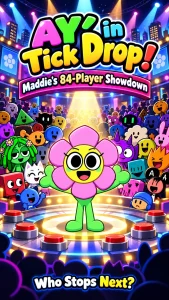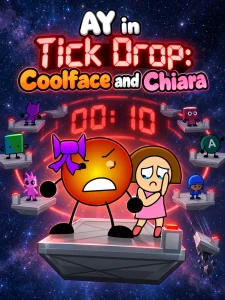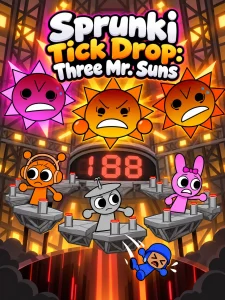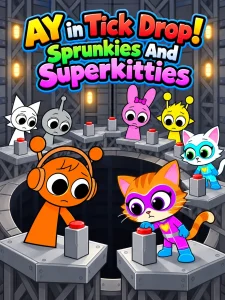
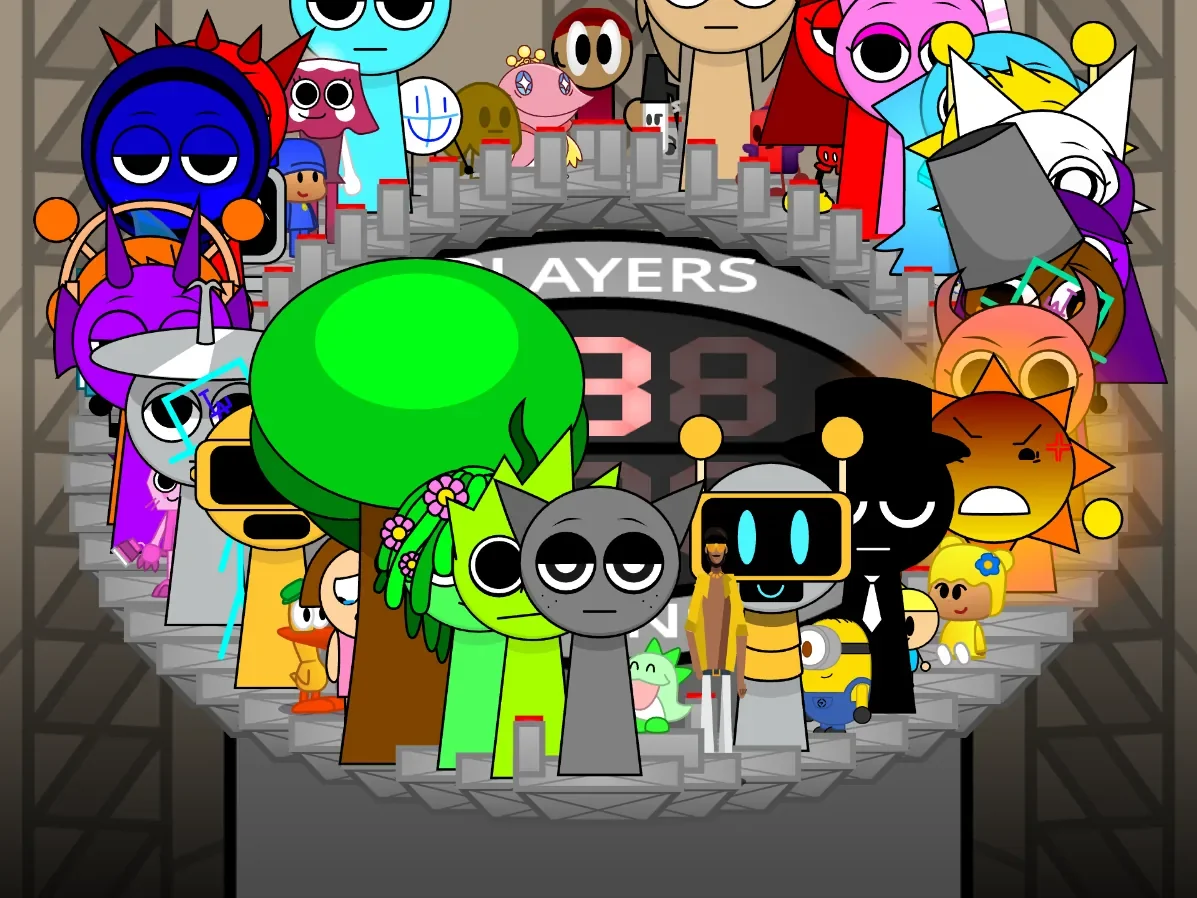
Forty-eight crossover contestants surround a circular game-show stage, each stationed next to a small red button, but the competition in AY in Tick Drop! Sprunkies but Rodrigo Gonçalo Joins The Game is entirely hands-off. Rather than testing player reaction times or mechanical accuracy, this browser-based simulation runs on automated rolls. Each round, remaining participants independently decide whether to press their button. The total number of presses becomes the turn count, the entire ring rotates by that number of slots, and whichever character stops at the final danger position gets eliminated.
The catch that gives this edition its distinct flavor is its named newcomer. Creator @FTSF72 introduces Rodrigo Gonçalo not just as another sprite in the crowd, but as an invincible rule-breaker. While standard entrants disappear one by one as the roster counter ticks down from 48, Rodrigo refuses normal knockout logic. If the rotation lands on him, he triggers a unique prank animation, remains safe on stage, and forces the simulation into an extra button phase. Because every other entrant can be deleted, Rodrigo is mathematically guaranteed to win eventually, shifting the viewer's focus from guessing the victor to seeing who lasts longest beside him.
 4 Game Screenshots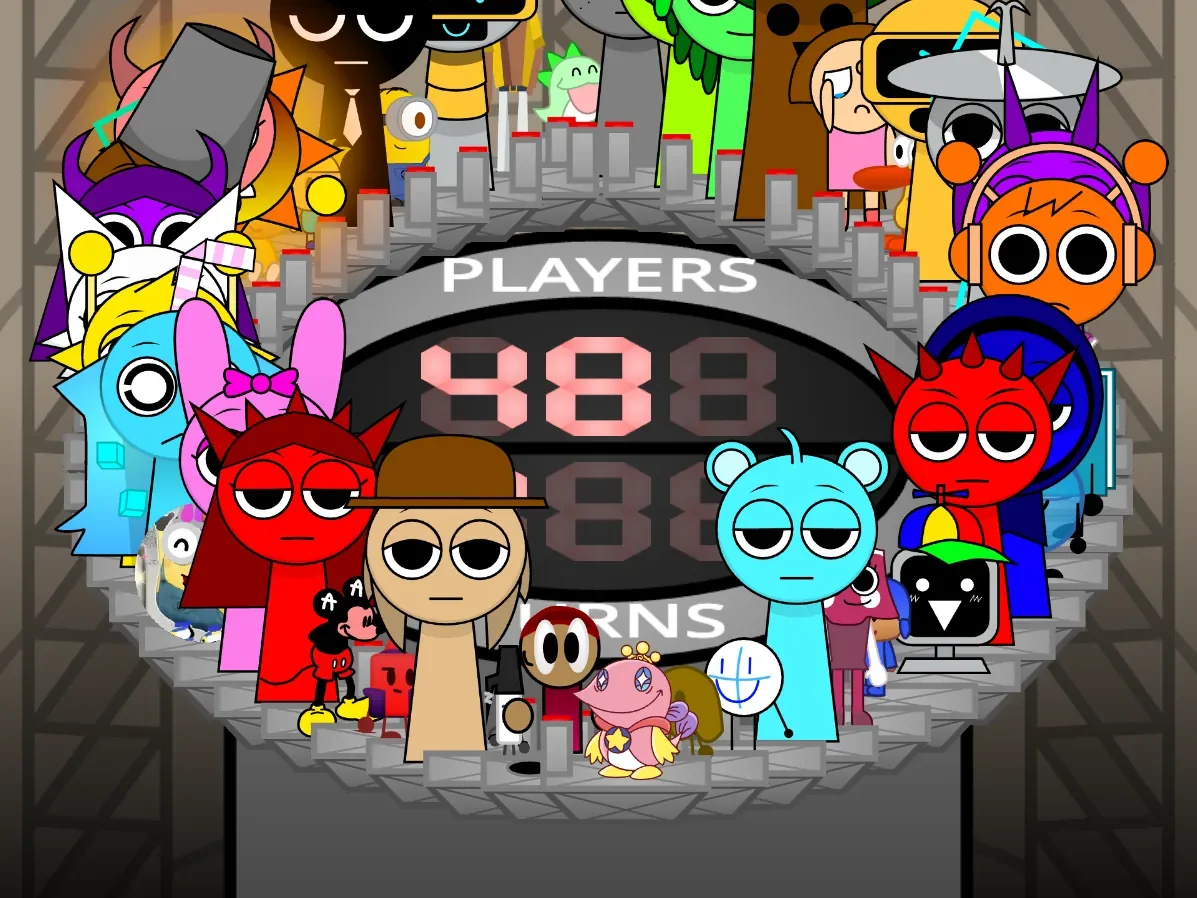
A 48-Character Arena with Automated Turns
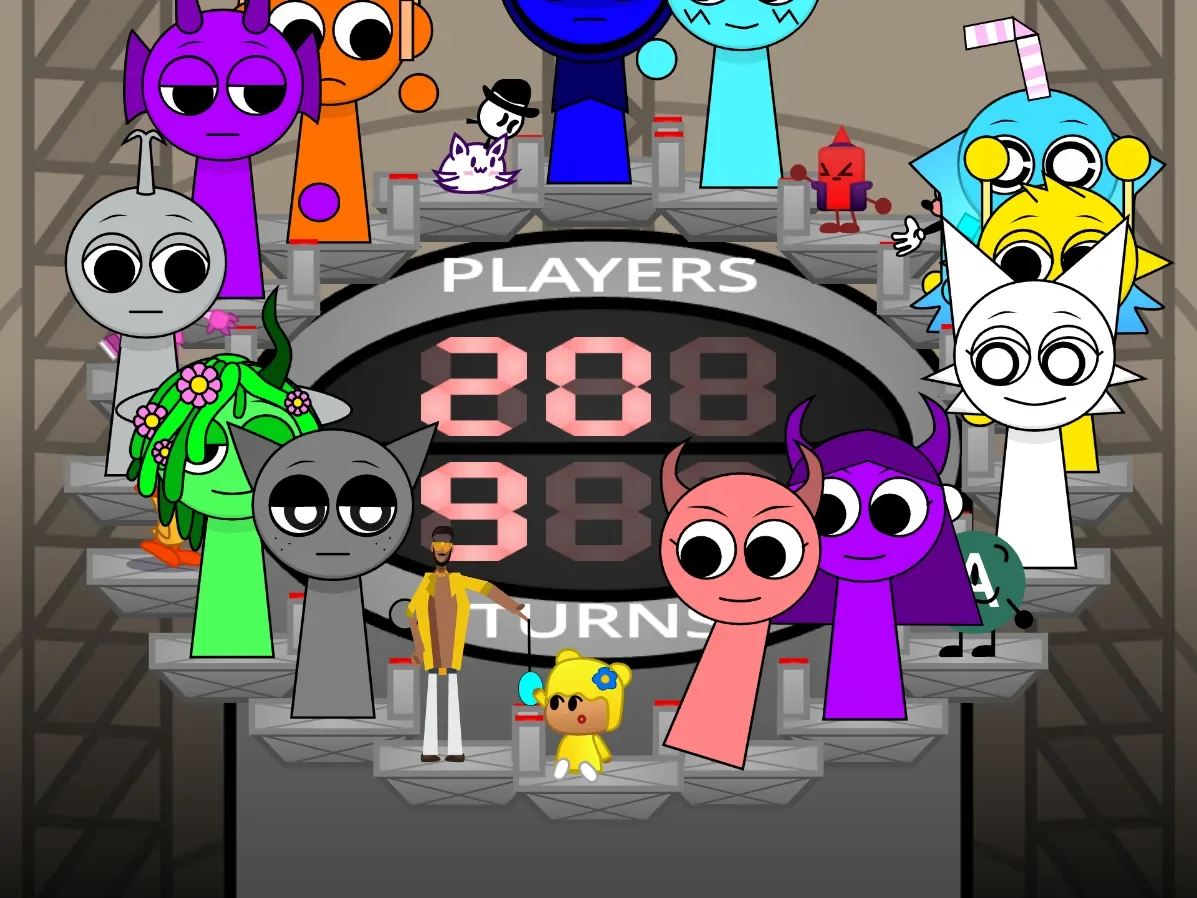
The roster brings together familiar Sprunki figures—including Oren, Raddy, Clukr, Funbot, Vineria, Gray, Brud, Mr. Sun, Wenda, Pinki, Black, and Durple—alongside guest characters like Pocoyo, Teardrop, Animatic, Book, Goobert, Brightney, and Rodrigo Gonçalo. Keeping track of such a crowded field is made manageable by two digital displays framed above the gray mechanical arena. The upper counter tracks the total number of surviving contestants, dropping sequentially after each valid elimination sequence, while the lower display shows how many button presses were generated during the active phase.
In a typical turn, roughly half of the remaining cast will randomly decide to press. Pressing characters flash brightly, swap to a distinct button pose, and add one increment to the turn counter. Once the total count is set, the entire circle rotates continuously rather than teleporting instantly. This smooth motion allows players to follow the moving line and anticipate which character will land in the knockout spot. When an elimination occurs, the selected entrant undergoes a quick reaction sequence before vanishing from the platform.
Minimal Controls and Name Bubble Tracking
Because the survival logic is fully automated, player input is limited to setup and monitoring actions:
| Action | Input | Result |
|---|---|---|
| Start or restart the simulation | Click the green flag | Resets roster positions, displays, soundtracks, and begins a fresh run |
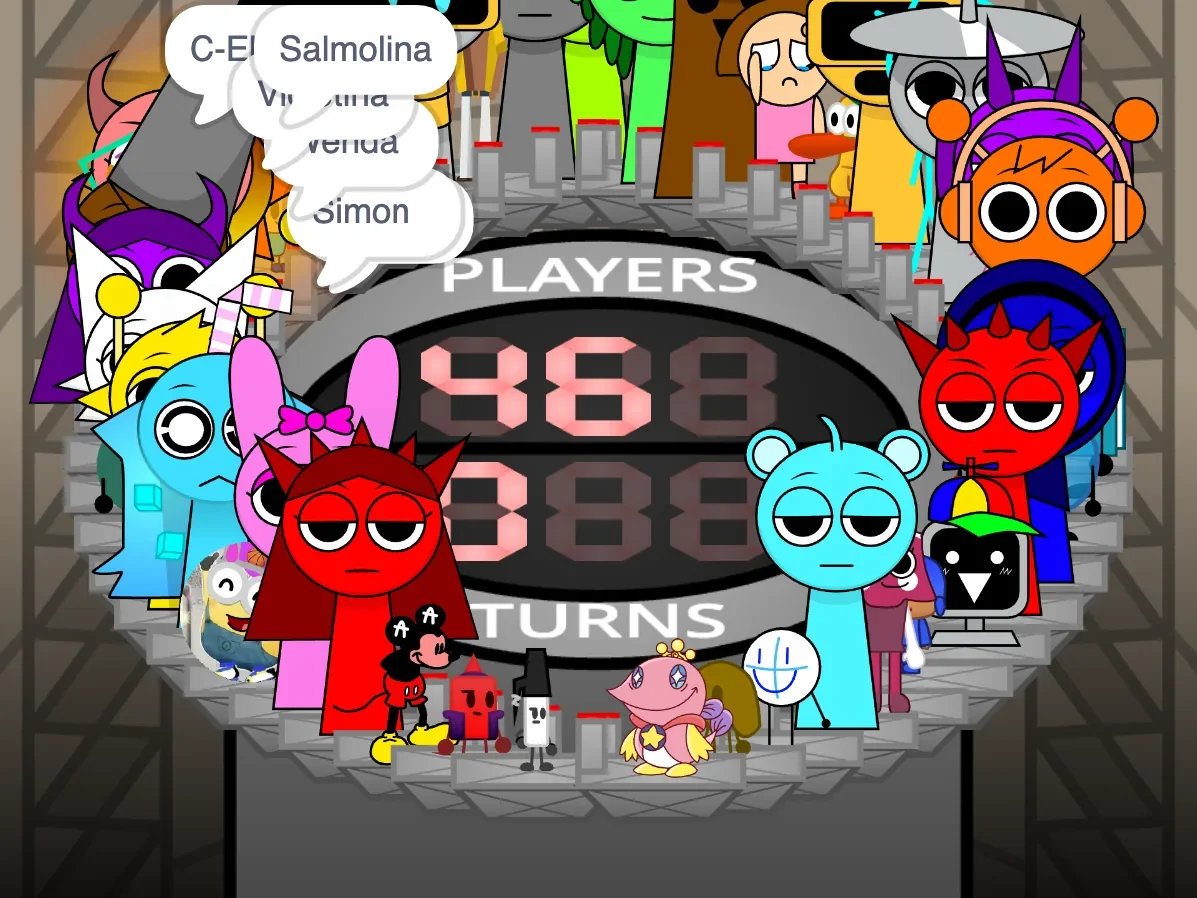
| Identify a contestant | Hover mouse over a character | Displays the contestant's name inside a speech bubble |
Hover identification proves essential during early rounds when 48 overlapping sprites crowd the stage. With larger character models frequently obscuring smaller ones and several sprites extending past the upper boundary of the playfield, hovering over dense clusters reveals who is who. As characters rotate and the overall roster shrinks, visual clarity improves, making it easier to track favorites like Brud, Gray, or Pinki without needing speech bubbles. However, players cannot manually force a button press, select elimination targets, or influence turn numbers.
The Rodrigo Twist and Game-Show Audio
Rodrigo Gonçalo stands out through custom visual assets and dedicated sound effects. He possesses his own idle stance, button press pose, prank animation, and victory sequence. When the ring stops on Rodrigo, his prank reaction plays, the player counter remains unchanged, and the game instantly restarts the button phase. This gimmick transforms the run into a test of endurance for the rest of the cast. Observing how many times Rodrigo evades elimination before claiming the confetti-filled victory presentation creates the main dramatic arc. On sites like Fortcade, where automated roster elimination simulators attract viewers looking for casual crossover chaos, this rule-breaking mechanic offers a funny subversion of standard tournament rules.
Audio design heavily reinforces the high-energy game-show aesthetic. The experience begins with an introductory music cue before cycling through rotating competition tracks drawn from series such as Mario Party and Super Smash Bros. A visible "Now Playing" UI element identifies the current song. Distinct audio effects accompany every key event, from the click of red buttons and teleportation movement sounds to heavy impact thuds, elimination drops, and celebratory victory fanfare.
Pacing Considerations and Overall Verdict
The primary drawback of the simulation is its extended pacing and lack of speed controls. Reaching a final winner requires at least 47 successful eliminations, plus additional rounds whenever Rodrigo triggers his prank defense. Because each elimination repeats the full cycle of turn counting, ring rotation, reaction animation, and counter updating, a complete run requires several minutes of passive watching. Without a skip button or fast-forward toggle, the spectacle demands patient viewing.
Despite the absence of direct player control, the huge roster, detailed character reactions, and Rodrigo's guaranteed twist make the simulation an enjoyable character-driven spectator experience. It functions best as a background competition or replayable roster showcase where the fun comes from watching favorite characters survive against all odds in a rigged game show.