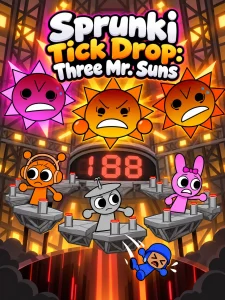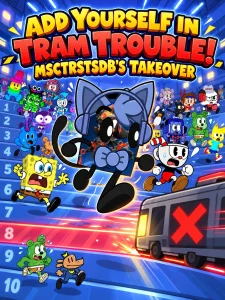
A group of 21 cartoon contestants takes turns walking onto a central suspended platform, stepping up to a large red button, and triggering a spinning wheel that decides whether they heal, lose health, or alter the course of the match. Created by @Babyvillager0373, AY in ULTIMATE Trauma Wheel! Modded version expands on the Add Yourself remix format and earlier Trauma Wheel concepts inspired by Mario Party 8's "Cardiators" minigame and @Burgnew_On_A_Laptop. It operates not as a traditional direct-control action game, but as an automated elimination tournament where random luck, scaling danger, and custom character animations create a long-form spectator experience.
Every competitor enters the arena with 35 health points (HP) and can stock up to a maximum of 60 HP. When a contestant's HP hits zero, they are eliminated from the match, leaving the remaining cast to push forward until a single survivor remains. Players do not steer characters, aim attacks, or manually trigger the central button during regular rounds. Instead, your direct interaction is restricted to setting up the match environment before or during the simulation through four optional mode toggles.
 3 Game Screenshots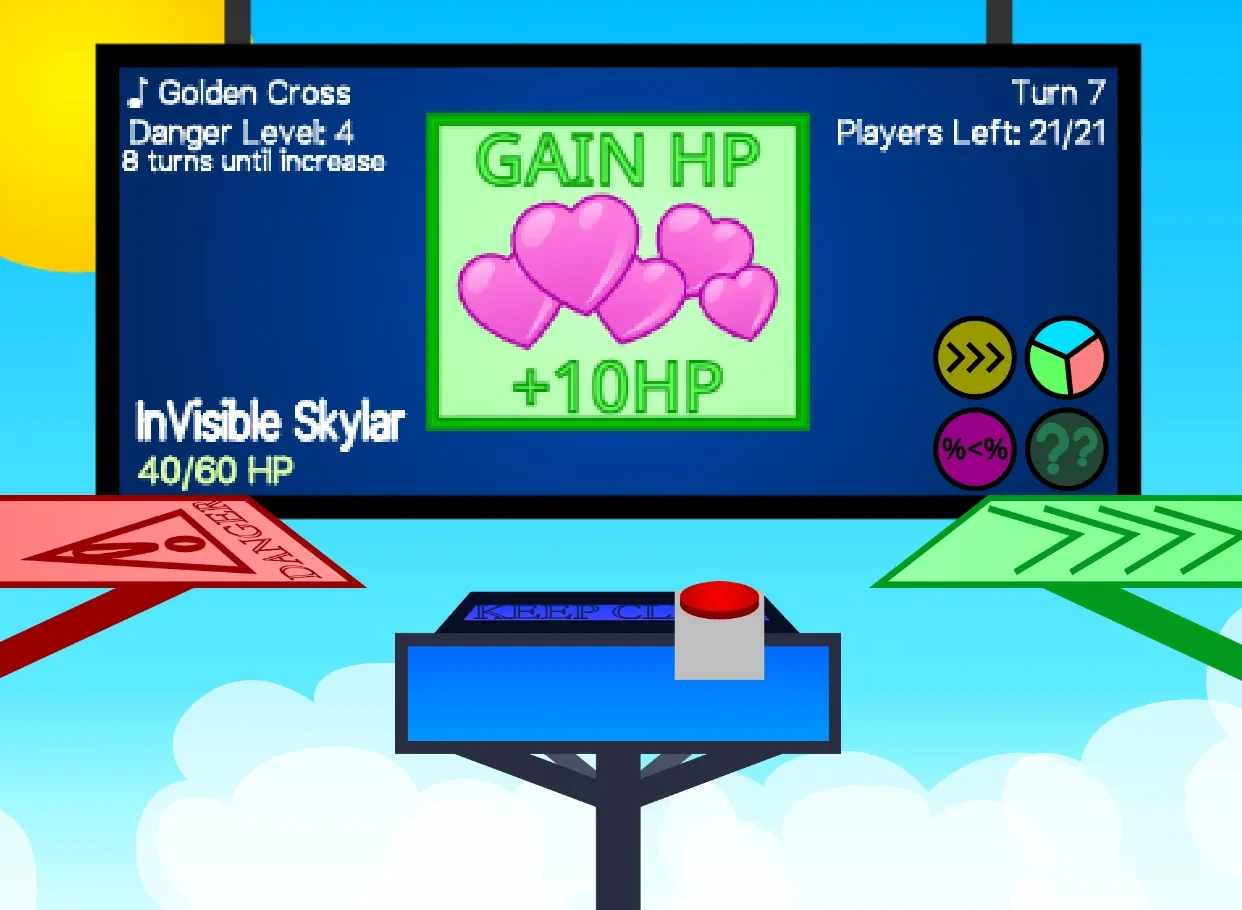
Automated Simulation and Rule Modifiers
Once initiated, the tournament proceeds automatically from turn to turn. The active contestant steps onto the middle platform, presses the button, and waits for the wheel to settle on one of three broad outcome categories:
- Green Panels: Restore health by awarding items such as fruit, hearts, stars, and tacos.
- Red Panels: Reduce health and trigger physical hazard animations on the active contestant.
- Blue Event Panels: Introduce secondary status items, badges, or overall rule shifts rather than direct health alterations.
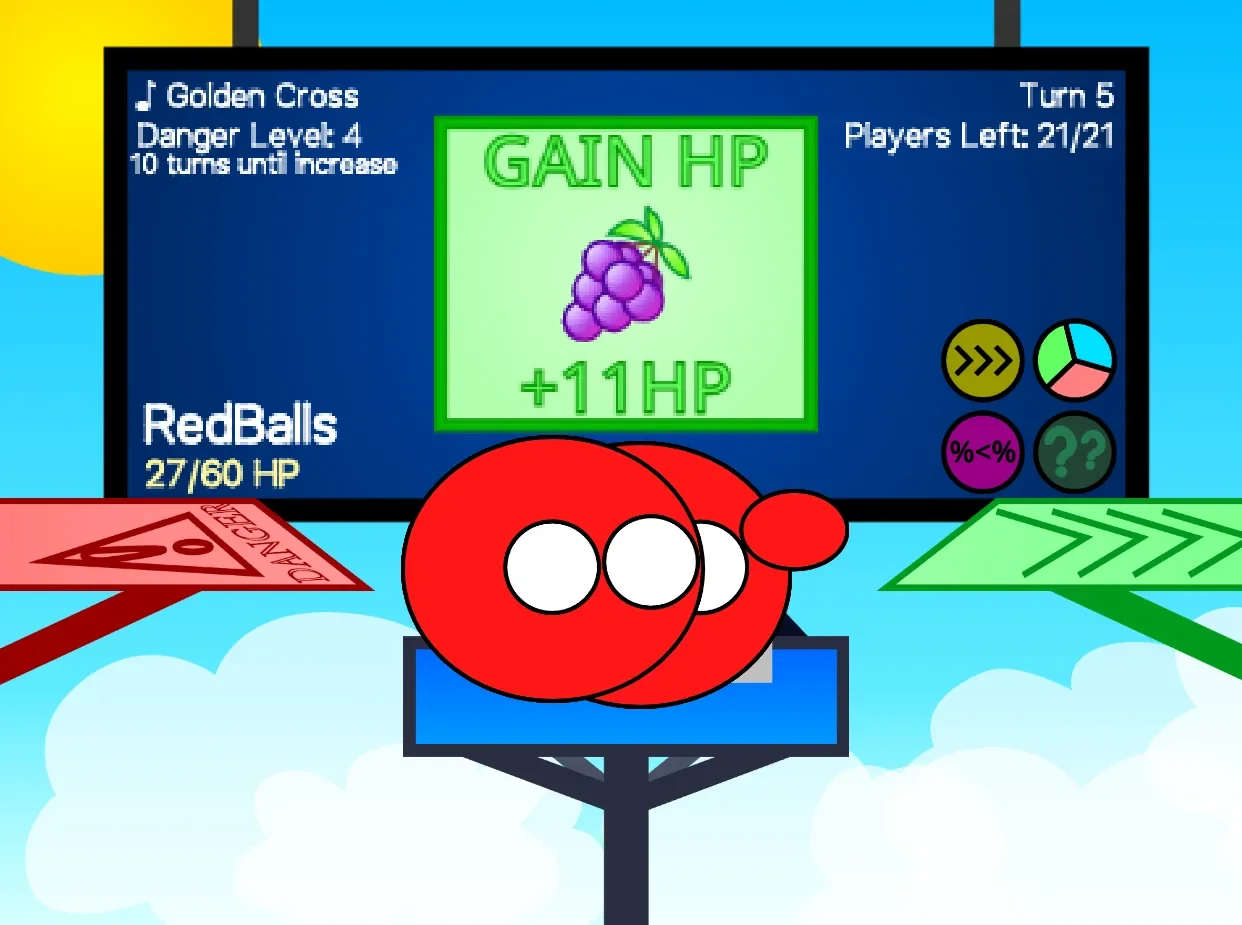
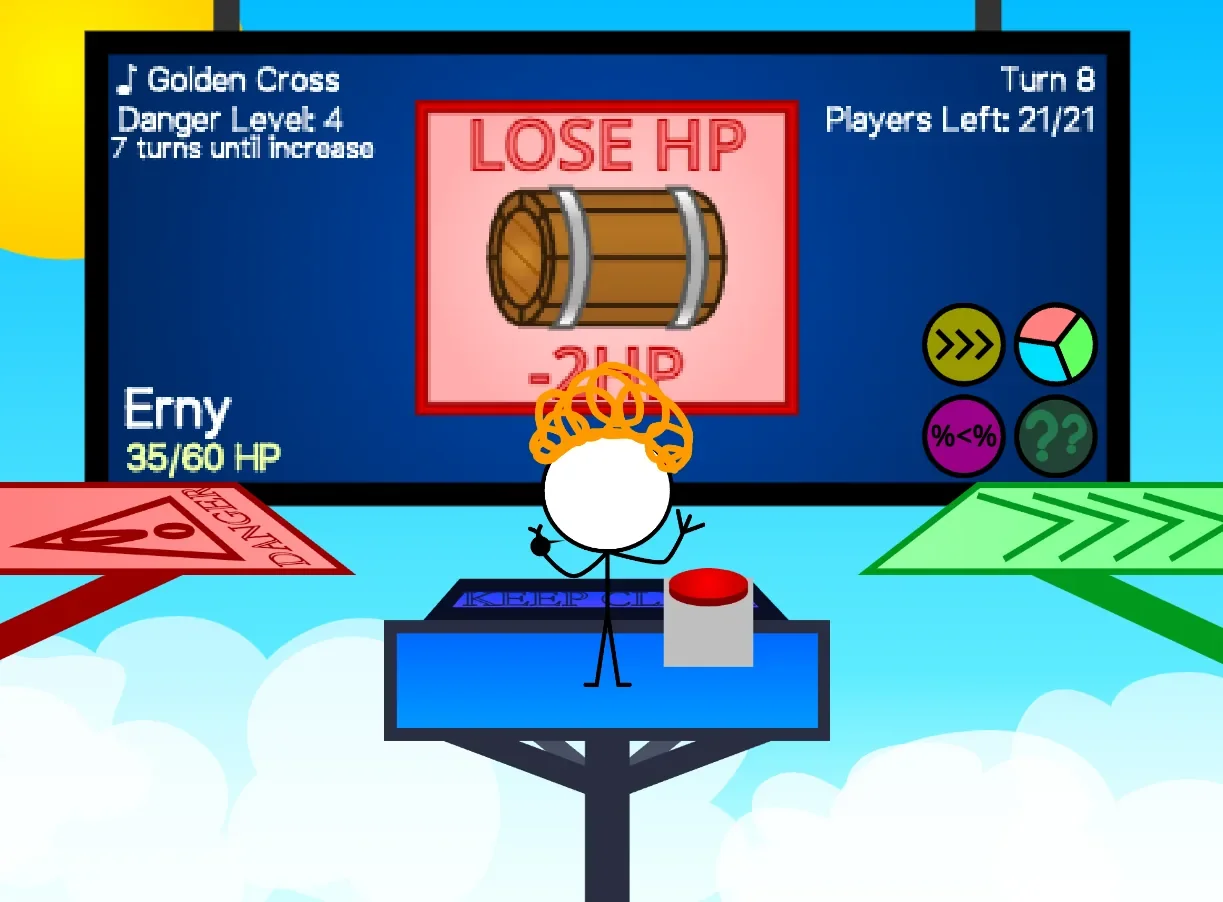
To help track the action, a dark-blue display screen remains visible throughout the match. It displays the current turn count, the number of surviving players, the active contestant's exact health, the active Danger Level, and a turn counter indicating when the Danger Level will step up next.
Because there are no character movement controls or directional inputs, the four circular mode icons act as director controls. These modifiers allow you to manipulate the speed, lethal intensity, probability distribution, or visual readability of the simulation at any time:
| Action | Input | Result |
|---|---|---|
| Start or restart match | Click Scratch green flag | Re-initializes roster, resets health to 35, and starts turn loop |
| Toggle rule modifier | Click circular mode icon | Displays mode explanation and toggles modifier active/inactive |
| Clear thumbnail cover | Click project cover | Hides cover graphic if displayed during playback |
| Halt simulation | Click Scratch stop button | Ends match processing immediately |
Each of the four modes alters the fundamental flow of a match:
- Speed Mode: Reduces transition delays and shortens reaction animations between wheel turns, speeding up long matches.
- Danger Mode: Restricts the wheel purely to Lose HP red panels, neutralizing the Danger Level progression and accelerating eliminations.
- Frantic Mode: Flattens health outcome probabilities so that massive health gains or heavy losses occur as frequently as minor adjustments.
- Mystery Mode: Obscures the outcome panel on the wheel until it completely stops spinning, preserving tension until the final frame.
The 21-Contestant Roster
The roster features 21 distinct participants drawn from various Add Yourself remix contributions. The full active lineup includes Nanobross, Skylar, G-RAY, Paul, Thomas, four distinct RedBalls entries, Mermina, Franky, Canal 13, Walburt, BlueStreak, Erny, Ripley, Stikwig, Amira, ZYellow, ZYella, and Invisible Skylar.
Rather than using static imagery, every character includes a dedicated set of custom reaction poses and animation states. Characters walk or drop onto the platform, reach out to press the red button, and express specific emotions depending on their fortune. Poses include expressions of delight upon healing, despair when damaged, pain responses, being knocked clean off the platform, smacking face-first into the screen, getting squashed flat, corroding in acid, getting electrocuted, and celebrating a final victory. Dedicated footstep sounds and custom voice clips accompany these actions, giving each turn individual personality.
Some roster choices deliberately lean into absurdity. Including four separate RedBalls entries fills the board with visually similar red spheres that contrast with humanoids and elaborate cartoon figures. Meanwhile, Invisible Skylar leaves the platform visually empty except for UI indicators, testing the player's ability to keep track of an unseen participant based purely on turn indicators and sound cues. Despite the wide cast, all 21 characters are CPU-controlled entries; there is no local or online multiplayer mode for human participants.
Scaling Danger Levels, Hazards, and Event Items
To prevent matches from stalling in endless cycles of healing, the game incorporates an escalating 15-tier Danger Level system. As the turn counter ticks down and the Danger Level increases, damaging red panels occupy a progressively larger portion of the wheel's probability distribution. Early turns frequently feature low-stakes damage or routine healing, whereas late-game turns at higher Danger Levels lean heavily toward elimination-grade hits.
When a character triggers a red panel, the damage is rendered visually through a large pool of slapstick hazards. Characters do not simply lose numbers; they are subjected to full animated sequences. The available hazard pool includes:
- Falling barrels, bowling-style heavy weights, falling pianos, and crushing wrecking balls
- Fired bullets, incoming fireballs, swinging logs, and spiked iron balls
- Strikes from meteors, direct lightning bolts, pooling acid, and explosive countdown bombs
- Attacks from hazardous food items like Evil Tacos
Blue event panels introduce utility items and match-wide disruptions that shift the balance of power outside of plain health calculation. The 11 available blue event outcomes are:
- Nothing Happens: The turn ends with no state change.
- Skip-Turn Badge: Forces the recipient to miss their next scheduled turn.
- Green Token & Red Curse: Grant beneficial or detrimental turn conditions.
- Blue Ticket: Provides a unique event status.
- Frantic Piñata & Mystery Scroll: Temporarily apply or mimic the global Frantic and Mystery mode effects.
- Rainbow Star: Grants a powerful beneficial effect.
- Danger Level Increase & Danger Level Decrease: Manually step the global threat meter up or down.
- Spin Again: Grants the active contestant an immediate extra turn.
Because event items, skip-turn badges, and stored health interact unpredictably, lead positions change constantly. Match lengths vary wildly as a result. In one documented match, a full simulation ran for 291 turns over nearly 28 minutes before Ripley secured a final victory against the last survivor. Restarting the match completely reshuffles the turn order and wheel outcomes, ensuring no two runs play out identically.
Presentation, Audio, and Technical Considerations
The stage layout places three floating platforms against a bright sky filled with clouds. A central dark-blue display screen frames the active contestant and hazard visual effects, while color-coded result cards (green for heal, red for damage, cyan for events) flash clearly across the screen to communicate turn results instantly.
The audio architecture relies on a large rotating jukebox of energetic party, racing, battle, and platforming music tracks that change between matches. Character footsteps, button clicks, distinct voice lines, heavy impacts, warning sirens, explosion blasts, and victory fanfares fill out the soundscape. This continuous sound design helps sustain interest through lengthy automated runs.
However, the dense audiovisual presentation introduces specific performance requirements. High-density visual effects—including screen-filling explosions, flashing lightning, confetti bursts, zooming text, and rapidly changing cards—can create visual clutter. Additionally, because the project packages dozens of character sprites, voice files, hazard animations, and music tracks, initial loading times in Scratch can be substantial, and low-spec systems may experience frame lag. If the thumbnail graphic appears during playback, tapping or clicking the screen hides it to reveal the running match.
Evaluation and Audience Suitability
When evaluated on Fortcade as an automated spectator simulation, the game succeeds by turning simple luck into a multi-tiered cartoon spectacle. The combination of 21 custom characters, 15 Danger Levels, 11 event items, four operational modes, and dozens of physical hazards ensures that watching the simulation unfold remains entertaining.
Its main limitation lies in its complete lack of active gameplay mechanics. Once modifiers are selected, players cannot intervene, pick targets, or save favorite contestants from an unlucky streak. Long stretches between eliminations can feel slow if healthy characters repeatedly land on minor healing panels, though enabling Speed Mode addresses this issue effectively.
This title is best suited for players who enjoy automated elimination tournaments, marble-race simulations, object-show character interactions, and luck-driven party games. Those looking for direct character control or traditional strategy will find little interactive depth, but viewers content to sit back and watch a chaotic, randomized elimination show will find plenty of variety in every spin.