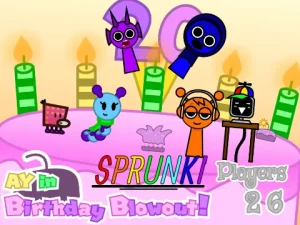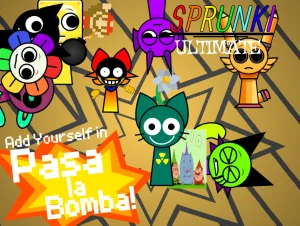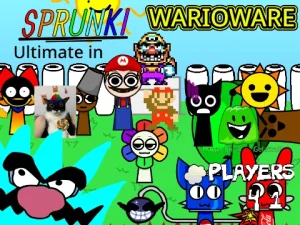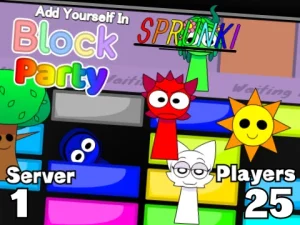
AY in Ultimate in Surviving Tornado Peak! but Sprunkies is a browser-based automatic survival game created by Madu_02. It places 42 computer-controlled characters on a narrow platform high in the mountains, then subjects them to an increasingly violent parade of tornadoes, flying rocks, ice effects, and electrical hazards.
The objective is wonderfully simple: stay on the platform longer than everyone else. Characters move and react automatically, so this is not a conventional platformer and there are no movement controls to learn. Instead, players watch the disaster unfold, choose a favorite contestant, and hope that character is still standing when the storm finally clears.
![Sprunki Ultimate in Surviving Tornado Peak! [ Remix 1| 42 Players ] game screenshot 1](https://fortcade.com/wp-content/uploads/2026/06/sprunki-ultimate-in-surviving-tornado-peak-remix-1-42-players-game-screenshot-1.webp) 3 Game Screenshots
3 Game Screenshots![Sprunki Ultimate in Surviving Tornado Peak! [ Remix 1| 42 Players ] game screenshot 2](https://fortcade.com/wp-content/uploads/2026/06/sprunki-ultimate-in-surviving-tornado-peak-remix-1-42-players-game-screenshot-2.webp)
![Sprunki Ultimate in Surviving Tornado Peak! [ Remix 1| 42 Players ] game screenshot 3](https://fortcade.com/wp-content/uploads/2026/06/sprunki-ultimate-in-surviving-tornado-peak-remix-1-42-players-game-screenshot-3.webp)
Despite the “42 Players” label, this is not an online multiplayer game. It is closer to an elimination simulator or miniature survival show. Individual matches usually last around two minutes, making it well suited to short browser sessions, prediction games with friends, and anyone who enjoys watching large casts collide with unpredictable physics.
Quick Facts
| Feature | Details |
|---|---|
| Full title | AY in Ultimate in Surviving Tornado Peak! but Sprunkies |
| Creator | Madu_02 |
| Genre | Automatic survival and elimination simulation |
| Contestants | 42 computer-controlled characters |
| Main objective | Be the final character remaining on the platform |
| Direct controls | None during the survival round |
| Multiplayer | No; all contestants are controlled by the game |
| Typical match length | Roughly 1.5–2.5 minutes |
| Arena | A stormy mountaintop platform |
| Endings | One winner or a draw if everyone is eliminated |
| Best platform | Desktop browser, although it can also run on mobile |
What Kind of Game Is It?
This is a last-character-standing simulation built around environmental hazards rather than combat. Forty-two contestants begin packed together on a metal platform while snow blows across a grey mountain landscape. After a short introduction, tornadoes begin appearing from either side of the screen.
Anyone caught by a tornado can be lifted, dragged, stunned, frozen, flattened, or thrown beyond the edge. Falling from the platform means elimination. A counter in the bottom-right corner tracks how many contestants remain, while the current music title appears on the opposite side.
The game starts chaotically. With 42 characters sharing a small space, the opening resembles a colorful pile-up more than an orderly competition. Once the first few tornadoes pass through, however, the crowd begins to thin and individual survivors become easier to follow.
There is no story campaign or sequence of levels. The entire game is built around repeated randomized matches on the same mountain. Its appeal comes from changing elimination orders, varied weather effects, randomized music, and the possibility that almost any contestant could become the next winner.
How to Play and Controls
The contestants handle movement and survival automatically.
| Action | Control | Purpose |
|---|---|---|
| Start the game | Green flag or Play button | Loads the arena and begins the introduction |
| Dismiss the cover | Click the title or game screen | Reveals the match if the cover remains visible |
| Watch the round | No input required | Characters move, jump, and react automatically |
| Start another match | Restart the project | Resets all 42 contestants and generates a new result |
There are no keyboard controls for walking, jumping, attacking, or selecting a contestant. Once the round starts, the player becomes a spectator.
That makes the game exceptionally easy to understand, but it also defines its limitations. Players looking for a skill-based survival platformer may feel that they are watching rather than playing. Those who enjoy simulations, elimination brackets, marble races, or choosing a favorite before a randomized contest will get much more from it.
A desktop browser provides the clearest experience because 42 small characters can become difficult to distinguish on a phone screen. Mobile users do not lose any essential controls, but the crowded presentation is easier to read on a larger display.
How a Match Works
Every match begins with all 42 contestants standing on the same platform. An introductory message explains the situation: the weather is bad, and everyone must remain on the platform while avoiding tornadoes.
The first hazards are comparatively manageable. Tornadoes appear at intervals and travel across the arena, catching characters who fail to move or jump away. As time passes, the storm becomes steadily more aggressive.
The hazard pool expands in stages:
The opening seconds introduce basic tornadoes.
After approximately ten seconds, more tornado patterns and rock-related hazards become possible.
Later phases add unusual variants, including ice and electrically charged effects.
After about one minute, the full hazard collection can appear, while the delay between tornadoes becomes much shorter.
This escalation is important because it prevents rounds from continuing indefinitely. Even if many contestants survive the opening, the faster late-game spawning eventually overwhelms most of them.
When fewer than two characters remain, the storm ends. A large “FINISH!” message appears and the grey sky begins to clear. If one contestant survived, the camera zooms toward that character before displaying a “WINNER!” screen with confetti, victory music, and the winner’s name.
If the final contestants are eliminated together, the game can produce a separate draw result. There are therefore two confirmed endings: a winner celebration and a draw sequence.
There is no persistent leaderboard, save file, tournament bracket, or character progression. Restarting creates a completely independent match.
The 42-Character Roster
The unusually large roster is one of the game’s strongest attractions. Familiar Sprunki characters such as Oren, Raddy, Clukr, Fun Bot, Vineria, Gray, Brud, Garnold, OWAKCX, Sky, Durple, Mr. Sun, Mr. Tree, Simon, Tunner, Wenda, Pinki, Jevin, and Mr. Black all participate.
The cast also includes crossover and remix characters such as Mario, Boyfriend, Lucky Block, Lollipop Cat, Animus, Broker, Thysto, Sulfur, Neon, Gatoman, Mard, Acid, and Penz. The result feels less like a strict Sprunki roster and more like a chaotic fan-made crossover tournament.
Characters have more animation than their small size initially suggests. They can stand, blink, walk, jump, fall, become stunned, appear frozen, get flattened, receive a knockout pose, and perform a dedicated victory animation. Many contestants also have individual voices or special sound clips.
These differences are primarily presentational rather than statistical. The game does not clearly indicate that one contestant is faster, stronger, or more resistant than another. A favorite character can win one round and disappear almost immediately in the next.
That randomness helps the roster feel useful. Even characters hidden behind larger contestants at the beginning can quietly survive until the final phase.
Tornadoes and Weather Hazards
The storm contains six visual tornado families, with some producing additional environmental effects. They vary in size, movement, strength, appearance, and the way they disrupt contestants.
Standard Tornadoes
The standard tornado is the basic threat and appears from the beginning. It crosses the platform and can lift nearby contestants into the air. A character may land safely, but being thrown too far horizontally usually results in elimination.
Different Wind Patterns
Some tornadoes are smaller and easier to overlook, while others occupy a larger section of the platform. Their different throwing strength creates deceptive moments: the most dramatic-looking hazard is not always the one that removes the most contestants.
The direction is also unpredictable. A tornado may enter from either side, so characters cannot simply remain near one edge and expect to be safe.
Rock Tornadoes
Rock-based tornadoes add flying debris to the arena. Stones are launched into the air before falling back toward the platform. A direct impact may flatten or stun a contestant for several seconds, leaving them vulnerable to the next tornado.
These rocks are particularly effective during crowded phases. A character can survive the wind itself, get knocked down by debris, and then be swept away before recovering.
Ice Tornadoes
Ice effects can leave characters frozen in place. A frozen contestant may remain on the platform temporarily, but being unable to move during a follow-up hazard is dangerous.
There is also a small interaction between different hazards: a rock impact can break a character out of the frozen state. This occasionally produces an accidental rescue, although the same impact can leave the contestant flattened and exposed.
Electrified Tornadoes
The electrically charged variant uses crackling sounds and an unstable visual effect. It adds extra intensity to the late game and helps the final minute feel more dangerous than the opening.
The electrical presentation is especially noticeable when only a few contestants remain, since there is less visual clutter hiding the effect.
Combined Hazard Chains
The most entertaining eliminations often involve more than one hazard. Contestants are not always removed the instant a tornado touches them. They can be lifted, recover, become frozen, get struck by debris, or narrowly land back on the platform.
One character might survive a tornado only to be flattened by a falling rock. Another may be thrown high into the air and land safely, while a nearby contestant barely moves but slides beyond the platform boundary.
These chains of events make the simulation less predictable than a simple random elimination screen.
Pacing and Replayability
The game’s pacing is impressively efficient for a hands-off simulation. Forty-two contestants sound like enough to create a very long match, but the hazard frequency increases as the round continues.
Most observed matches conclude in roughly two minutes. The early phase reduces the initial crowd, while the increasingly aggressive storm prevents the final survivors from remaining comfortable for too long.
The supplied gameplay footage contains four complete rounds with four different winners: Mario, Sulfur, Fun Bot, and the flower contestant. That variety demonstrates how dramatically the outcome can change after restarting.
Early eliminations are often difficult to follow because several characters may be caught simultaneously. The middle of a round is usually the most entertaining section: the crowd has become readable, yet enough contestants remain for group disasters.
The final two or three survivors create a different type of tension. With fewer bodies on the platform, every tornado is easier to track. A contestant can look completely safe, only to be hit by a rock or thrown beyond the boundary a few seconds later.
Replay value comes entirely from these changing results. There are no unlocks or permanent rewards, but the game works well as a prediction challenge. Let each person choose a contestant, start the round, and see whose favorite survives.
The Most Memorable Moments
Watching the Opening Crowd Explode
The first powerful tornado can scatter a large part of the roster at once. Some characters rise into the clouds, others tumble along the platform, and a lucky few land as if nothing happened.
It immediately establishes the game’s slapstick tone. The storm looks dangerous, but the exaggerated reactions keep it playful rather than frightening.
A Rock Creating a Chain Reaction
Falling debris is more interesting than a simple instant knockout. A rock can flatten one contestant, interrupt another, and leave both exposed to an approaching tornado.
These layered accidents are some of the clearest examples of the game’s hidden complexity. The basic rules are simple, but the hazards can combine in amusing ways.
Frozen Contestants Waiting for Disaster
A frozen character standing motionless while tornadoes pass nearby creates surprisingly effective suspense. Sometimes the character escapes when the ice breaks. At other times, the next tornado calmly carries the helpless contestant away.
Survivors Landing Back on the Platform
Being caught does not always mean elimination. Some contestants are thrown upward but manage to land on the narrow platform again.
These unlikely recoveries create natural underdog stories. A character can survive several close calls and become memorable even without winning.
The Storm Clearing for the Winner
The transition from grey storm clouds to a bright sky gives the ending a strong sense of relief. The camera focuses on the final survivor, confetti appears, and the winner receives a proper celebration rather than a simple text message.
Unexpected Characters Reaching the Finale
With such a large cast, it is easy to overlook contestants hidden behind Mr. Tree or other large sprites. Seeing one of these background characters emerge as a finalist is a major part of the fun.
Visuals, Music, and Atmosphere
The mountaintop setting is deliberately cold and hostile. Layered grey mountains, moving clouds, snowfall, fog, and constant wind make the arena feel exposed even before the first tornado arrives.
The colorful character art contrasts effectively with the muted environment. Bright greens, reds, purples, and yellows remain visible against the snow and storm clouds, although the opening crowd is still extremely busy.
Large characters can hide smaller ones, and overlapping status effects occasionally make it difficult to understand exactly who was eliminated. Readability improves significantly once the roster falls below approximately 20 contestants.
Animation and sound do much of the communicative work. Different poses distinguish jumping, falling, being stunned, freezing, flattening, and winning. Wind, thunder, electrical crackles, impacts, footsteps, and character voices give collisions suitable weight.
The soundtrack is unusually extensive for such a compact game. A large randomized pool supplies opening jingles, gameplay music, victory themes, draw cues, and result-screen tracks. The title of the current track is displayed during each match.
This musical variety helps repeated rounds feel less identical. However, the combination of energetic music, weather noise, impact sounds, and several character voices can become intense when multiple events trigger at once.
The interface remains simple. The survivor counter is the most important element, while the opening and finishing messages clearly communicate the state of the match. The game does not need a complicated HUD because players have no abilities or resources to manage.
Content and Long-Term Appeal
This is a compact game rather than a progression-heavy experience. It offers one primary arena, one survival format, 42 contestants, multiple hazard types, randomized music, and winner or draw endings.
The game does not include:
A story campaign
Multiple selectable levels
Online multiplayer
Character upgrades
Unlockable contestants
Persistent win statistics
Achievements
A saved tournament bracket
Those omissions do not necessarily hurt a short browser game. The project is designed around immediate spectacle rather than long-term investment. It works best when played for several rounds instead of an entire afternoon.
Players who enjoy tracking winners manually could easily create their own tournament outside the game, but that structure is not built into the project itself.
Pros and Cons
Pros
A huge 42-character roster: The crowded cast makes every round feel like a miniature tournament.
Strong hazard variety: Tornadoes, rocks, ice, electricity, stunning, and flattening create several routes to elimination.
Effective difficulty escalation: Hazard frequency increases naturally, preventing matches from continuing forever.
Clear match structure: The survivor counter, finishing sequence, winner zoom, and result screen make each round easy to understand.
High replay value for a simulation: Different winners and elimination chains make restarting entertaining.
Detailed audiovisual feedback: Individual reactions, voices, weather effects, and randomized music give the project personality.
Cons
No direct control: Players cannot move or protect their chosen contestant.
The opening is visually crowded: Forty-two overlapping sprites make early eliminations difficult to follow.
Only one main arena: Every match takes place on the same mountaintop platform.
Results depend heavily on randomness: There is little strategy beyond choosing someone to support.
No persistent features: Wins are not recorded, and there are no rankings, unlocks, or tournament modes.
Small screens reduce readability: Mobile browsers can run it, but desktop is more comfortable.
Who Should Play It?
This game is best suited to:
Sprunki fans who enjoy large crossover casts.
Players who like automatic survival simulations and elimination games.
Friends who want to choose contestants and predict a winner.
Casual browser players looking for a two-minute distraction.
Viewers who enjoy physics-driven accidents and unpredictable results.
It may not appeal to players seeking manual platforming, online multiplayer, tactical decisions, story progression, or long-term character development.
Frequently Asked Questions
Is AY in Ultimate in Surviving Tornado Peak a multiplayer game?
No. The 42 contestants are controlled automatically by the game. There is no confirmed online or local competitive multiplayer mode.
Can players control a Sprunki character?
No. Players start or restart the match, but character movement and reactions are automatic.
How do you win?
A contestant wins by being the final character remaining on the mountaintop platform. If everyone is eliminated, the result is a draw.
How long does one match take?
Most observed rounds last approximately 1.5 to 2.5 minutes. Random events can make individual matches shorter or longer.
How many characters are in the game?
There are 42 active contestants, including familiar Sprunki characters and several crossover or remix characters.
Does the game have different levels?
No. Matches use the same main mountaintop arena, although the storm intensifies and introduces additional hazards over time.
Does it work on mobile?
It can run in a mobile browser because there are no keyboard controls. However, the large roster is easier to follow on a desktop or larger screen.
Does the game save your winners?
No persistent save system or winner history is implemented. Restarting begins a fresh independent match.
Ratings
| Category | Rating | Summary |
|---|---|---|
| Gameplay Design | ★★★★☆ | A simple survival premise supported by varied hazards |
| Player Interaction | ★★☆☆☆ | Accessible but almost completely hands-off |
| Character Variety | ★★★★☆ | A large and colorful 42-contestant crossover roster |
| Pacing | ★★★★☆ | Escalating storms keep matches short and eventful |
| Content Variety | ★★★☆☆ | Good hazard variety, but only one main arena and mode |
| Visuals and Audio | ★★★★☆ | Strong weather atmosphere, expressive reactions, and extensive music |
| Replayability | ★★★★☆ | Random outcomes make prediction-based replays entertaining |
| Overall Experience | ★★★★☆ | A lively spectator game with more detail than its simple premise suggests |
Final Verdict
AY in Ultimate in Surviving Tornado Peak! but Sprunkies succeeds by treating a simple automatic simulation like a full-scale weather disaster. Watching 42 characters get lifted, frozen, flattened, struck by rocks, and thrown beyond the platform produces a steady supply of unpredictable comedy.
Its greatest strength is escalation. The storm begins at a readable pace, introduces additional hazards, and eventually turns the mountain into a compact chaos machine. Detailed character reactions, a large soundtrack, and a proper winner presentation give each match a satisfying shape.
The lack of direct control remains its biggest limitation. This is a game to watch, predict, and replay—not one to master through reflexes. Its single arena and absence of progression may also limit longer sessions.
For Sprunki fans and players who enjoy randomized elimination games, however, it fits the browser format extremely well. Choose a contestant, watch the survivor counter fall, and hope your favorite is still on the platform when the clouds finally clear.