ClueRoll starts like a traditional daily word puzzle, but it quickly refuses to let a solved clue be the end of the challenge. Identifying the missing target word is only the first step of a multi-stage puzzle. Once you determine the correct term, the game shifts to a spatial board work system where you select six-faced letter cubes, place them into marked grid entrances, and roll them across a compact board so that the top faces land in order to spell out your answer.
Created by @kiko, the experience blends the deductive satisfaction of crossword clues with the spatial planning of a cube-net exercise. A cube sitting in your tray might display the exact letter you need, but rolling it across the board constantly changes which face points upward. Because a direct route can spoil the required orientation, reaching an answer slot demands careful pathing rather than quick typing or repeated guessing.
 3 Game Screenshots
From Word Clues to Spatial Route Planning
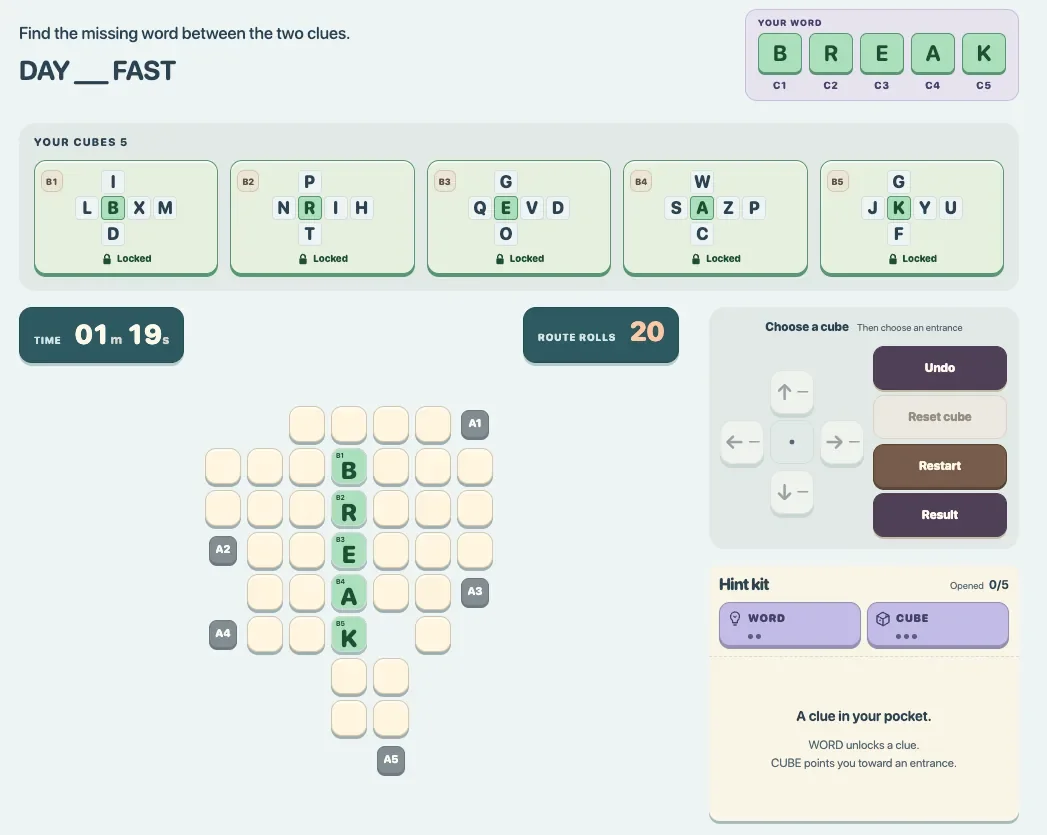
The core mechanics rely on a clear two-step sequence where linguistic solving gives way to geometric execution. On September 16, 2026, for example, the daily puzzle presented the clue DAY ___ FAST, a classic missing-link format where the target word BREAK connects the two prompts into "daybreak" and "breakfast." Identifying BREAK provides the destination, but every letter in that five-letter sequence must still be earned by navigating the grid.
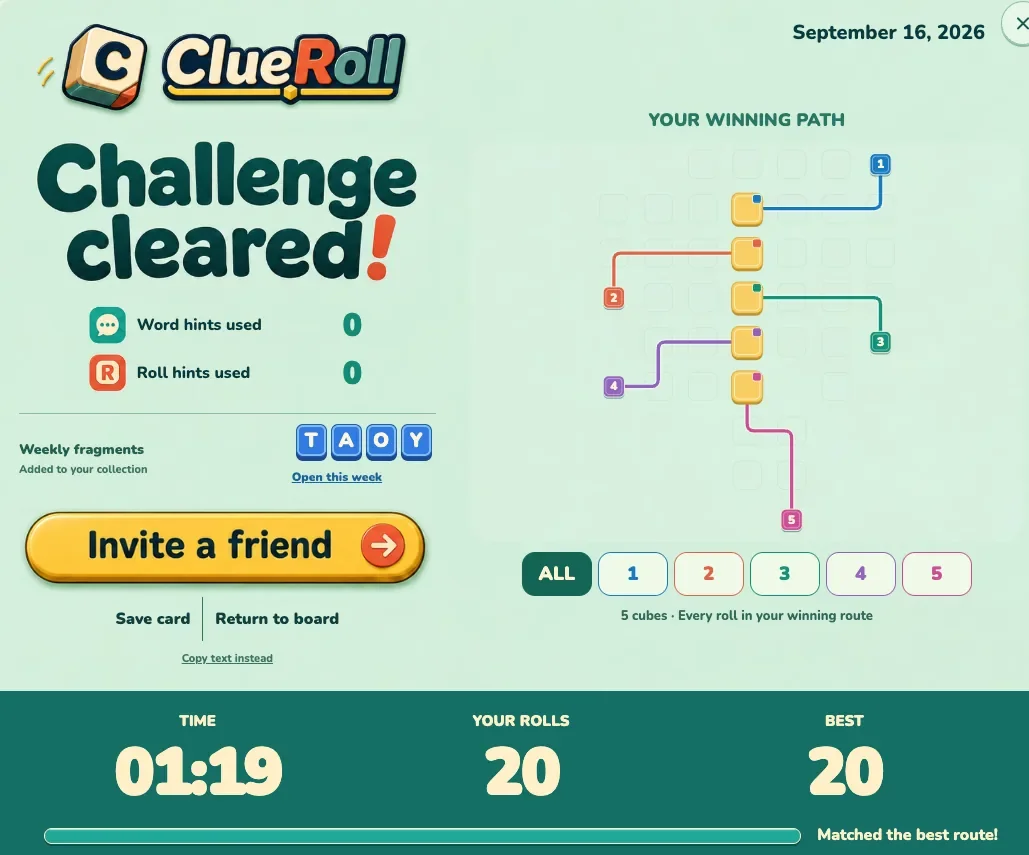
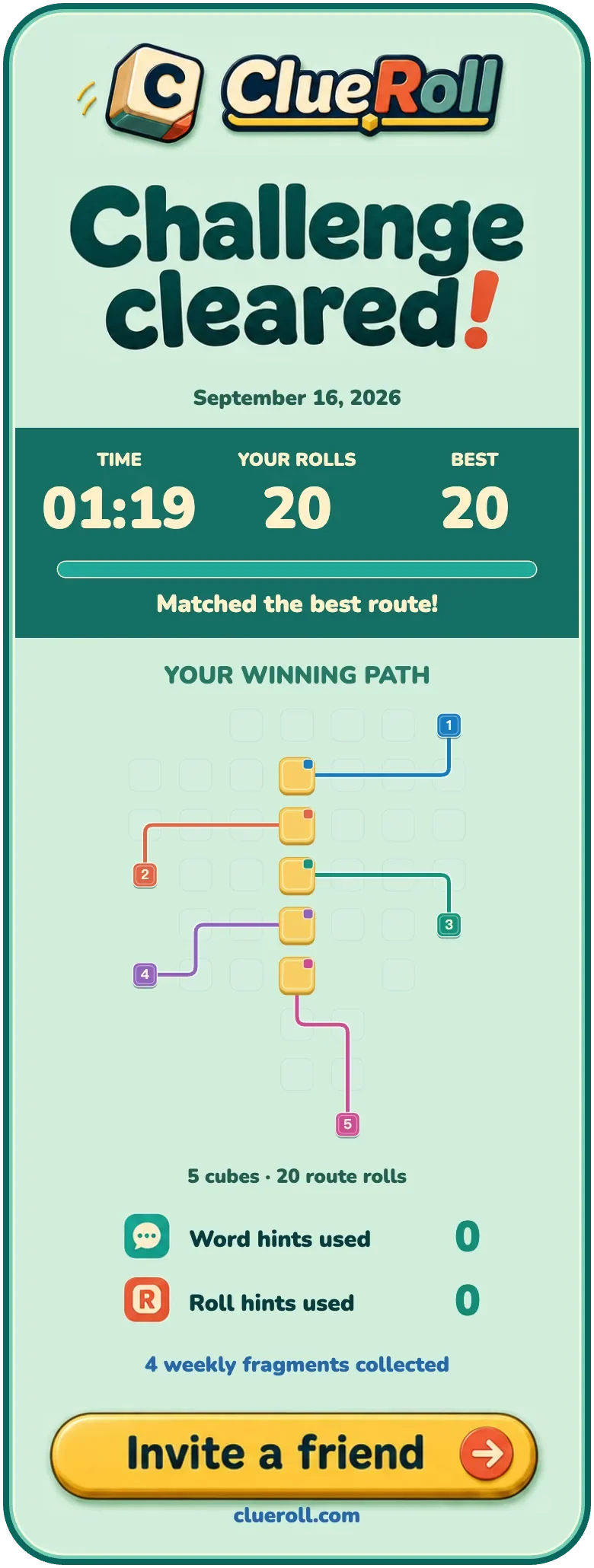
In that verified daily challenge, five distinct cubes sat in a tray, each featuring a complete set of six letters printed across its faces. Selecting a cube activates the available grid entrances, and placing a cube onto the board does not consume a movement roll. Once on the grid, directional controls move the cube one square at a time, flipping its orientation with every step. When a cube enters an answer slot with the correct letter facing up, that letter locks into position as part of the solved word. Completing the optimal path for BREAK took exactly 20 route rolls, matching the displayed benchmark best route for that day.
| Action | Input | Result |
|---|---|---|
| Select cube | Click or tap a cube in the tray | Enables valid board entrances |
| Place cube | Click or tap an entrance | Places cube on board without adding route rolls |
| Roll cube | Arrow buttons or keyboard arrows | Moves one cell and changes the top letter face |
| Undo | Undo button | Restores previous board state and route roll count |
| Reset cube | Reset button | Returns selected cube to the tray |
| Use hints | Word hint or cube hint buttons | Reveals clue assistance or spatial route assistance |
Responsive Interface and Dual Assistance Systems
ClueRoll maintains a clean presentation focused strictly on readable letters, movement tracking, and board state. The top interface keeps the active answer slots visible alongside elapsed time and total route rolls. Visual feedback relies on functional status changes: correct letters lock firmly in place, misplaced letters indicate that a useful character has landed in the wrong answer slot, and absent letters signal that the current top face is not part of the target word.
The hint structure is divided into two independent systems, recognizing that language hurdles and spatial obstacles require different kinds of aid. Requesting a word hint provides targeted assistance with the textual prompt, while asking for a cube hint offers pathfinding guidance across the grid. On web gaming catalogs like Fortcade, this functional layout ensures players can isolate whether their difficulty stems from vocabulary recognition or cube rotation physics without unneeded visual clutter.
Guided Lessons, Daily Archives, and Weekly Fragments
Beyond standalone daily levels, ClueRoll offers structured progression modes that expand its longevity. Beginners can access a guided lesson mode separate from daily progress. This tutorial teaches basic movement using a simplified single-cube board where the objective is landing on a purple target square with the letter T on top. In testing, placing the practice cube and rolling it right twice locked the T, recorded two route rolls, and kept the action strictly inside the training environment without modifying daily stats. The lesson also introduces various prompt styles, including common-link and analogy demonstrations.
The daily archive allows players to revisit past puzzles, each tied to a broader weekly framework. Completing the September 16 daily challenge awarded four specific letter fragments—T A O Y—toward that week's larger puzzle. The weekly board for the week of September 14 required 28 total fragments spread across a six-word layout with word lengths of 7, 6, 3, 6, 3, and 3 letters, accompanied by the overarching clue: "Being brave starts with a willingness to begin."
Placing earned fragments into the weekly phrase layout delivers immediate feedback, including explicit wrong-word warnings if a letter is assigned to an incorrect position. Future fragments remain locked behind subsequent daily completions, creating a steady long-term incentive. The game contains no character avatars, narrative cutscenes, or hidden collectibles; the entire experience rests on the interaction between textual clues, tray cubes, spatial routing, and phrase gathering. Local browser storage handles all progress tracking, allowing instant sessions without user registration.
Language Requirements and Spatial Demands
While the hybrid structure is compelling, ClueRoll places specific demands on its audience. The initial clue layer relies heavily on familiarity with English wordplay styles, including double definitions, missing links, analogies, and common links. While the word hint system alleviates stuck states, players seeking straightforward vocabulary tests or direct anagrams may find the indirect phrasing challenging.
Similarly, the spatial routing phase demands analytical foresight rather than quick mechanical inputs. Calculating how a cube's faces will rotate across three or four turns requires mental visualization of 3D geometry. Players accustomed to fast Wordle-style guess loops might find the deliberate planning phase slower than expected. Additionally, while the weekly fragment system provides rewarding long-term continuity, players jumping into a week mid-stream must wait for daily puzzle drops to unlock remaining letters and complete the master phrase.
Ultimately, ClueRoll delivers a focused puzzle experience for players who enjoy the moment after a word answer becomes clear—the added challenge of physically proving that answer through careful spatial manipulation across a board.