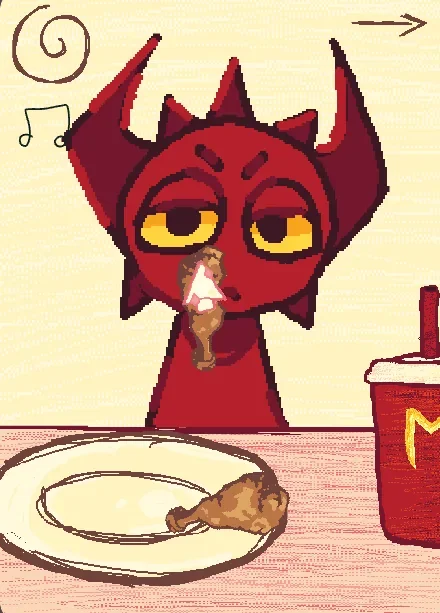
Dragging an oversized piece of fried chicken toward a red, half-lidded character and watching him lazily chew is the core rhythm of Feed Raddy Sprunki Mukbang. Created by @Raddtherabiesdude, this interactive feeding showcase abandons traditional arcade pressure—there are no ticking clocks, hunger bars, failure states, or point tallies. Instead, the game presents an eight-table tasting menu where players manually deliver burgers, sweets, ramen, and soft drinks to Raddy, watching his facial frames shift with each bite.
The lack of strict goals means the experience plays less like a structured puzzle and more like a digital ASMR toy. Raddy sits at the center of every scene against a neutral backdrop, maintaining a permanently unimpressed expression that contrasts with the exaggerated eating animations triggered by contact. Because every dish can be eaten, ignored, or reset at will, progress is entirely user-driven, relying on curiosity rather than objective completion.
 4 Game Screenshots

An Eight-Course Spread of Fast Food and Oddities
Rather than relying on simple color swaps, Feed Raddy Sprunki Mukbang structures its content across eight distinct tables, accessible in sequence or through forward and backward navigation controls. Each scene introduces a fresh assortment of food, beverages, and tableware, shifting the visual aesthetic and audio cues as players progress through the meal set:
- First Course: Establishes the basic drag-and-drop layout with a fast-food meal containing a burger, two pieces of fried chicken, and a red soda.
- Second Course: Shifts toward dark grain or dessert bowls, chocolate-dipped sticks, and a pink milkshake.
- Third Course: Piles the table with fried rings and French fries alongside a serving of spicy ramen.
- Fourth Course: Brightens the color palette with fresh strawberries and pink skewered sweets.
- Fifth Course: Focuses on frozen treats, pairing vanilla and chocolate ice creams with a glass of lemonade.
- Sixth Course: Revisits noodles in a ramen-centric layout that gives chopsticks a more active role.
- Seventh Course: Features green canned drinks alongside a single rice ball.
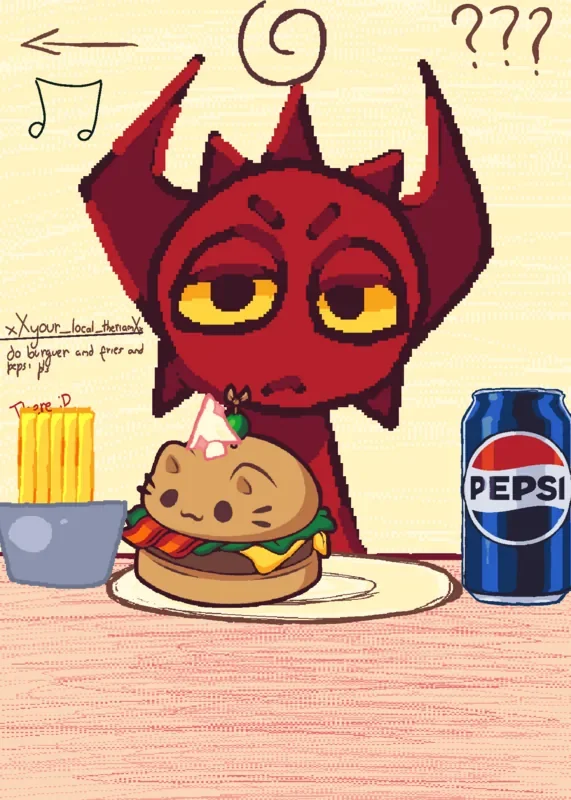
- Eighth Course: Replaces conventional dining with a surreal final spread containing Pepsi, scattered fries, questioning decorations, and a burger-like creature that emits a laser-style reaction when tapped.
The transition from familiar fast food to dessert skewers, noodle bowls, and eventually a laser-firing burger creature gives the progression a playful escalation. While the underlying feeding objective remains unchanged across scenes, discovering how individual dishes act keeps the simple drag-and-drop routine engaging throughout the run.
Interaction Rules, Chopstick Mechanics, and Controls
Directing the action requires simple mouse or touch interactions, relying on clicking or dragging objects across the table surface. However, the game offers no formal tutorial, food labels, or onscreen text instructions, leaving players to discover specific mechanics through trial and error.
| Action | Input | Result |
|---|---|---|
| Feed Raddy | Drag food or drink onto Raddy | Triggers eating sound cue and chewing animation; consumed item disappears |
| Use Chopsticks | Drag chopsticks to ramen noodles, then to Raddy | Collects noodles onto chopsticks, plays an extended chewing response, and resets utensil |
| Poke Character / Props | Tap or click Raddy or special objects | Triggers unique facial expressions, visual effects, or joke reactions |
| Course Navigation | Click forward/back arrows | Moves between the eight available table spreads without requiring plate completion |
| Scene Reset | Click restart control | Restores all food items and tableware to their default table positions |
Standard food items clear immediately upon completing their chewing sequence. The primary mechanical shift occurs during the ramen tables, where dragging the noodle bowl directly to Raddy produces no result. Players must first hover the chopsticks over the ramen to collect a portion—changing the chopstick graphic—before bringing the loaded utensil to Raddy's mouth. This multi-step sequence is not explicitly explained in the interface, making it one of the few interactions that requires deliberate experimentation.
Beyond feeding, players can tap Raddy directly at any time to trigger alternative expressions and minor visual effects. Similar interactive jokes appear in the final course, where clicking the unusual burger creature produces a laser beam visual rather than a standard eating animation.
Visual Character, Audio Landscape, and Player Observations
Visually, the game mixes hand-drawn character art with varied food sprites. Raddy's bright red body stands out clearly against pale background walls and light tablecloths. His half-lidded eyes and flat mouth deliver solid comedic timing when suddenly replaced by wide-mouthed chewing frames. Food illustrations vary in detail: the burger displays visible lettuce and patty layers, fried chicken pieces feature textured shading, and frozen desserts appear in distinct glass bowls.
This mix of visual approaches gives the project an eclectic sketchbook feel. Community observations frequently point out this stylistic variance, with some players noting that certain food assets look like digital PNG cutouts placed over hand-drawn backgrounds. Players also highlight regional food additions across the menus, with Brazilian audience members specifically identifying items reminiscent of brigadeiro, guaraná soda, and coxinha.
Sound is central to establishing the mukbang format. Food collisions call distinct crunching, slurping, gulping, or pickup cues rather than relying on a single generic bite noise. Background audio relies on looping music tracks—including the 'Misery' track recognized by players—which help set a relaxed tone for each table. However, when a spread contains multiple identical items, such as rows of canned drinks or dessert sticks, repeating the same audio cue in rapid succession can become noticeable.
Unrestricted Progression and Evaluative Summary
The absence of rigid rules defines the overall structure. Because the forward navigation control remains active at all times, players are free to sample a single strawberry and immediately jump to the eighth table, or meticulously clear every item from every plate. There are no score tracking displays, meal counters, or summary screens upon reaching the end of the eighth course. Once the final burger creature interaction is complete, players can use the navigation controls to travel back to earlier menus or reset their favorite tables.
This open structure makes Feed Raddy Sprunki Mukbang an accessible browser toy for quick, low-stress interactions. As part of the broader index of casual titles cataloged on Fortcade, its value lies in visual novelty and playful sound design rather than mechanical challenge or long-term progression. Players seeking restaurant management mechanics, timed scoring, or cooking recipes will find the depth minimal, but those looking for a lighthearted interactive mukbang spread will find plenty of personality across its eight hand-crafted tables.


![AY in Noggin's RL, GL Game Redux [ 40 Players ] game cover](https://fortcade.com/wp-content/uploads/2026/10/ay-in-noggin-s-rl-gl-game-redux-40-players-225x300.webp)