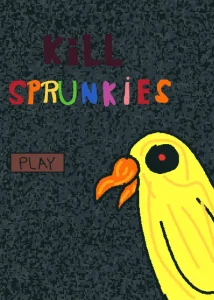
Limon Killed Sprunkies 2 (Baldi Basic) is a compact interactive horror short that drops the familiar yellow bird, Limon, into a surreal classroom setting with clear Baldi’s Basics energy. It is not a long adventure, and it is not trying to be one. Instead, it works more like a tightly packed fan-made chapter: quick to start, easy to understand, and built around a small number of strange scenes.
Compared with its predecessor, Kill Sprunkies But You’re a Bird!, this sequel feels more focused and less sprawling. The first game was broader and more node-heavy, while this one is shorter and more direct, with only a handful of cards and one active room segment. That makes it a better fit for players who want a bite-sized weird game rather than a larger branching short story.
If you like Sprunki fan projects, Baldi-style parodies, or browser games that lean into glitchy horror humor, this one is easy to try for a few minutes. Just don’t expect deep progression or a long list of systems — this is a small, concentrated experience with a very specific mood.
 3 Game Screenshots

What Kind of Game Is This?
This is an interactive horror short with light exploration elements. Most of the game is driven by scene switching: you click through cards, enter a classroom-themed chapter, and watch Limon’s chaotic path unfold. The actual gameplay is very light, but the presentation gives it enough structure to feel like a proper short chapter instead of a simple slideshow.
The goal is not to solve puzzles, farm points, or clear a long stage list. Instead, the game wants you to move through its scenes, see the weird crossover setups, and follow the flow from menu to classroom to ending. It has the feel of a fan-made episode more than a traditional adventure game.
One important detail is that this sequel also links back to the first game through a portal. That makes the two projects feel connected, almost like chapters in the same odd little universe.
Controls and Gameplay
The controls are extremely simple, which is part of the appeal.
| Action | Control | Result |
|---|---|---|
| Start the game | Click the Play Button | Enter the main flow |
| Advance scenes | Click cards or nodes | Move to the next scene |
| Return to the prequel | Click the Chapter 1 portal | Jump back to the first game |
| Move Limon | Directional keys / joystick | Walk through the classroom area |
| Trigger interactions | Approach targets | Auto-collect or advance the scene |
Most of the game is point-and-click. You move from one scene card to the next, and the structure is easy to follow even if you only have a few minutes to spare. The one more active segment is the classroom room, where you control Limon directly and move through the area rather than just watching events happen.
That room sequence is the part that gives the game its only real sense of motion. It is still simple, but it breaks up the card-based flow enough to keep the experience from feeling completely static.
Flow, Length, and Content
This is a very short game. The whole structure is compact enough that you can understand it almost immediately, and finish it in just a few minutes.
What stands out here is how little it tries to overcomplicate itself. The game is built around a small number of scenes, a classroom chapter, and a short interactive sequence. There is no heavy branching system, no long chain of puzzles, and no large-scale progression loop. That makes it easy to play, but it also means the experience ends quickly.
Compared with the first game, this sequel is more like a chapter than a collection. That is probably the best way to think about it. The first title had a wider spread of cards and character paths, while this one narrows its focus and keeps the experience more linear.
For some players, that will be a strength. It keeps the pacing clean and prevents the game from overstaying its welcome. For others, it will feel a little too brief, especially if they were hoping for more branching or more room-to-room gameplay.
What Makes It Memorable
The most interesting thing about Limon Killed Sprunkies 2 is not any single mechanic — it is the way it combines a few small ideas into one sharply defined mood.
The classroom setting is probably the biggest shift from the first game. By moving Limon into a Baldi-inspired school space, the game gets a more coherent horror-parody identity. The environment feels familiar enough to recognize immediately, but strange enough to keep the fan-game energy alive.
The direct link back to the prequel is another nice touch. Instead of pretending this sequel exists on its own, the game folds the earlier chapter into the structure. That gives the whole project a slightly more deliberate feel, as if the developer wanted players to see this as part of a small series rather than a one-off.
The playable room segment also matters more than it first appears. It is short, but it gives the player something to do beyond clicking through scenes. That small shift in control helps the sequel feel more interactive and less like a pure visual short.
And finally, the game’s glitchy presentation is doing a lot of work. The static, sharp contrasts, and odd scene transitions all support the same off-kilter tone. It is not polished in a mainstream way, but it does have a consistent identity.
Visuals and Sound
This is a lo-fi horror-style project, not a polished commercial release. The menus and transitions lean into noise, contrast, and an unstable digital look, which helps immediately establish the game’s strange tone. Once the classroom appears, the visuals echo Baldi’s Basics with a stripped-down schoolhouse vibe that fits the parody well.
The game’s visual style works because it is committed. It does not try to be soft, colorful, or clean. Instead, it uses a rough, glitchy presentation that makes the whole thing feel intentionally unsteady.
The sound design follows the same idea. It is not a layered soundtrack-heavy game. The audio is used more for cues, atmosphere, and occasional punchy moments than for long-form music or ambient world-building. That matches the short format nicely, even if it means the game does not have a lot of audio depth.
Pros and Cons
Pros
- Very easy to start and play in a browser.
- Short, focused structure keeps the pacing clean.
- Clear connection to the first game adds continuity.
- The classroom chapter gives the sequel a stronger identity.
- The one interactive room segment gives the player a bit more direct control.
- The glitchy horror-parody style is consistent throughout.
Cons
- Extremely short; it can be finished in just a few minutes.
- Less branching variety than the first game.
- The active gameplay section is interesting, but not developed in depth.
- New players may not care as much if they have no context for the prequel.
- It feels more like a chapter than a full standalone experience.
Who Should Play This?
This game is a good fit for:
- Players who like Sprunki fan games and crossover parody projects.
- Fans of Baldi-style horror humor.
- People who enjoy short browser games with a strange atmosphere.
- Players who already liked Kill Sprunkies But You’re a Bird! and want the next chapter.
- Anyone looking for a quick, unusual game to try during a short break.
It may not be the best choice for players who want:
- Long playtime
- Deep puzzle mechanics
- Multiple endings
- Heavy exploration
- A more complete standalone story
Final Verdict
| Category | Rating | Brief Summary |
|---|---|---|
| Design | ★★★☆☆ | Simple, but the chapter structure is clean and easy to follow. |
| Controls | ★★★★☆ | Very intuitive, with little to learn. |
| Content | ★★☆☆☆ | Extremely short, but tightly arranged. |
| Atmosphere | ★★★★☆ | Strong glitch-horror identity with a clear Baldi influence. |
| Overall | ★★★☆☆ | A compact sequel that works best as a short fan-made chapter. |
Limon Killed Sprunkies 2 (Baldi Basic) is not trying to be a huge game, and that is exactly why it works as a small one. It takes the yellow-bird chaos of the first game and compresses it into a shorter, more focused chapter with a classroom twist. The result is fast, odd, and easy to understand.
Its biggest strength is clarity: it knows what it wants to be, and it gets there quickly. Its biggest limitation is also clear: there is not much of it. If you want a longer game, this will probably end too soon. But if you are in the mood for a brief, strange browser chapter with a strong fan-game personality, it does the job nicely.
If you enjoyed the prequel, this is worth a look. If you just want a quick, glitchy little horror parody in your browser, it is easy to recommend for a few minutes of play.