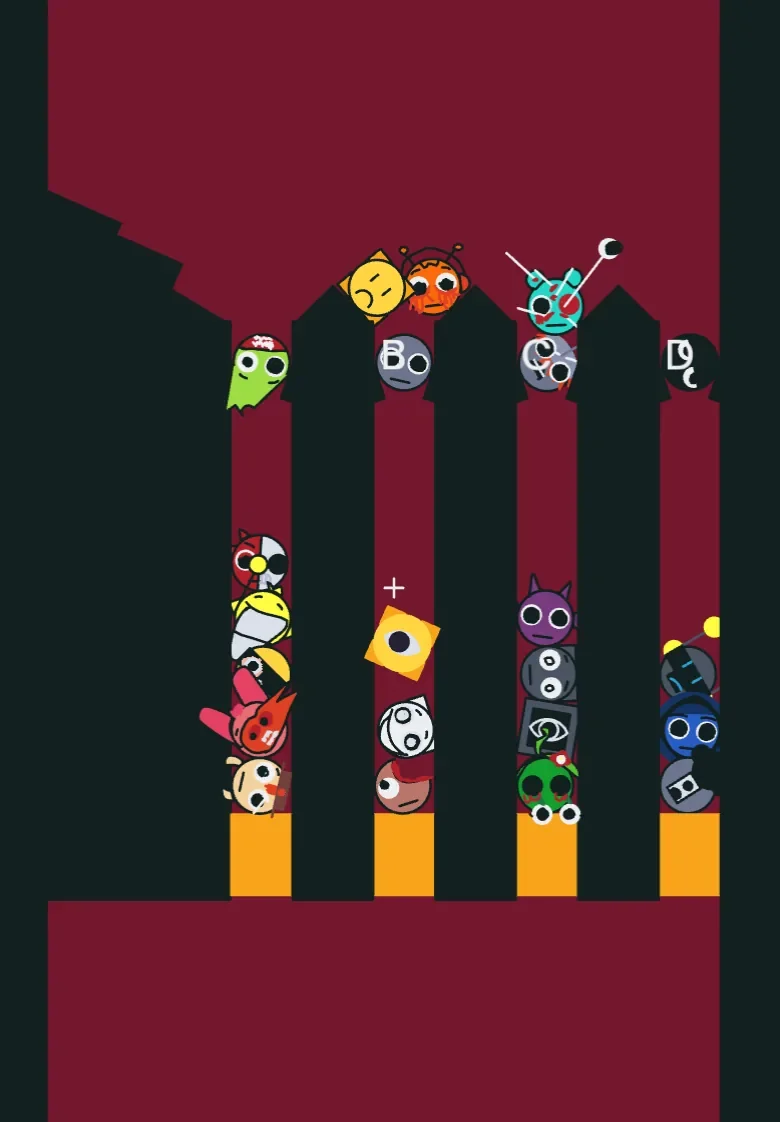
Packing roughly twenty Sprunki characters into a tight starting chamber, Sprunki Marble Race: Who Will Win? immediately transforms familiar faces into bouncing physics marbles. Rather than putting players directly behind the wheel of a single contestant, creator @gafin_rafasya sets up a towering vertical obstacle course where gravity, collision physics, and optional player intervention dictate who reaches the finish line. The racers start crammed together, forming unstable towers of spinning faces before spilling through four funnel entrances marked A, B, C, and D.
 3 Game Screenshots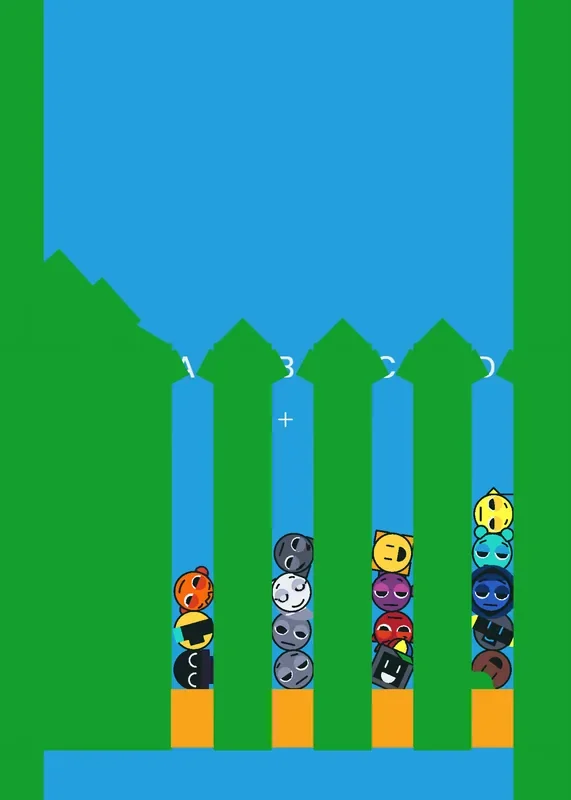
Gravity, Obstacles, and Channel Traffic Jams
Once the marbles enter the main track, they descend through a long, multi-stage vertical course filled with varied mechanical obstacles. Fast and slow rotating paddles can split tight clusters of racers, knock leaders backward, or launch trailing marbles into open lanes. Dense obstacle grids, moving horizontal bars, and alternating split paths keep momentum unpredictable. A racer leading one section can easily get trapped against a barrier, while a marble buried deep in the pack might catch a deflection and shoot ahead.
Because the course features narrow channels and tight choke points, traffic jams are frequent. Marbles regularly pile on top of one another or become wedged inside starting chambers and narrow passages for extended periods, sometimes leaving competitors stuck until physical collisions resolve the pileup or the player steps in.
Player Intervention and Spectator Controls
While the physics engine can run the event automatically, players have direct tools to manage, troubleshoot, or alter the race:
| Action | Effect |
|---|---|
| Tap removable barriers | Releases racers into the next course section |
| Drag a Sprunki marble | Repositions, rescues, or manually moves a racer |
| Use movement controls | Pans the spectator camera down the vertical track |
| Tap transition racer | Switches the race card to the horror variant |
The ability to drag marbles adds an interactive sandbox element to the observation format. Players who want an unaltered simulation can leave the racers untouched and only remove gates when necessary. However, because marbles can remain stuck in tight passages for long periods, manual intervention often becomes practical. Many players actively use the drag feature to rescue trapped favorites or manually rig the outcome, dragging preferred Sprunkies straight to the 1st-place podium while dropping disliked competitors into the back of the pack.
The vertical nature of the track presents an immediate navigation hurdle. Because the entire course is significantly taller than the visible play screen, players must use the movement controls to pan the camera down the track alongside the falling marbles. The game provides no instructions explaining camera movement or barrier functions, which often leaves new players waiting passively at the starting chamber without realizing they need to scroll down to follow the event.
Normal and Horror Variant Cards
The project features two playable race cards. The primary card uses a bright blue-and-green color scheme paired with standard, colorful Sprunki character artwork. The secondary card shifts to a dark red-and-black presentation featuring horror-styled character designs. Mechanically, the horror variant reuses the same underlying course layout and obstacle structures, functioning as an atmospheric rematch rather than a completely new track layout.
Discovering the horror mode is one of the game's least transparent features. Accessing it requires tapping one specific character on the standard race card, but no tutorial or visual cue points this out. As a result, players frequently trigger the horror mode by accident when attempting to interact with nearby marbles, causing confusion about why the visual style suddenly changed or how to return to the standard race.
Course Presentation and the Unmarked Finish
Visually, character faces remain readable even when spinning rapidly down the track. The track environments, however, are minimal, relying on flat green or dark walls against plain backgrounds. The lack of decorative section markers, crowd animations, or start and finish banners gives the long track a basic aesthetic, though it keeps physical collisions readable.
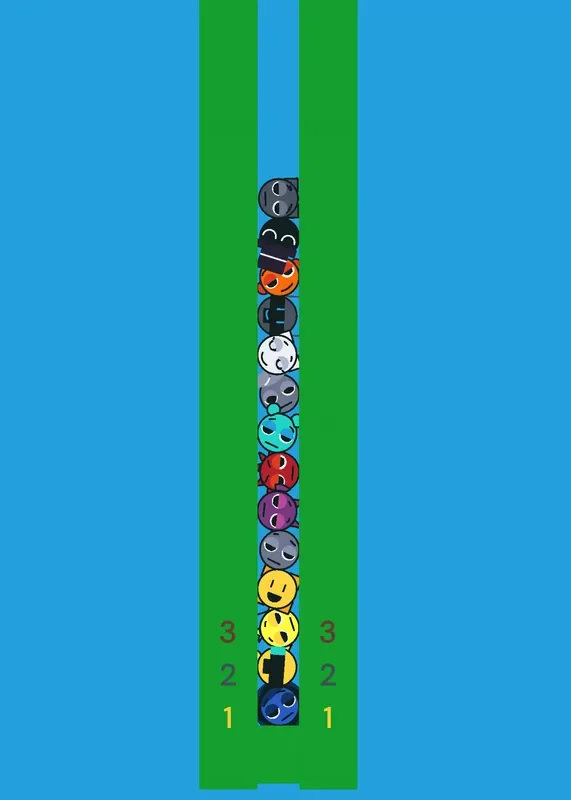
The end of the race suffers from similar communication gaps. While the bottom of the course features a numbered podium for 1st, 2nd, and 3rd place, there is no official victory screen, race timer, ranking banner, or celebratory sound effect when marbles land. Players must simply watch which racers roll into and settle around the numbered positions. This missing declaration can leave players uncertain whether a race has officially concluded or if multiple marbles occupying the podium area represent a tied result.
On Fortcade, Sprunki Marble Race: Who Will Win? works best as a flexible physics playground rather than a strict competitive simulation. Its mix of autonomous marble collisions, recognizable cast members, and direct drag controls provides simple spectator entertainment, provided you are willing to act as both camera operator and race director to keep the marbles moving down the track.