A scarf-wearing stickman accelerating across flat ground quickly gives way to timed leaps over spike beds, precision stomps on moving enemies, and high routes lined with collectibles. In Stick Run: Wasteland Adventure, platforming relies on deliberate movement mechanics rather than instantaneous speed. The protagonist builds horizontal momentum gradually, and holding the jump input extends both vertical height and jump distance. This variable jump control transforms simple obstacles—such as stacked blocks or raised coin formations—into tests of timing where short taps clear low hurdles and sustained presses reach higher ledges.
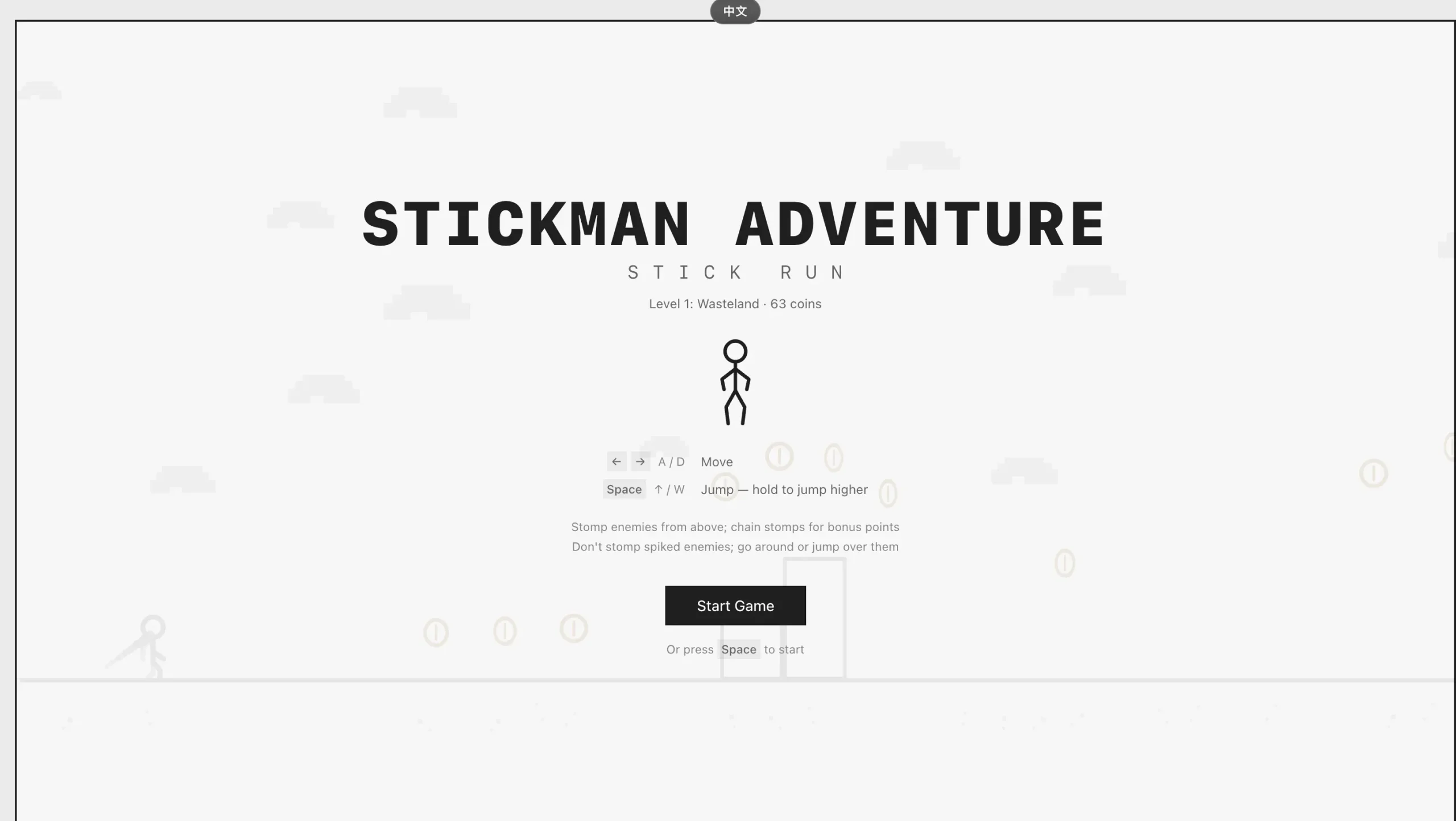
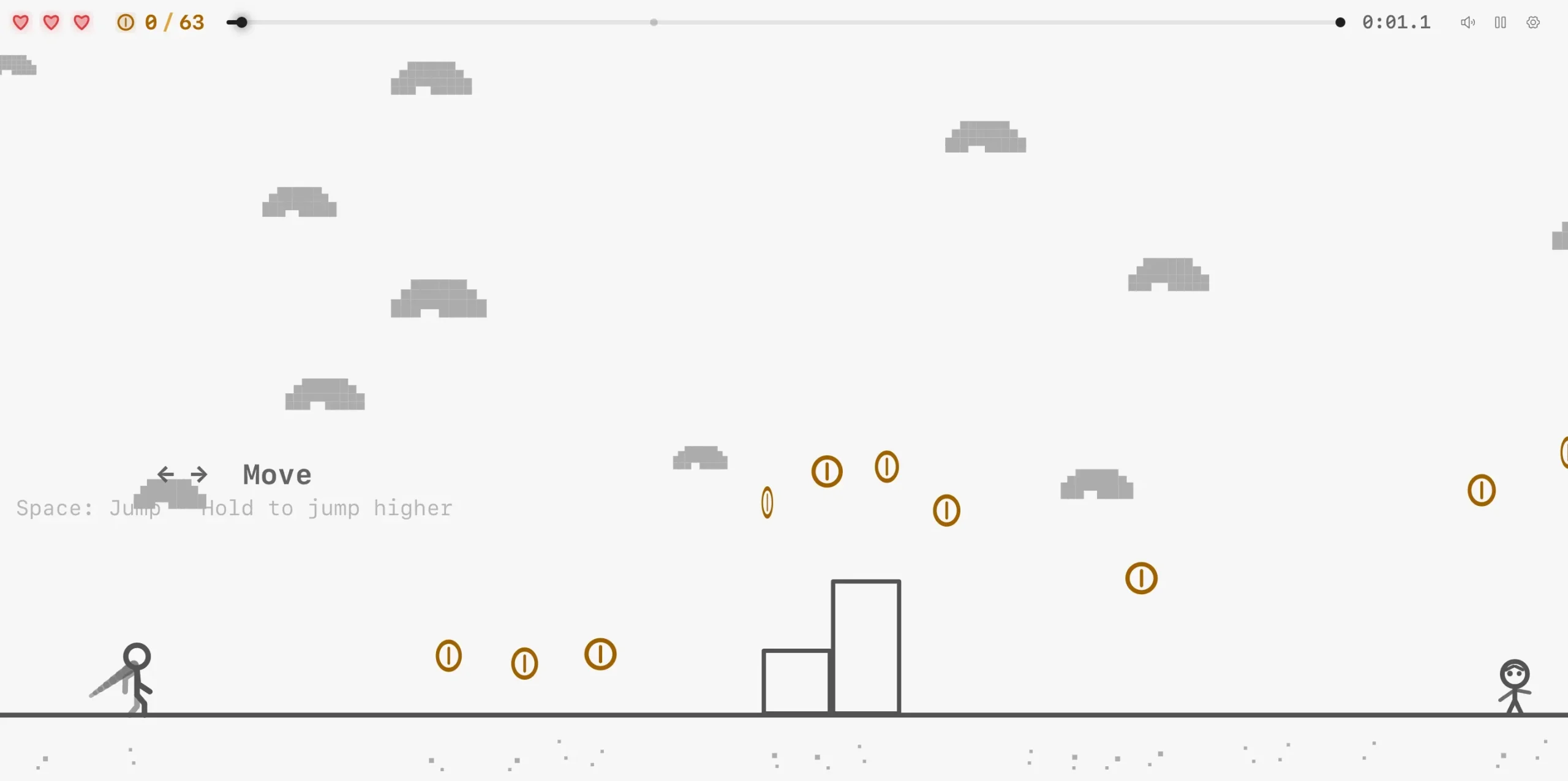
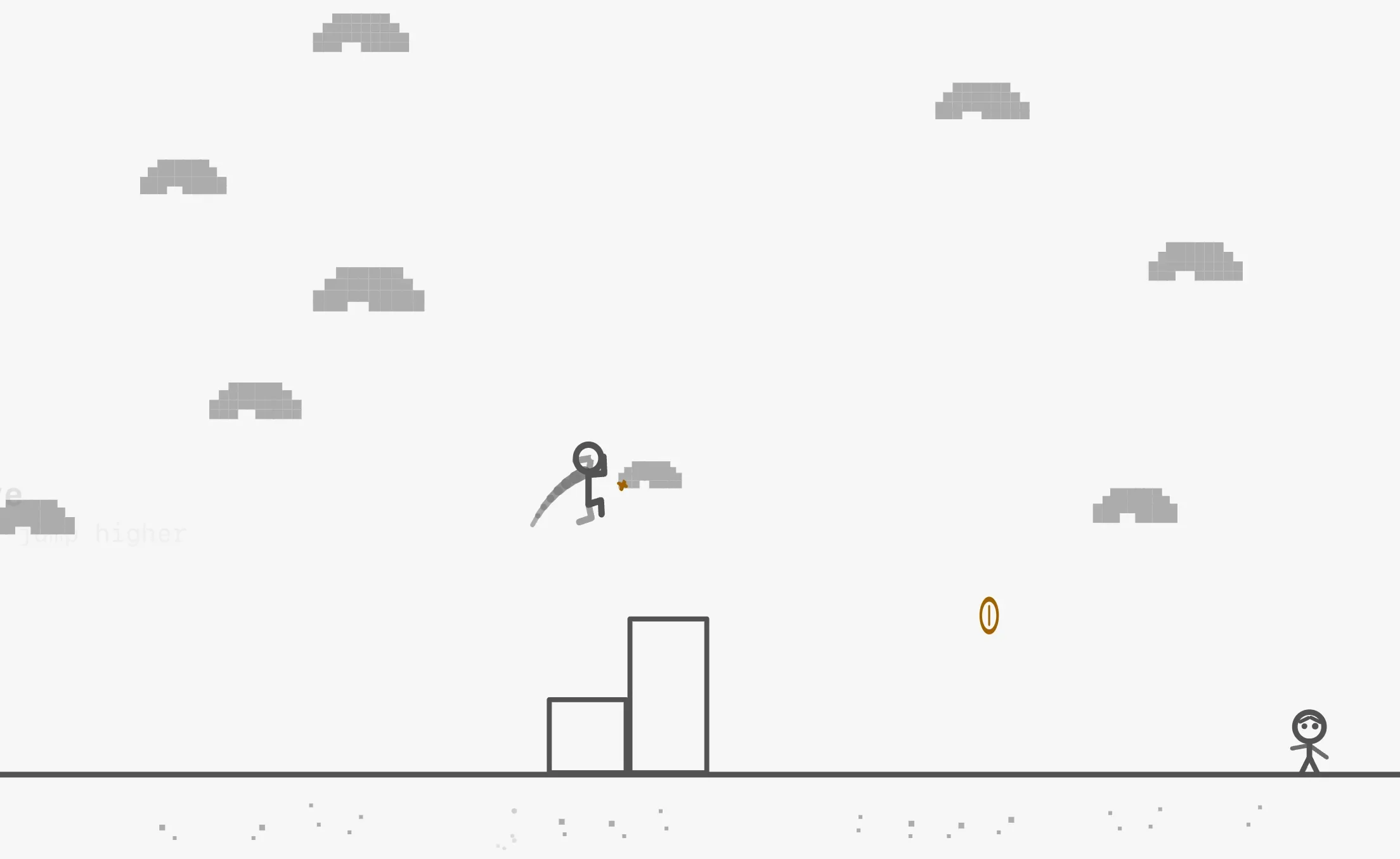
The game, created by @ZaynHao, presents its single playable course as "Wasteland" while retaining visible "STICK RUN" branding on its interface. Navigation relies on straightforward keyboard inputs or dedicated touch controls:
| Action | Input | Result |
|---|---|---|
| Move | Left / Right arrows or A / D | Run and build horizontal speed |
| Jump | Space, Up arrow, or W | Jump; hold to gain additional height |
| Pause | P or Escape | Open or close the pause screen |
| Restart | R | Restart the current run |
| Mute | M | Toggle game audio |
Mobile touchscreen users receive on-screen left, right, and jump buttons, paired with a prompt asking portrait users to rotate their device into landscape orientation for the wide 16:9 view. Throughout the run, the top interface displays three real-time counters—collected coins, overall level progress, and elapsed time—alongside three heart icons tracking remaining health. Taking repeated damage from hazards or falling beneath the terrain depletes health, resulting in a death and immediate respawn.
Wasteland distributes 12 active enemies across its obstacle course: seven ground walkers, three flying creatures, and two spiked enemies. Landing directly on a regular enemy's head defeats it and triggers an upward bounce. Skilled players can turn this bounce into consecutive stomps, chaining hits without touching the ground to build a score multiplier that starts at 100 points for the first defeat and scales with each subsequent hit. However, spiked enemies disrupt this rhythm because landing on them causes damage rather than a bounce. Static spike beds and flying enemies further complicate jump trajectories, introduced through brief environmental hints rather than a separate tutorial screen.
In the second half of the level, the terrain introduces three moving platforms, tiered block structures, and a spring that launches the stickman toward elevated upper routes holding additional coins. To prevent late mistakes from erasing all progress, a checkpoint positioned just before the midpoint updates the respawn location. Coins collected prior to dying remain saved, ensuring that players learning the timing of moving platforms can still complete the course.
Visual presentation can be toggled at any time using a compact settings panel that supports both English and Chinese text. The default "Offline Dino" mode features a pale background, pixel-like clouds, thin black terrain, and minimal brown or red accents, offering clear silhouette contrast reminiscent of classic offline browser runners. Switching to "Moonlit Blueprint" shifts the course into a dark navy landscape lit by glowing blue platform edges, gold coins, stars in the sky, and an orange, purple, and pink color scheme for enemies. The Moonlit Blueprint mode also adds a synthesized looping soundtrack, complementing the action-specific generated sound effects for jumping, stomping, taking damage, triggering the spring, and reaching the finish flag that both modes share.
Reaching the finish line opens a results panel evaluating overall performance. The game records completion time, coin count, total deaths, maximum stomp combo, and cumulative stomp score before awarding a letter grade:
- S Grade: Requires a completely deathless run while gathering nearly all 63 coins.
- A Grade: Permits one death while still requiring most coin collectibles.
- B Grade: Awarded for collecting at least half of the level's coins.
- C Grade: Given for reaching the end with a minimal coin total.
This grading framework gives the single level strong replay value, shifting the goal from simple survival to route optimization and stomp execution. The primary limitation of the current version is its scope. Although the title screen labels Wasteland as "Level 1," there are no secondary levels, level selection menus, or boss encounters available. As a refined single-course platforming challenge on Fortcade, the game delivers responsive movement and well-structured scoring mechanics, even if its underlying systems currently outgrow its single playable stage.