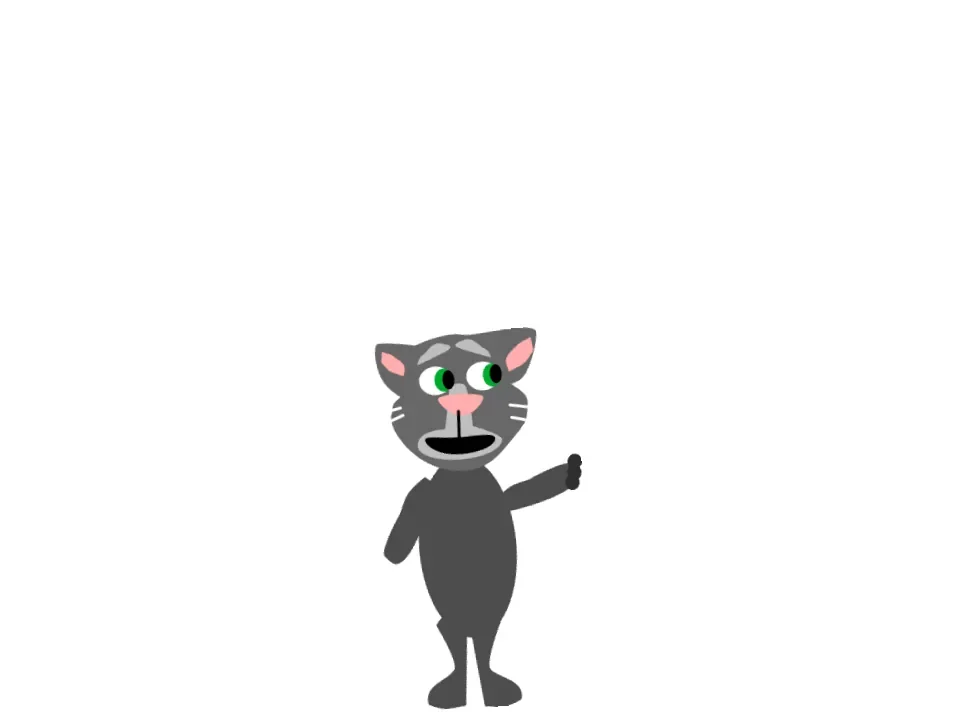
Pressing the green flag in Talking Tom Opinion on Doors launches directly into an escalating reaction clip rather than an interactive challenge. Talking Tom stands on a plain light-gray stage next to a photorealistic wooden door, smiling and gesturing as a backing rap track begins. There are no spatial choices, movement controls, puzzles, or scoring systems. Instead, the project functions entirely as a short character animation where the player's only role is to start the sequence and watch Tom become absurdly excited about a household entry point.
 3 Game Screenshots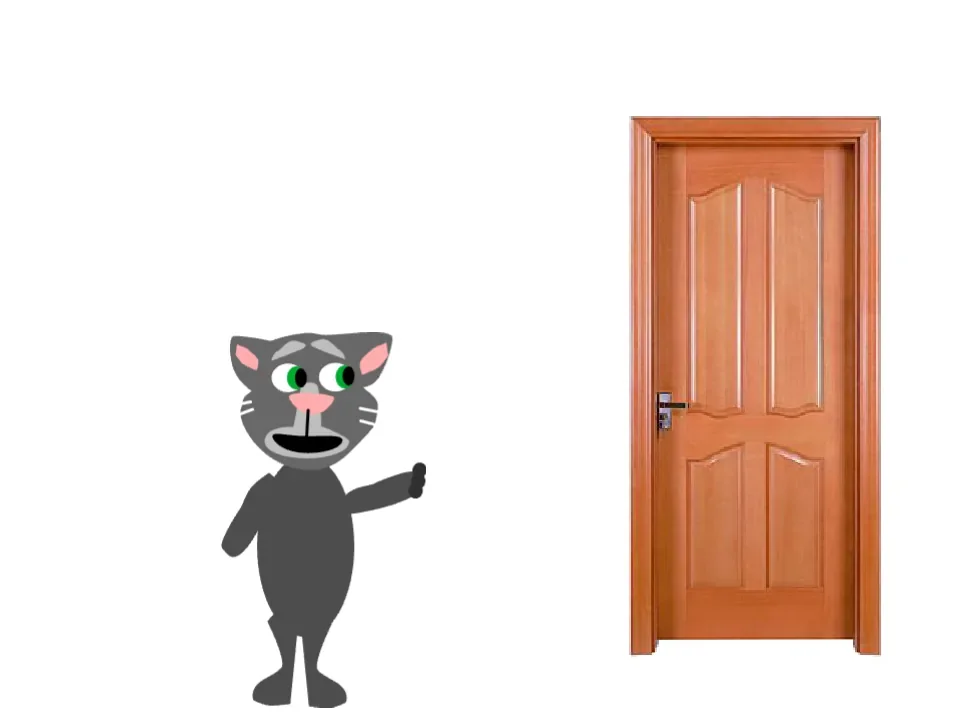
Escalation from a Plain Stage to Frantic Visuals
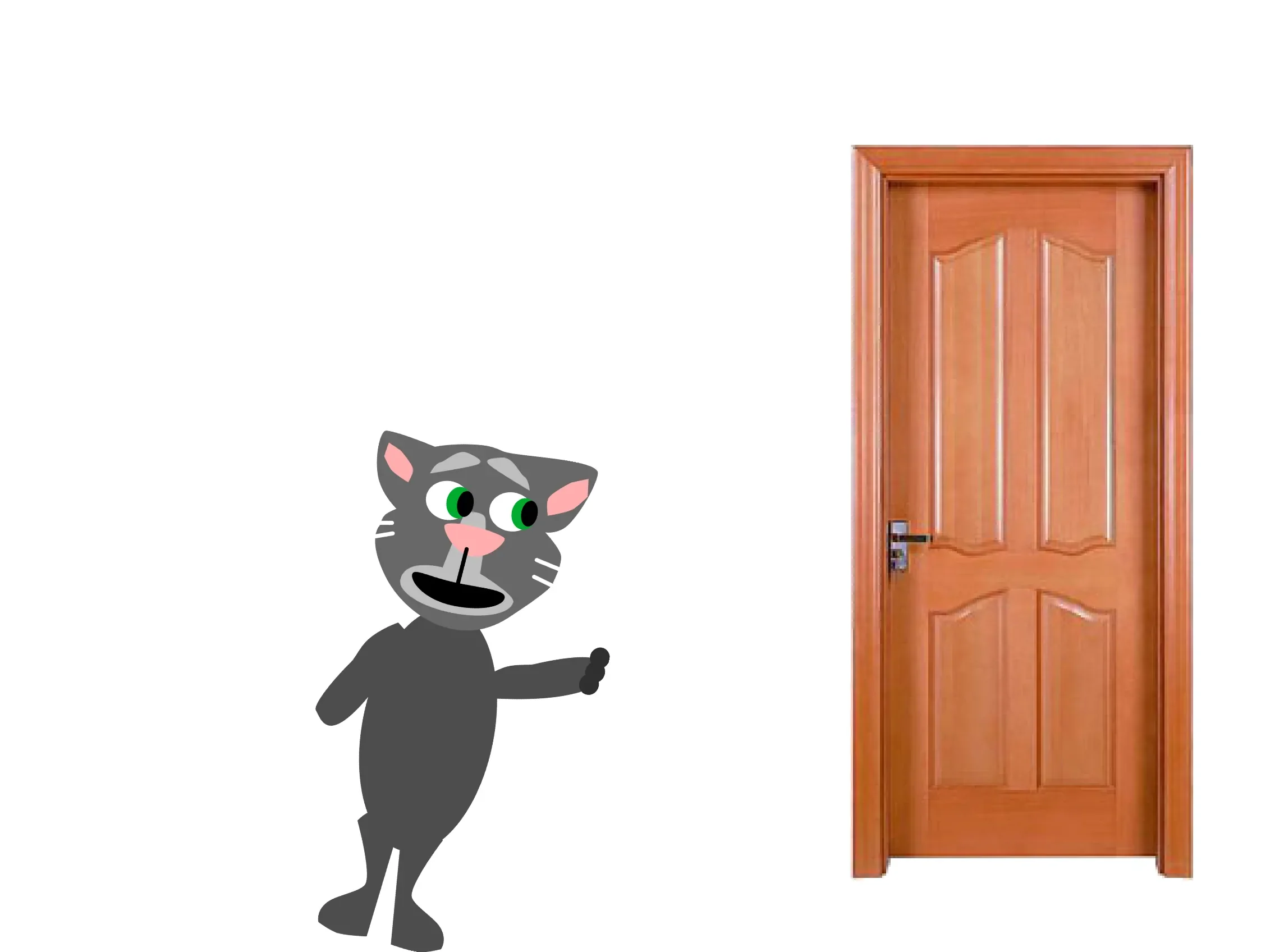
The opening moment relies on an unblended contrast between assets. Talking Tom is drawn as a simple vector character, while the wooden door looks like a cut-out photograph. This rough collage aesthetic sets up a rapid succession of visual edits. As Tom starts speaking, his body rocks from side to side. The first door rotates on its axis and disappears entirely, prompting Tom to move toward the center of the frame.
His reaction grows more exaggerated every few frames. His facial features shift, his body leans at sharper angles, and his sprite rapidly scales up to fill more of the screen. Short vocal clips, dramatic musical stings, and a rap-like rhythm overlap to build momentum behind a completely mundane object. Before the initial animation settles, a second copy of the photographic door slides into the frame from the left.
The presentation becomes increasingly frantic during this second phase. Tom's sprite cycles through rapid costume shifts, sudden size jumps, flash effects, punctuation-style impact graphics, and a brief red screen overlay. The animation deliberately uses jerky, un-smoothed movement. Because each visual burst cuts off the previous reaction before it can resolve, the joke relies almost entirely on relentless visual noise and fast pacing.
The Garfield Non Sequitur and Replay Mechanics
Instead of building toward a traditional climax or resolving Tom's evaluation of the door, the sequence cuts off abruptly. The screen transitions to a black card displaying the text: “not gonna continue this so heres Garfield singing Hine Nah Tov.” A recording of Garfield singing then repeats while the card remains static on screen. This intentionally abandoned ending drops narrative closure entirely in favor of an unexpected audio gag.
Because the main animation takes only a few seconds to run, replay value depends on catching split-second edits rather than uncovering new content. The active clip lasts just seconds, though creator uploads and video mirrors extend to 32 seconds by holding on freeze-frames and adding author branding. The controls begin and end with Scratch's standard interface:
- Green Flag: Starts or restarts the animation sequence from the beginning.
- Red Stop Button: Immediately halts playback and audio.
Clicks directly on the stage, key presses, and mouse movements produce no response from Tom, the doors, or the background. There are no hidden branches, failure states, or customizable options.
Scratch Remix History and Framing
Dating back to December 2021, the project was created by @tomybenluis11 and belongs to a specific era of Scratch remix chains. The project's source credits explicitly point to tjsimon1786’s Opinion on Doors and Mario’s Opinion on Doors as direct inspirations. A matching creator video preserved on YouTube mirrors the exact layout, timing, audio tracks, and Garfield card ending seen in the project.
Evaluating this piece on Fortcade requires treating it as an animated artifact of 2021 meme culture rather than a playable browser game. Its appeal stems from its fast timing, absurd focus, and intentionally unpolished visual style. Viewers interested in brief internet jokes will appreciate its hyperactive energy, but anyone seeking active gameplay, puzzle solving, or interactive mechanics will find the experience far too brief and completely passive.