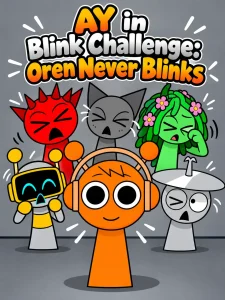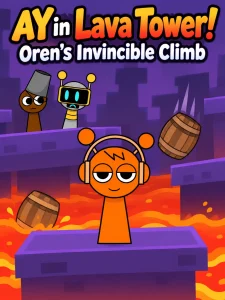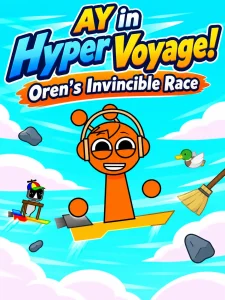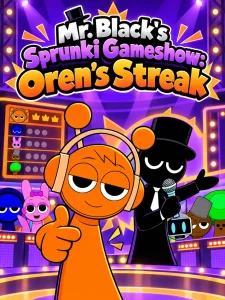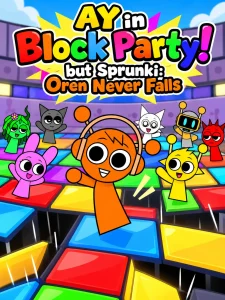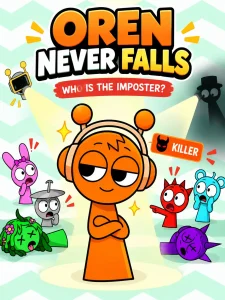
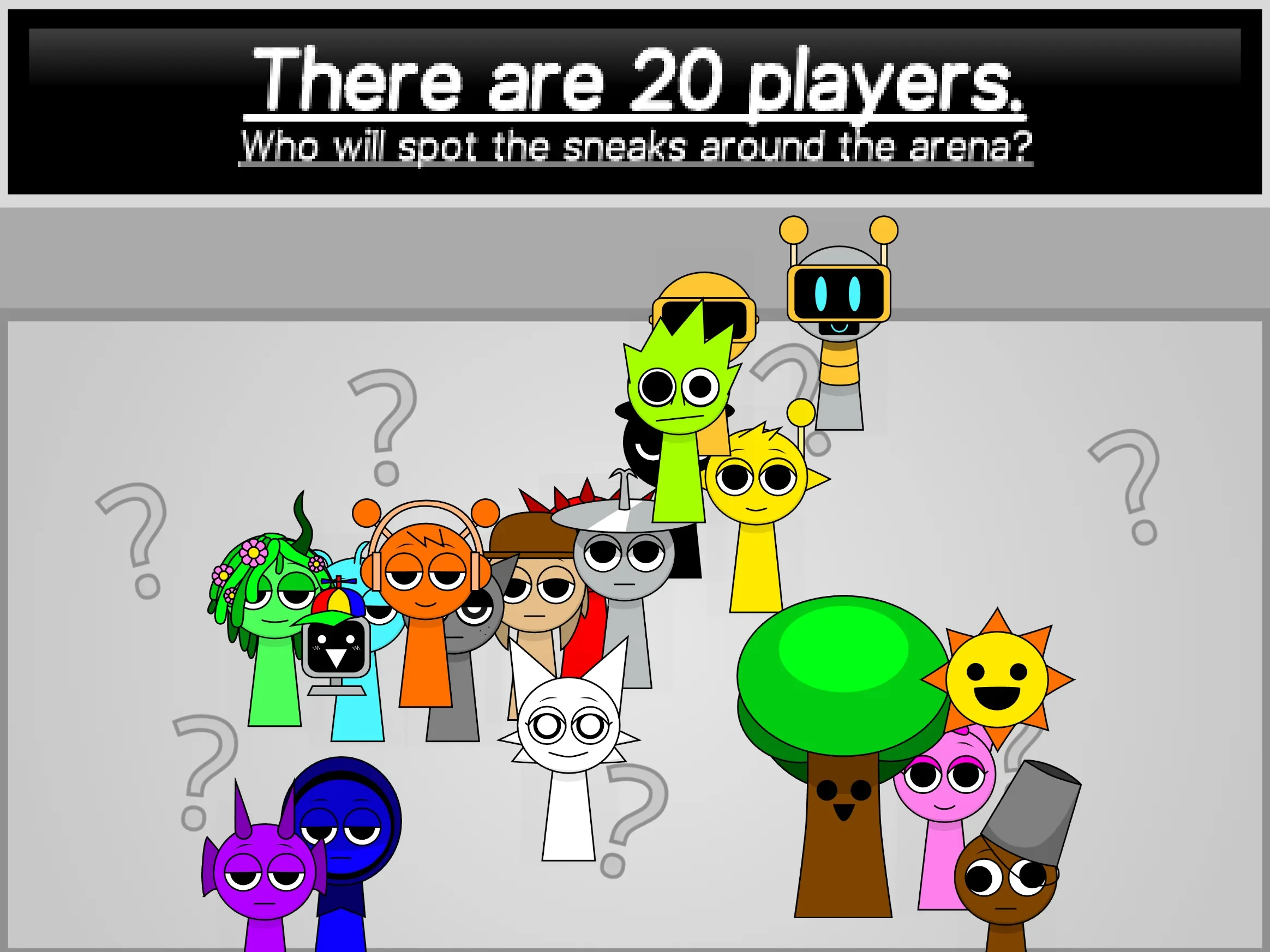
Twenty Sprunki characters line up inside a gray, Wii Sports-inspired arena beneath a backdrop filled with large question marks, ready for a hidden-sneak mystery that unfolds round by round. In AY in Spot the Sneak! Sprunkies but Oren never gets sent away as the sneak, the familiar elimination format of a search-and-catch game is disrupted by one central rule: whenever Oren is selected as the hidden sneak, the project refuses to send him away. Creator @OrenTheOrangeSprunki uses this rule to alter the expectations of an otherwise automated character show.
 3 Game Screenshots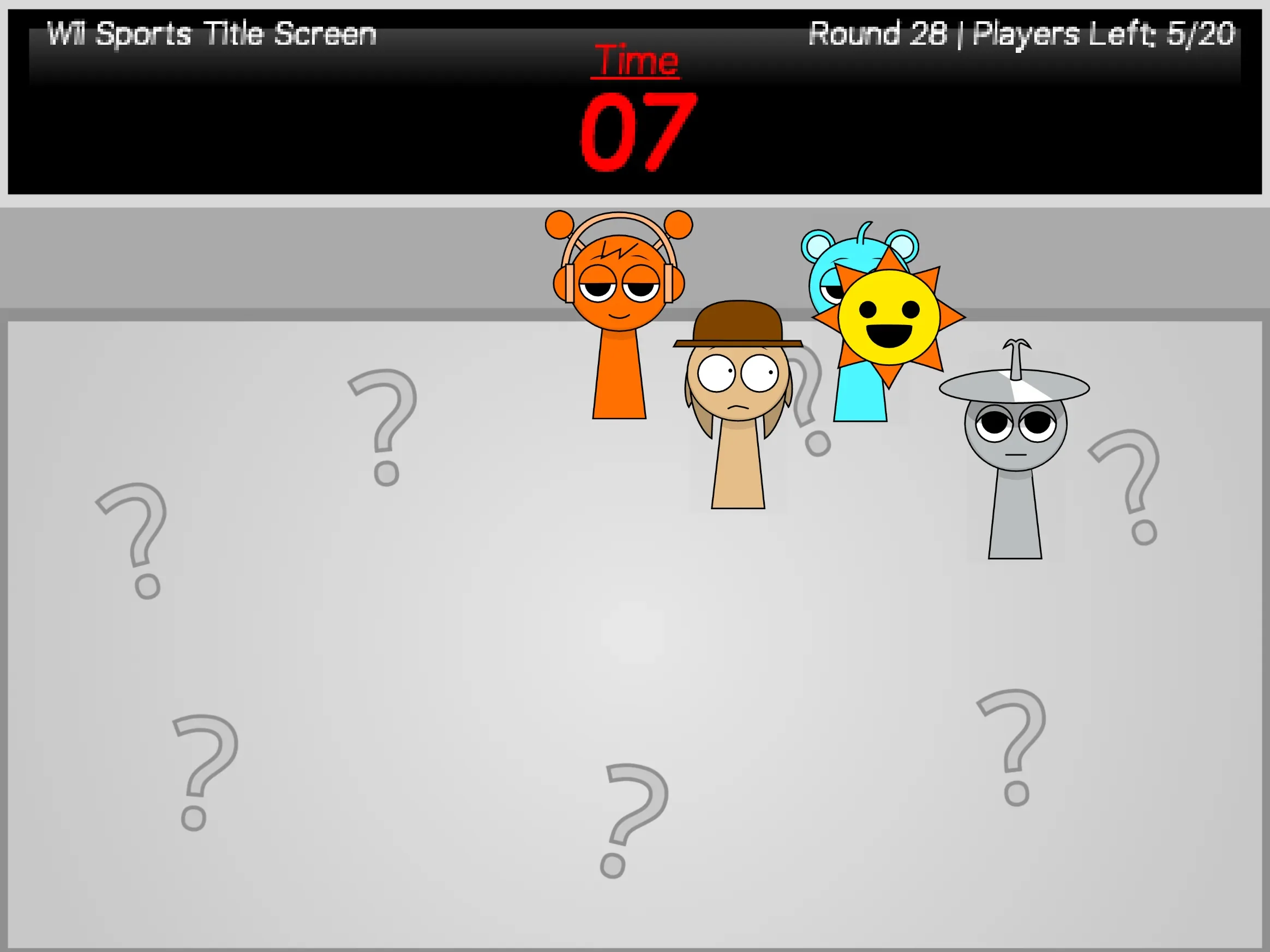
Timed Rounds and Elimination Structure
Launching the project begins with a title-card presentation featuring a large black panel at the top of the screen with white condensed lettering. An opening message declares that "There is a sneak hidden around the arena." The initial live round displays "Round 1 | Players Left: 20/20" alongside a large green START prompt. Once the sequence kicks off, the 20 contestants spread across the arena floor, standing at varying scales and positions to simulate an active search phase.
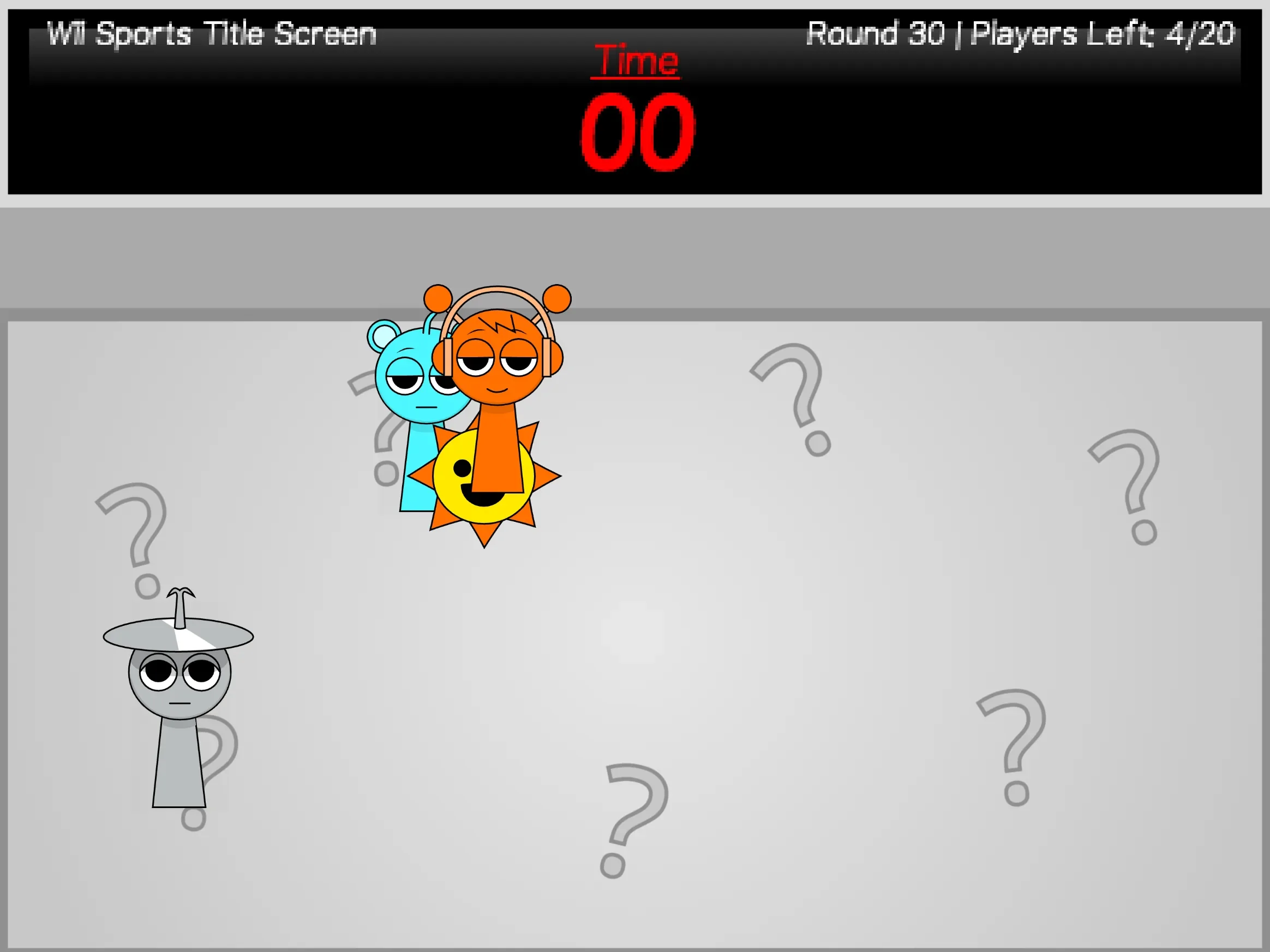
The simulation advances automatically through timed search intervals guided by visible countdown indicators, such as a prominent red "Time 09" panel. Certain timer sequences transition to a sparse, clue-like screen filled with red speech bubbles before revealing who was caught. Progression remains easy to track thanks to the persistent header counters. For example, Round 3 updates the counter to "Players Left: 18/20" while announcing "Brud was caught!" across the top panel. By Round 8, the roster shrinks to 13 players accompanied by the banner "Simon was caught!" These clear text notifications help players follow individual eliminations even when the stage grows crowded.
Visual Staging, Audio Cues, and the Oren Twist
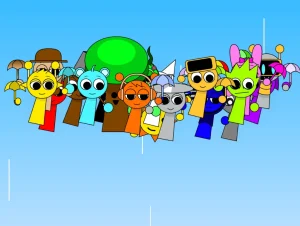
The 20-player cast comprises Oren, Raddy, Clukr, Funbot, Vineria, Gray, Brud, Garnold, Owackx, Sky, Mr. Sun, Durple, Mr. Tree, Simon, Tunner, Mr. Fun Computer, Wenda, Pinki, Jevin, and Mr. Black. Visual staging serves as the project's main graphical hook: characters stand apart across the monochrome arena during the search phases and cluster together around result cards when an elimination occurs. The quiet, gray backdrop contrasts sharply with the colorful Sprunki character designs.
Oren forms the core mechanical twist of the project. While standard rounds proceed by catching and removing hidden sneaks, assigning Oren as the sneak triggers his unique protection rule: he is never sent away upon being caught. The project reinforces this exception with dedicated presentation assets. Audio design plays an active role in building atmosphere, incorporating "Get Ready" cues, start and finish sound effects, character catch, safe, loss, and victory voices, confetti visual effects, and outcome music. Oren specifically receives separate safe, caught, eliminated, and victory sound presentations, giving his unique rule explicit sensory framing.
Interactive Limits and Viewing Experience
Despite its title implying active gameplay, the project operates as an automated mystery simulation. The only confirmed player interaction is clicking the green flag to start the Scratch project. No keyboard controls, movement commands, or suspect-selection mechanics are present; players watch the search-and-catch process unfold rather than manually pointing out the sneak.
A typical run follows a predictable loop: starting the green flag, meeting the 20-player lineup, watching a timed search round, viewing a caught contestant announcement, and repeating the process with a shrinking pool of characters. The persistent player counter creates a clear sense of momentum as numbers step down from 20/20 to 19/20, 18/20, and beyond.
Evaluating the project on Fortcade highlights its primary identity as an animated character experiment rather than a traditional deduction game. Its main limitations stem from this passive design: players cannot influence the outcome, individual characters can be difficult to track in early crowded rounds, and the underlying logic behind each catch is not always transparent. Additionally, because full test sessions did not reach a final victory screen, the ultimate winner sequence remains unverified compared to the early elimination rounds. For viewers who enjoy Sprunki character rosters and randomized elimination shows, the protected-Oren twist offers a specific, recognizable reason to watch the sequence play out.