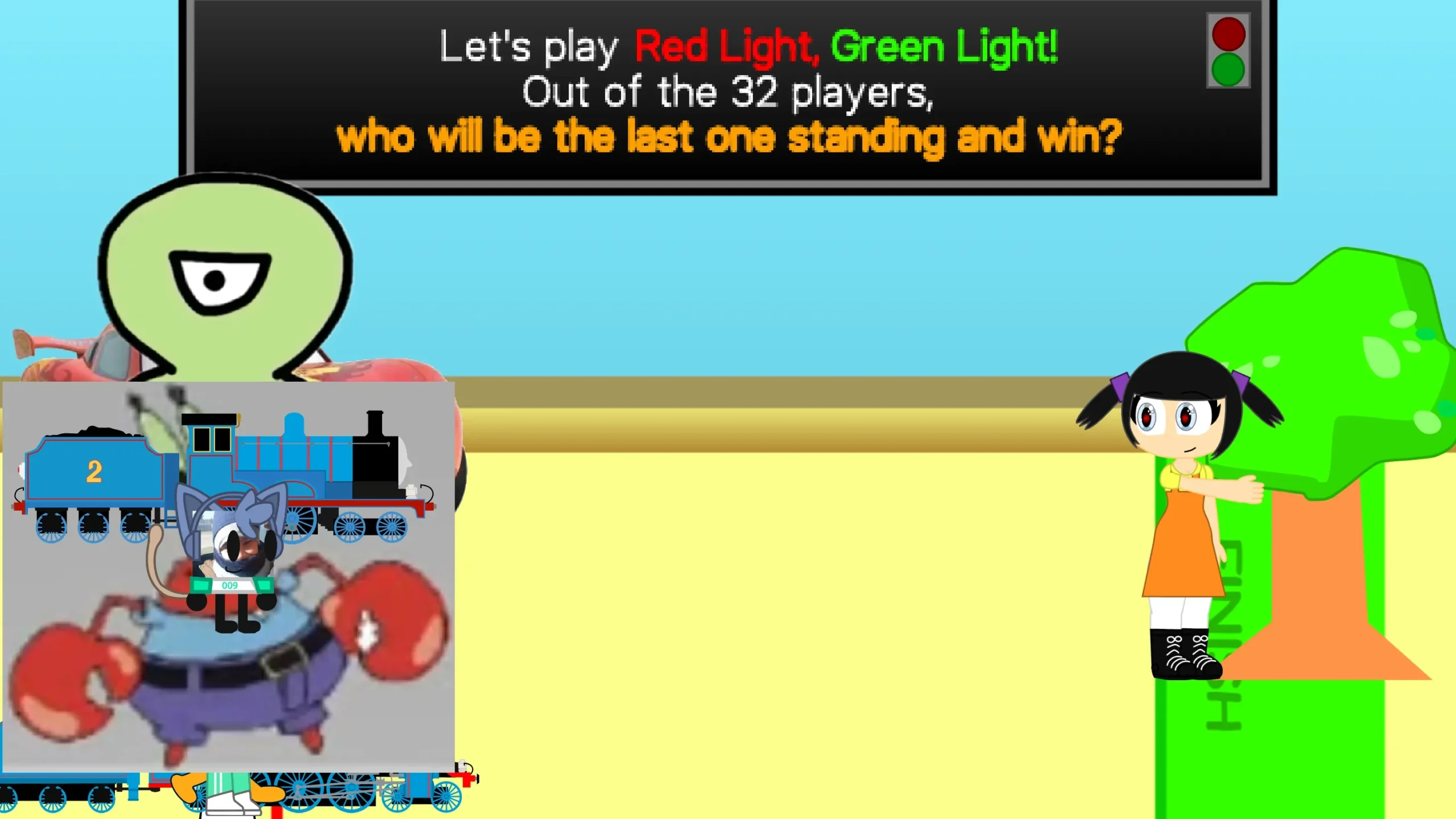
Thirty-two contestants line up behind the starting boundary while Young-Hee monitors the opposite side of the course, transforming the deadly premise of Squid Game into a fully automated character tournament. When the digital signal board flashes green, every active runner dashes forward at an independently randomized movement speed. When the light turns red, most contestants halt into waiting poses, but a few skid forward and trigger an angry shout from the host. Rather than suffering instant removal, those who fail to stop are teleported back to the far-left starting position, while the actual elimination is reserved strictly for whichever character crosses the finish line last.
Published as AY in Young Hee RL, GL Game Redux by @HtayNawSara, this automated simulation plays out across thirty-one sequential rounds. The opening roster narrows down from a 32/32 count until a single survivor wins the final head-to-head match. Because the player acts as a pure spectator without direct input over running speeds or stopping decisions, the game functions as an extended character bracket or automated marble race. Spectators watch an unpredictable series of resets, speed changes, and detailed knockout sequences unfold across a crowded track.
From Scratch Cat to McQueen: The Thirty-Two Contestant Roster
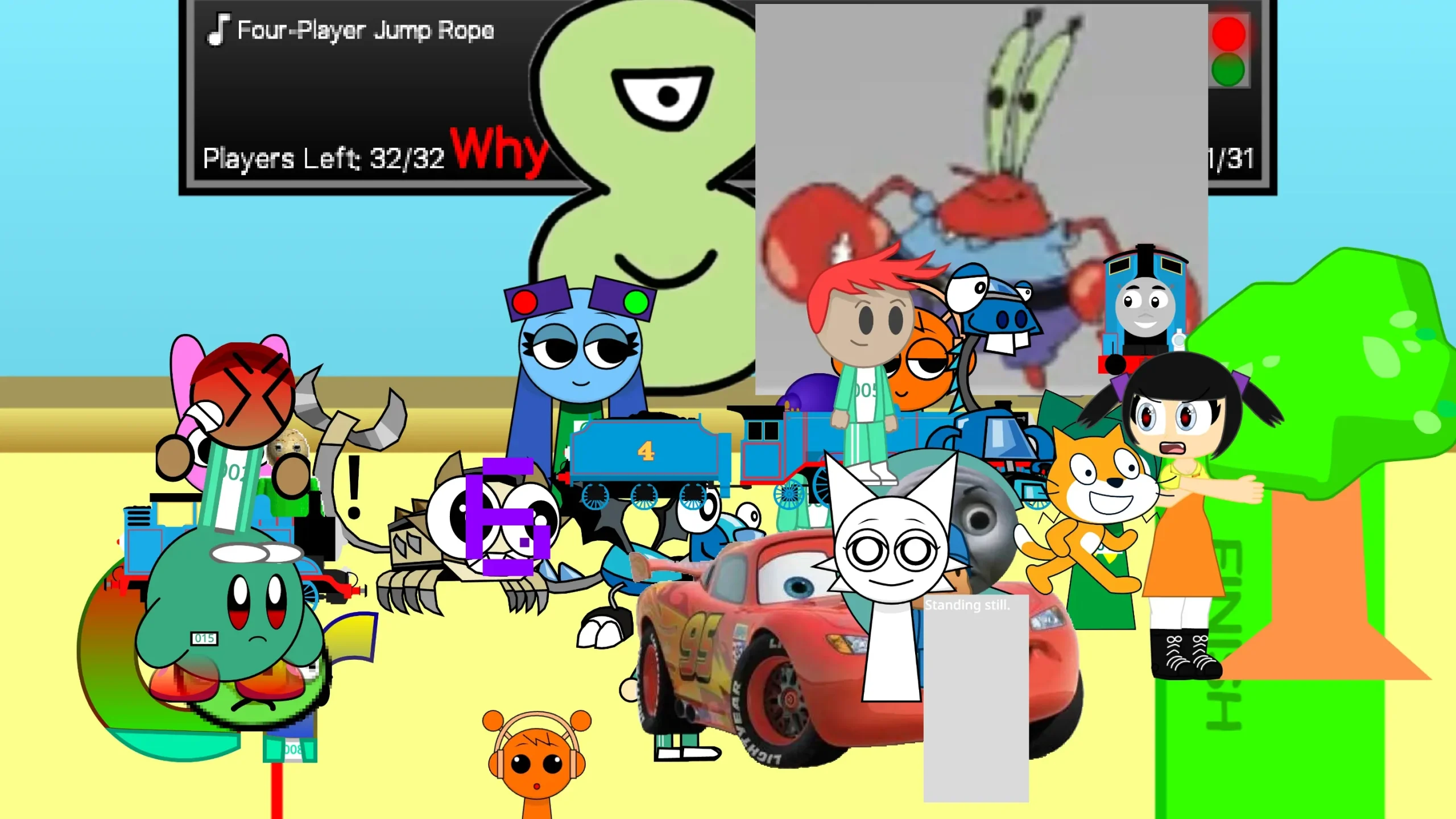
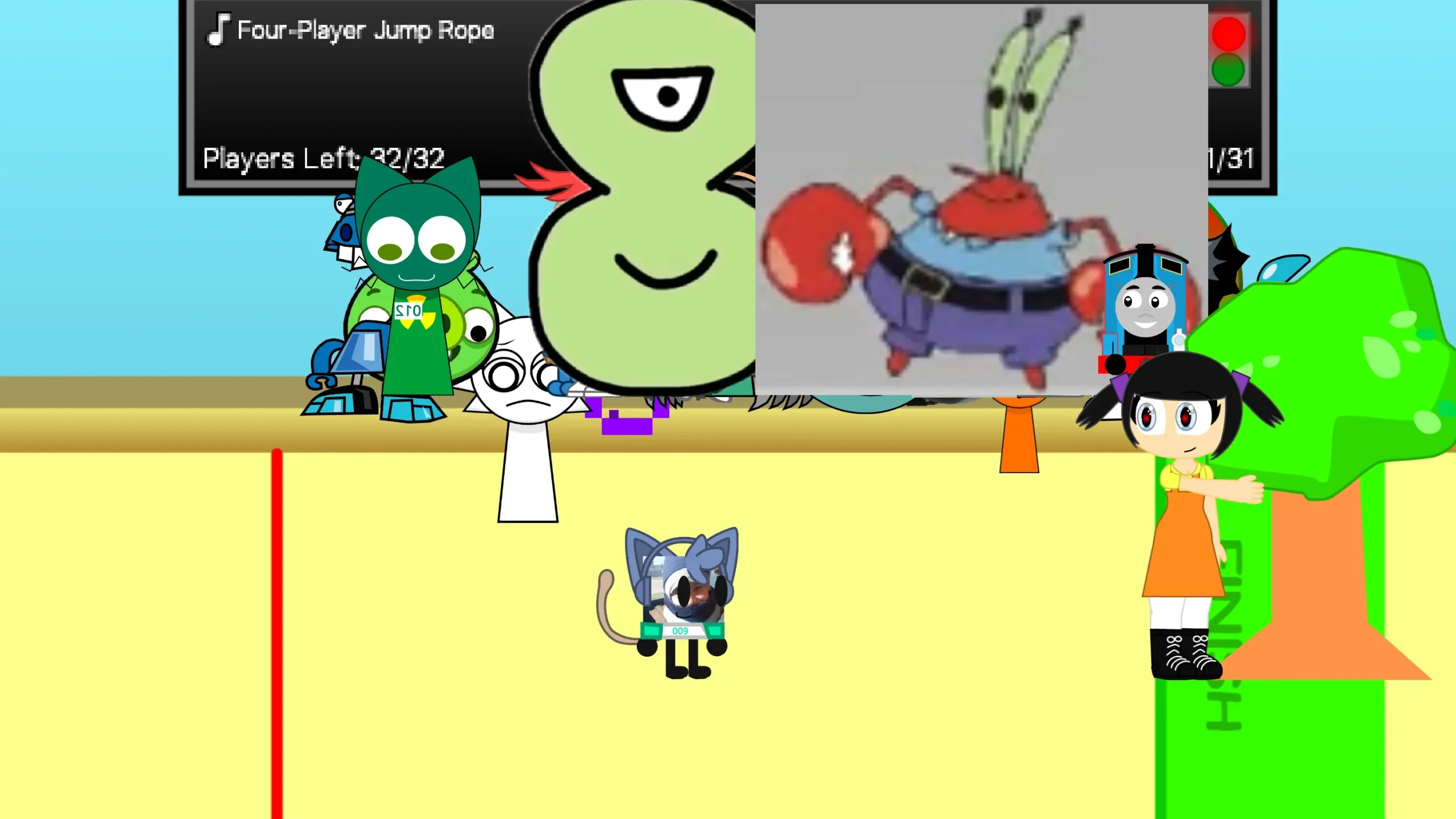
The opening field brings together a wide mashup of thirty-two figures drawn from internet culture, animation, gaming, and original creations. The roster includes Scratch Cat, Randy, Alex, Isabella, Zeke, Pocoyo, Andy, Chromium, Julian, Oren, Miguel hauck, Tox, CPU, Pinki, flurr, Gordon, lunk, Lightning McQueen (WGP Custom), scorpi, Baldi, Edward, Ei, O Face, Thomas, Piggie, Mr crab, Eight, Six Pixelated, Koby, Tekana, Baby Oren, and Wenda. Rather than using identical sprite templates, every single character features custom visual and audio assets. Each participant has distinct walking animation frames, idle waiting poses, skidding frames, caught animations, finish line celebrations, defeat states, voice clips, and victory poses.
Movement speeds are re-randomized at every new green light phase within a round. A contestant who leads the pack during the first few seconds can receive a much slower pace during the next green signal, preventing early front-runners from securing effortless victories. Reaching the finish line earns temporary safety: successful runners execute brief celebration poses, exit the active field, and watch the remaining competitors struggle. The round continues until only one runner remains on the track. That last-place finisher receives a dedicated defeat sequence and is permanently removed from the remaining player count, after which all surviving contestants walk back to the starting line for the next race.
Red Light Penalties and the Rubber-Band Effect
A central mechanical distinction in this edition is that red-light mistakes serve as distance setbacks rather than immediate eliminations. When the light switches to red, contestants independently roll to see if they stop successfully. Those who fail perform an exaggerated skid before coming to a halt. Young-Hee then turns toward the field with an alarmed expression, calling out offenders. The caught contestants shout their individual voice lines before dissolving through combined brightness, pixelation, and transparency visual effects, immediately reappearing back at the starting line.
This reset system introduces a noticeable rubber-band dynamic to every round. A fast runner can build a massive lead, fail a single red light, and instantly lose all progress, allowing slower characters trailing near the starting line to overtake them. Conversely, a contestant can get caught multiple times, recover lost ground during subsequent green lights, and survive the round as long as another character finishes even slower. Elimination occurs solely through placement, meaning a runner who obeys every single red light can still be knocked out if its randomized running speed remains too low across the entire run.
Automated Pacing and Viewing Interface
Because the contest is entirely simulated, viewer interaction is limited to standard media interface actions rather than character movement. Players cannot steer runners, influence stopping probabilities, adjust running speeds, or trigger manual eliminations.
| Action | Input | Result |
|---|---|---|
| Enter the CoCreate player | Click the fullscreen play button | Opens the playable tournament view |
| Dismiss the game cover | Click or tap the cover if it appears | Reveals the active race |
| Identify a contestant | Hover over a visible character | Shows that character’s name |
This structure caters to viewers who enjoy randomized elimination series, simulated brackets, or background streams, but it offers no physical challenge for those seeking a traditional reaction-based racing game. The complete thirty-one round length represents a substantial time commitment. The initial round alone frequently lasts over a minute as slower characters are repeatedly caught and teleported back to the start. Without speed toggles or round-skipping functions, watching the full tournament requires patience, particularly in early rounds when the field is still crowded.
Visual Overlap and Audio Presentation
The simulation compensates for its non-interactive nature through expressive audio-visual touches. Events across the field are driven by a variety of Young-Hee voice calls, running footsteps, skidding sounds, teleportation chimes, character-specific voice clips, explosions, finish line cues, and specialized elimination sounds. An overhead scoreboard selects match tracks from an extensive soundtrack library, displaying titles such as "That's All of It." The ultimate survivor receives a dedicated walk-on sequence, victory pose, voice clip, custom winner banner, celebration jingle, and falling confetti. On platforms like Fortcade, this rich presentation helps maintain interest across the longer spans of automated competition.
However, squeezing thirty-two active sprites into a single arena creates significant visual clutter during early rounds. Contestants spawn overlapping one another at the starting boundary, and exceptionally large character graphics—such as Lightning McQueen, Mr crab, Eight, train sprites, and oversized faces—regularly obscure smaller runners, Young-Hee, the light board, or overhead text. Hovering the cursor over the crowded field can spawn large speech bubbles that further block the action. While visual clarity improves steadily as characters are eliminated across thirty-one rounds, tracking specific runners during the opening legs remains a persistent visual challenge.