Two stacked block towers wobble against a bright sky backdrop as money ticks steadily upward and explosive ordnance appears around the arena. In Crazy OP Sprunki Bomb Tower, players watch a yellow character named Simon attempt to outlast a green Sprunki rival positioned across the screen. Instead of managing complex unit paths or navigating multi-layered menus, the match converts every hit into visible structural damage, turning the block towers themselves into living health bars that collapse block by block during combat.
The basic flow operates like a compact clicker duel built around resource timing rather than traditional lane defense. The left side of the portrait screen belongs to Simon, while the right side houses the opponent. As bombs trigger and loose pieces fly off the structures, the changing positions of the characters visually communicate who holds the advantage, allowing players to read the battle state at a glance before spending their accumulated funds.
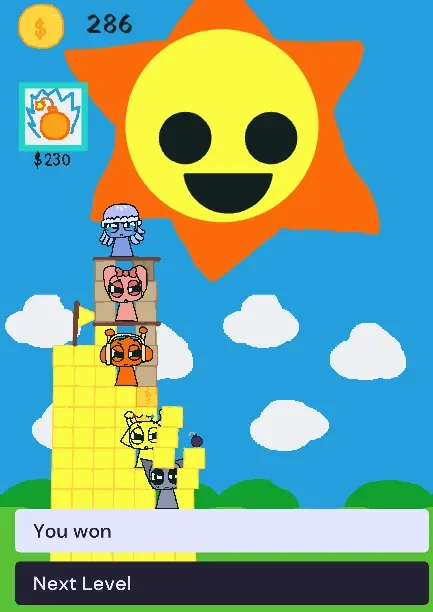 3 Game Screenshots
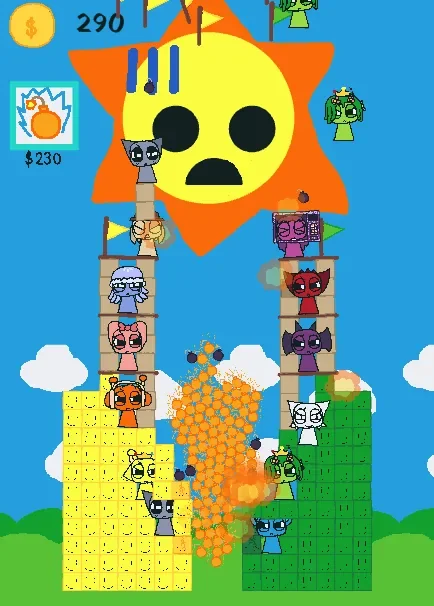
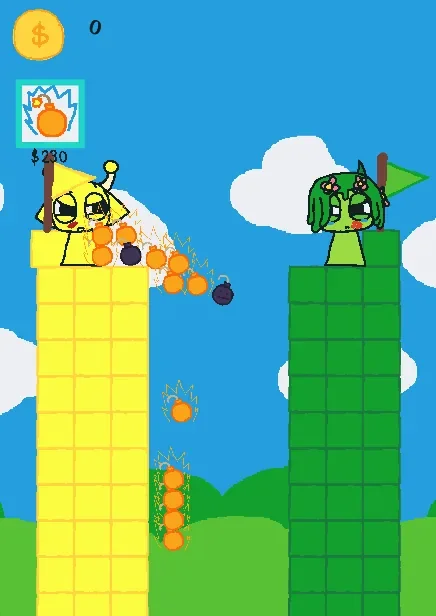
Tapping, Bomb Timing, and Resource Limits
Direct player participation centers on a dedicated bomb icon positioned near the top-left area of the portrait arena. Clicking or tapping this icon attempts to launch a high-powered bomb attack, updating the status of both towers and shifting available explosive hazards. Because the cost of this primary action is high relative to your starting funds, early moments in a match require waiting for the cash counter to rise while observing how much damage your tower has sustained.
The game relies on direct interface messaging to communicate economic gates rather than detailed cost tags or visual cooldown bars. If you tap the bomb icon before accumulating enough funds, the screen displays "Not enough money :(". This explicit notification confirms that your click registered while explaining why the action failed to trigger, keeping the resource boundary clear during fast exchanges.
| Action | Input | Result |
|---|---|---|
| Use bomb action | Tap/click the bomb icon | Attempts a bomb strike and updates towers and hazards |
| Try without enough money | Tap/click before meeting resource cost | Displays "Not enough money :(" feedback message |
| Progress after winning | Tap/click the "Next Level" prompt | Advances to the next stage in the sequence |
| Restart after a result | Tap/click the "Restart?” prompt | Restarts the current stage |
The Six-Stage Tower Duel Progression
Progression follows a linear structure that advances from Level1 through Level6. Each stage retains the fundamental battle setup: Simon's yellow block stack on the left, the green rival's tower on the right, scattered bombs, an active money counter, and immediate result text upon match completion. Winning a round presents a clear "Next Level" prompt to move forward, while losing reveals a "Restart?" prompt to retry the current stage.
Level6 serves as the current endpoint for the game's campaign sequence. Completing this final stage triggers the closing message "New update soon thx for playing", establishing a firm finish line for the play session. On web gaming platforms like Fortcade, short fan-made experiments often rely on clear visual feedback to balance out lightweight tutorials, and this duel uses its tumbling blocks to bridge that gap effectively without needing extensive menu systems.
Sprunki Aesthetic and Presentation Details
Created by @Dresden23 as a Castle remix connected to @tommychristiono, the game uses a distinctive, hand-drawn fan presentation. Hand-rendered bombs, simple cloud shapes, bright block colors, and expressive character designs give the game an unpolished, custom feel. The game listing tags the experience under tower, Sprunki, bombgame, and thenotpro1998, grounding its visual identity in character-driven block duels rather than music-creation mechanics.
Audio elements included in the game package provide background beats and sound tones during matches, but the visual indicators remain the primary source of operational information. Watching stacked square blocks break apart under pressure, tracking money figures at the top of the display, and monitoring on-screen prompt messages provide all the data required to navigate each stage.
Tactical Nuances and Trade-Offs
The strength of the experience lies in its immediate readability. By reducing the combat loop to two towers, one money counter, and a single bomb activation button, players can pick up the core loop within seconds of launching Level1. The physical shifting of blocks creates unexpected turns, as a single heavy hit can destabilize a stack faster than expected.
However, the lack of explicit cost numbers, upgrade trees, or detailed stat meters means players must learn resource timing through trial and error. Additionally, because all six levels share the same underlying rules and tower arrangements, the gameplay remains strictly focused on short-session dueling rather than deep tactical variety. It functions best for players seeking a quick, physics-flavored Sprunki battle experiment where destruction is instant, clear, and easy to follow.