What starts as a bright, relaxed character scavenger hunt across a wide landscape gradually turns into a tense, timed rescue mission under constant threat. Created by @Gabriel_super_games13, Find and Save All Sprunkies carries a title far more descriptive than its original working name, "I Find All Sprunkies Horror Update." The experience begins with an open-ended search across a sprawling top-down map, but once every hidden figure is accounted for, the entire environment transforms. Methodical exploration gives way to map memorization, resource gathering, and pursuit evasion as the game shifts from a cheerful hide-and-seek collectible challenge into a dark, two-stage survival puzzle.
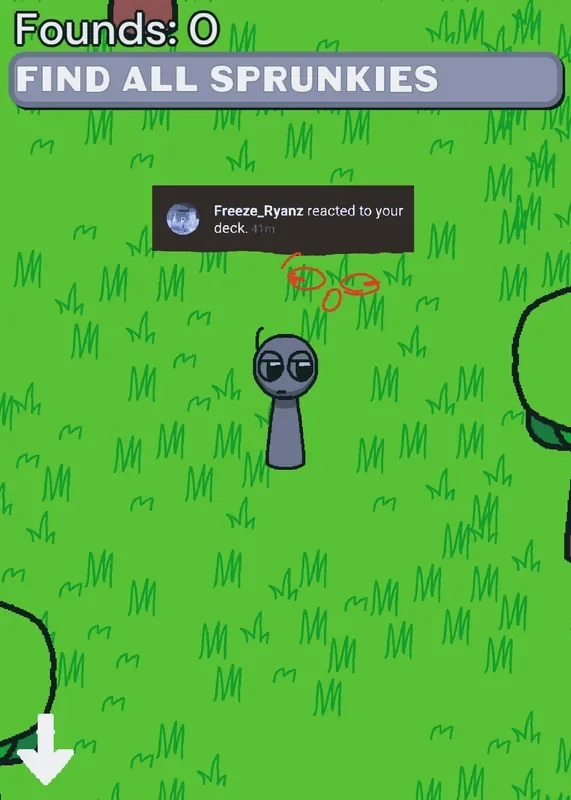
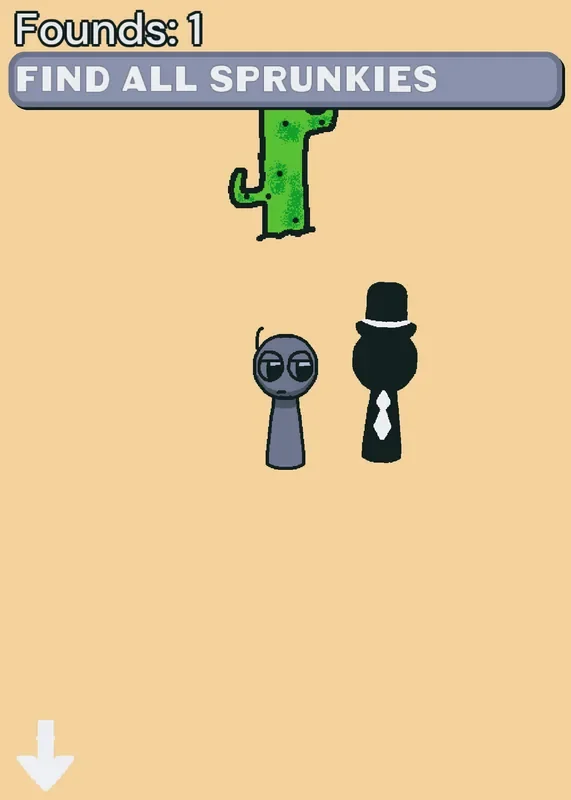
The opening phase sets a lighthearted tone on a vibrant green field under the fixed objective prompt "FIND ALL SPRUNKIES." Controlling a gray Sprunki explorer, players navigate through distinct terrain features including grassland, sandy coastlines, open fields, water boundaries, trees, cacti, and decorative obstacles. The screen centers on the player character while the camera follows movement across a map significantly larger than the visible viewport. There are 19 regular Sprunkies scattered throughout this landscape: Brud, Cluckr, Durple, Fun Bot, Garnold, Gray, Jevin, Mr. Fun Computer, Mr. Sun, Mr. Tree, Oren, Owakcx, Pinki, Raddy, Simon, Sky, Tunner, Vineria, and Wenda.
Finding each character requires physical collision rather than pressing an interaction button. Walking directly into a hidden Sprunki plays a distinct pickup sound, displays a confirmation message such as "You found Cluckr!", increases the visible Founds counter, and partially fades the character's sprite. This visual fading is an essential mechanic: found characters remain on the map as landmark anchors without looking identical to undiscovered targets. Some characters are cleverly hidden behind environmental elements, such as Cluckr being partially concealed underneath a large tree canopy near the starting zone. Because there is no visible minimap or checklist of individual names, players must rely entirely on visual inspection and spatial memory to track down missing figures.
 3 Game Screenshots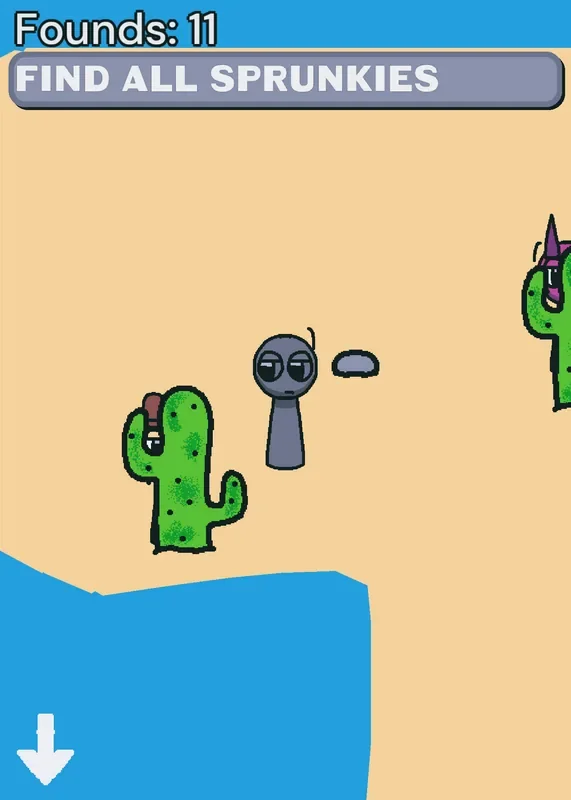
From Scavenger Hunt to Timed Rescue
Reaching 19 discoveries alters the objective to "Find the Black and talk to him...", making Black the twentieth encounter rather than a standard collectible. Locating and touching Black immediately shifts the atmosphere. Flashing warning messages including "RUN!" and "They are all dead.." fill the screen before the game transitions into its horror phase. The bright green environment is replaced by a dark, gray-and-red landscape scattered with debris, dead or injured Sprunkies, darker lighting, and environmental hazards. Water bodies are now marked with explicit warnings reading "DON'T TOUCH IN THE WATER!", adding spatial limits to navigation.
Phase two alters both the visual tone and the gameplay objective, dividing the rescue effort into two mandatory sequential steps:
- Locate all 11 supply items scattered across the darkened map to fill the item counter to 11/11.
- Deliver supplies to 15 injured Sprunkies by touching each one to heal them and advance the hidden rescue counter.
A countdown timer set to 3:30 begins immediately upon entering phase two. Reaching zero on this timer does not trigger an instant loss; instead, it marks the exact moment Black enters the map and begins actively hunting the player. When the countdown expires, the ambient music changes, Black spawns, and he continuously moves directly toward the player's position. It remains possible to continue gathering items and healing characters while being pursued, but maneuvering around environmental hazards becomes drastically more dangerous. Touching Black at any point results in a "Game Over.." screen. Selecting the Retry button resets all variables and sends the player completely back to phase one, erasing several minutes of dual-phase progress.
Control Mechanics and Environmental Navigation
Movement relies on a responsive virtual analog-stick system designed for simple one-finger operation, keeping the majority of the portrait screen clear of clutter.
| Action | Input | Result |
|---|---|---|
| Move | Drag and hold in a direction | Directs the gray explorer while the camera keeps them centered |
| Find a Sprunki | Walk into the character | Adds to the Founds counter and displays the character's name |
| Collect phase-two item | Walk into the object | Removes the item from the map and advances the 11-item counter |
| Heal a Sprunki | Touch injured character after collecting 11 items | Restores the Sprunki, lowers sprite opacity, and advances rescue total |
| Reset Run | Tap Retry button | Clears progress variables and restarts the run from phase one |
A white touch circle indicates the active drag direction, while character sprites rotate dynamically to face whichever direction they move. Because interaction is fully automated on collision, movement precision is the primary player skill tested during both phases.
Despite the smooth controls, navigation presents notable friction during late-game moments. Because the map lacks a minimap or active roster checklist, locating the final remaining Sprunki in phase one often leads to repetitive backtracking across vast fields. Players frequently report friction when attempting to track down the last missing target, unsure if a character was missed behind foliage or overlooked during initial sweeps. Similarly, phase two introduces interface confusion: the mission text box frequently displays erratic or misleading phrases like "They are all dead.." rather than clearly explaining that players must gather 11 items before touching the 15 injured characters will register. Clarifications provided by the creator in project comments remain essential for players trying to understand the exact win condition.
Successfully healing all 15 injured Sprunkies unlocks the true "You Win!" ending screen, which features Simon and Pinki standing together alongside a Retry option. Phase one isn't merely disposable setup; efficient players treat the initial scavenger hunt as a reconnaissance mission, memorizing character locations across the landscape so they can return quickly during the 3:30 window in phase two. Navigating this dual-phase structure on Fortcade highlights how simple scavenger hunts gain narrative weight when map knowledge directly affects survival. Rather than relying on simple jump scares, the game derives its tension from turning a once-familiar, bright landscape into an urgent, dark obstacle course where spatial memory is the key to rescue.
![AY in Noggin's RL, GL Game Redux [ 40 Players ] game cover](https://fortcade.com/wp-content/uploads/2026/10/ay-in-noggin-s-rl-gl-game-redux-40-players-225x300.webp)