Sweeping a pair of oversized chopsticks across crowded shelves—pulling blue ramen, dango skewers, and sushi straight toward the mouth of an elastic cartoon figure—forms the main interaction driving Goob's Squid Game Mukbang. Created by @C0SM0_L0L-0, this single-scene browser title combines character chaos inspired by Dandy's World with the visual motifs of a dystopian survival show. Rather than offering timed survival rounds or competitive elimination rules, the game functions as an interactive character toy built around a personal score tracker called the EATS counter.
 3 Game Screenshots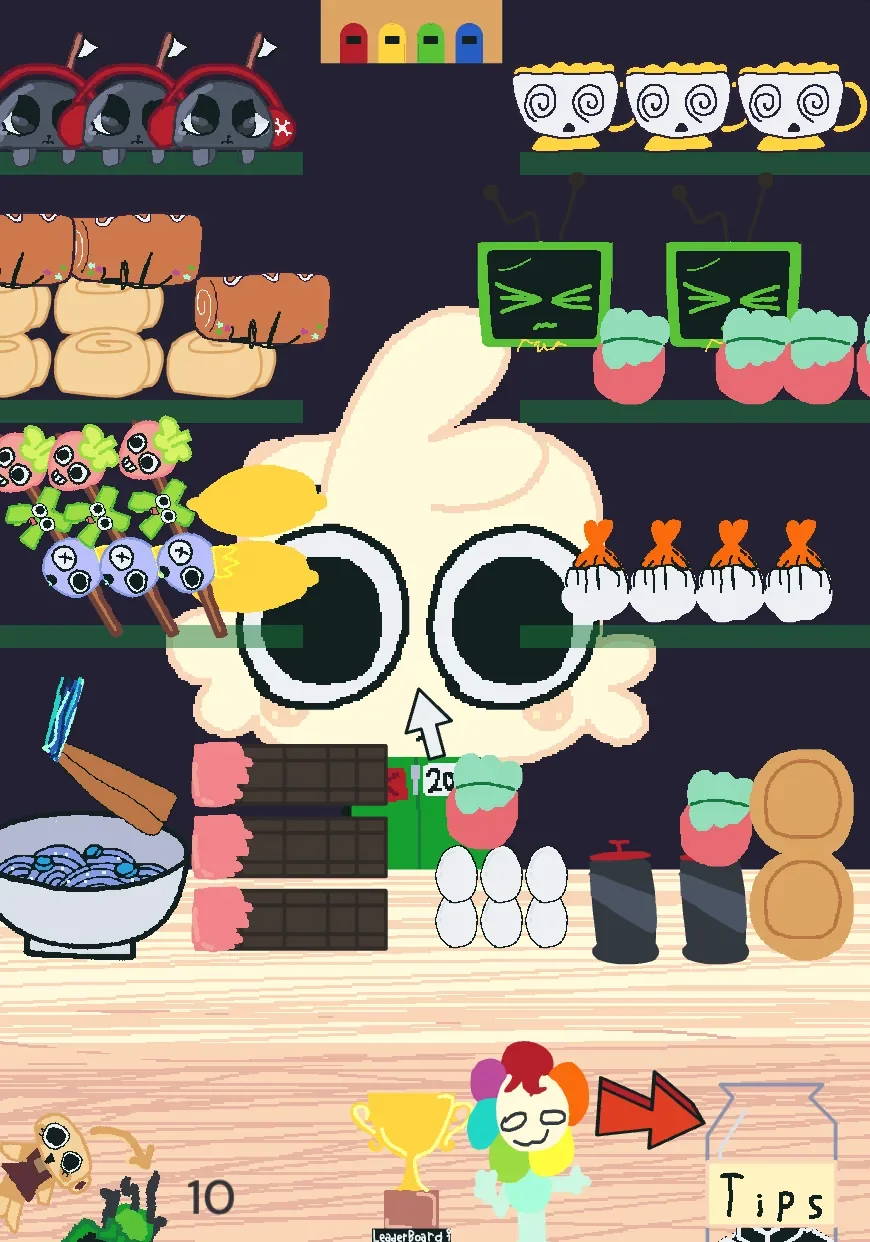
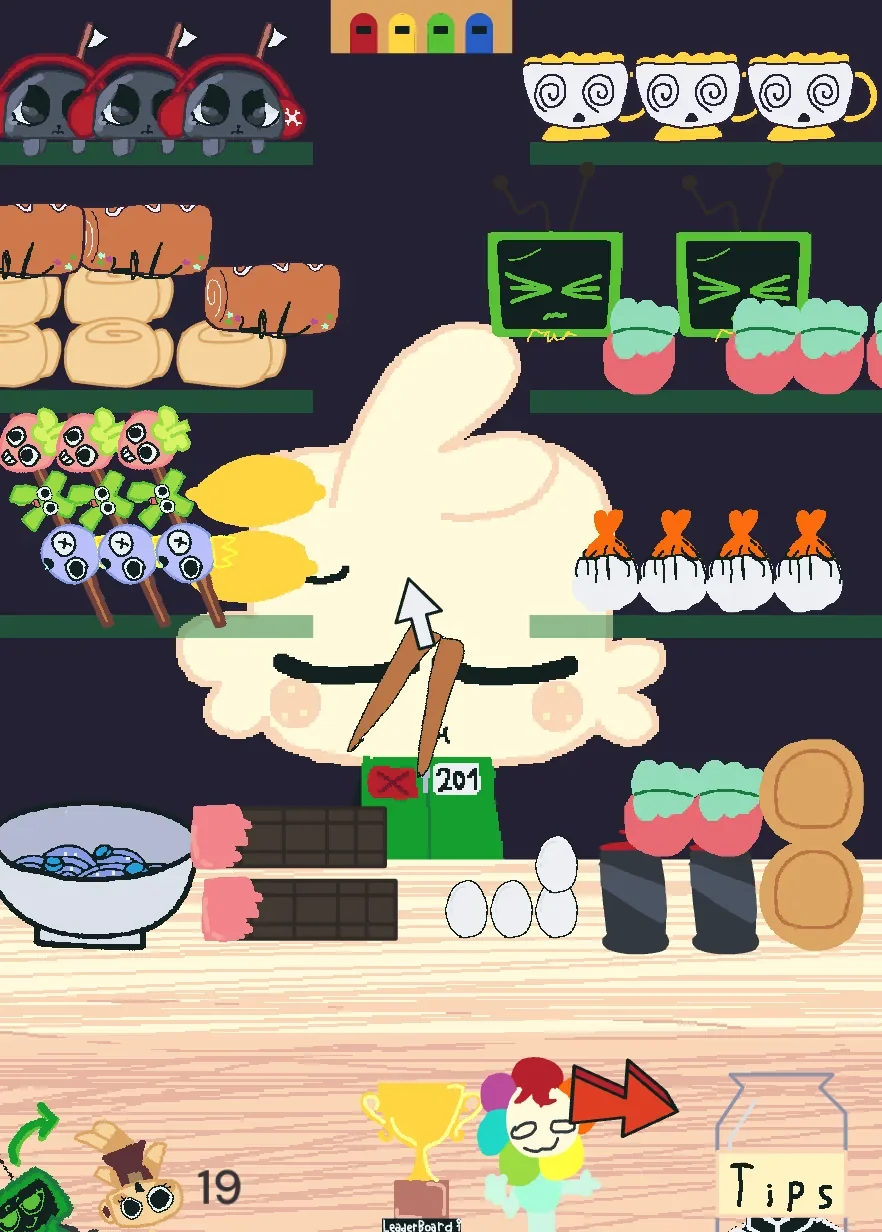
Dragging Utensils and Sweeping the Table
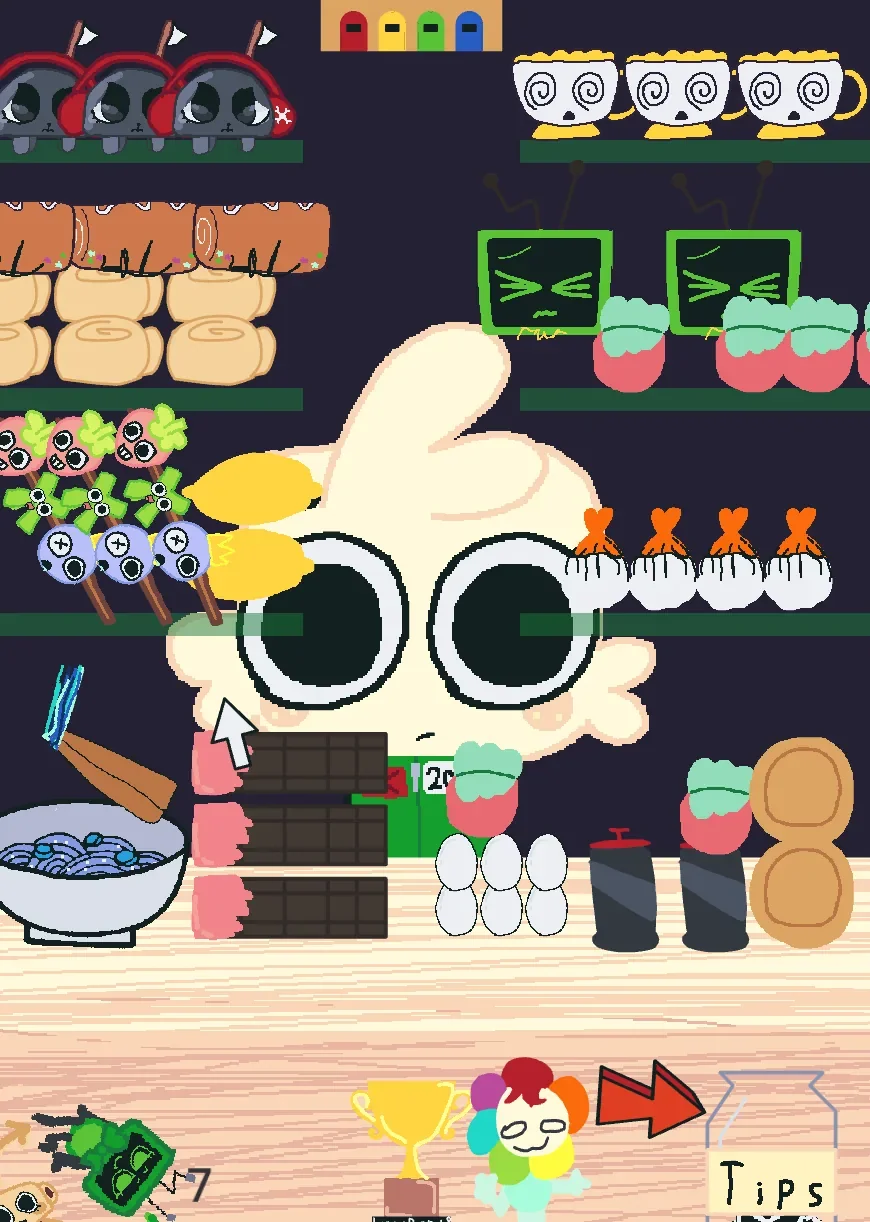
The active focal point of the scene is a pair of chopsticks resting beside a bowl of blue ramen near the lower portion of the screen. Instead of tapping individual dishes, players must click and drag the chopsticks directly across the table or up toward the surrounding shelves. Whenever the utensil collides with a compatible dish, the item shifts toward Goob’s mouth, alters its visual state, and adds to the running EATS total.
Because the collision areas around the dishes are unusually generous, broad movements are far more effective than careful, single-item pickups. A single wide drag through a densely packed shelf section can trigger multiple eating interactions in sequence, pushing the counter from 1 to 7 in a single motion. Several dishes, such as noodle cups with hypnotized spiral eyes, cake slices, and boiled eggs, feature multi-frame artwork that gradually changes appearance upon repeated contact before the item is fully consumed. Goob also reacts to each successful pickup by holding the food around the mouth area for several seconds, giving every sweep a clear visual reward.
The full food spread provides the primary visual variety across the single screen:
- Blue ramen and multiple spiral-eyed noodle cups
- Boiled eggs and wrapped rice balls
- Dango-style skewers and shrimp-shaped dishes
- Sushi rolls and stacked table plates
- Cake or chocolate slices
- Cola cups and soft drink containers
Dandy's World Character Remix Meets Squid Game Decor
The crossover presentation gives the brief feedback loop most of its identity. Goob dominates the center of the vertical display wearing a numbered green tracksuit, framed by red-uniformed guards stationed along the upper-left shelf and bright competition doors positioned above the main character. The hand-drawn aesthetic is deliberately crowded and noisy, packing nearly every corner of the screen with stylized character faces or edible props.
The standout visual detail is the physical connection between Goob and the draggable utensil. As players move the chopsticks across the upper shelves, Goob’s arm stretches across the screen, connecting the central character to the movement of the cursor. Animation remains lightweight but clear: food slides toward the mouth, Goob shifts expressions between poses, and background figures oscillate continuously while the player interacts with the table. These visual cues are paired with distinct eating sound effects and a cartoonish audio loop that plays throughout the session.
Interface Confusion and Web-Build Limits
While the drag mechanic is easy to execute once discovered, the game provides no opening tutorial, control prompt, or contextual arrow. First-time players frequently begin by clicking individual food items, expecting standard point-and-click responses, before realizing that the chopsticks themselves must be grabbed and moved. Furthermore, several decorative elements at the bottom of the scene—including a static Tips area and various background character doodles—resemble functional UI buttons despite having no interactive purpose.
The layout is strictly limited to one vertical view. There are no additional levels, unlockable costumes, story sequences, or secondary minigames reachable from the main menu. A trophy icon at the bottom of the screen hints at a high-score leaderboard labeled EATS, but tapping the trophy in the browser build does not open a working ranking panel. For players evaluating browser games on Fortcade, this title serves best as a brief, funny character showcase rather than a structured arcade challenge.
Without a countdown clock, a limited supply mechanism, or a functional global leaderboard, the EATS score exists solely for personal experimentation. Goob's Squid Game Mukbang delivers its main joke within seconds: sweeping a stretched arm across packed shelves to stuff a character's mouth full of noodles and sushi. Beyond that initial visual payoff, there are no additional systems or evolving challenges to sustain long sessions.