Moonshot turns category knowledge into rocket fuel. In this daily browser word game, you type answers to prompts such as a sea, a scientist or a clothing brand, then discover how familiar those answers are within the game's rarity system. The interesting decision is not simply finding something correct: sometimes the obvious answer is ideal, and sometimes you need to reach far beyond it.
 3 Game Screenshots
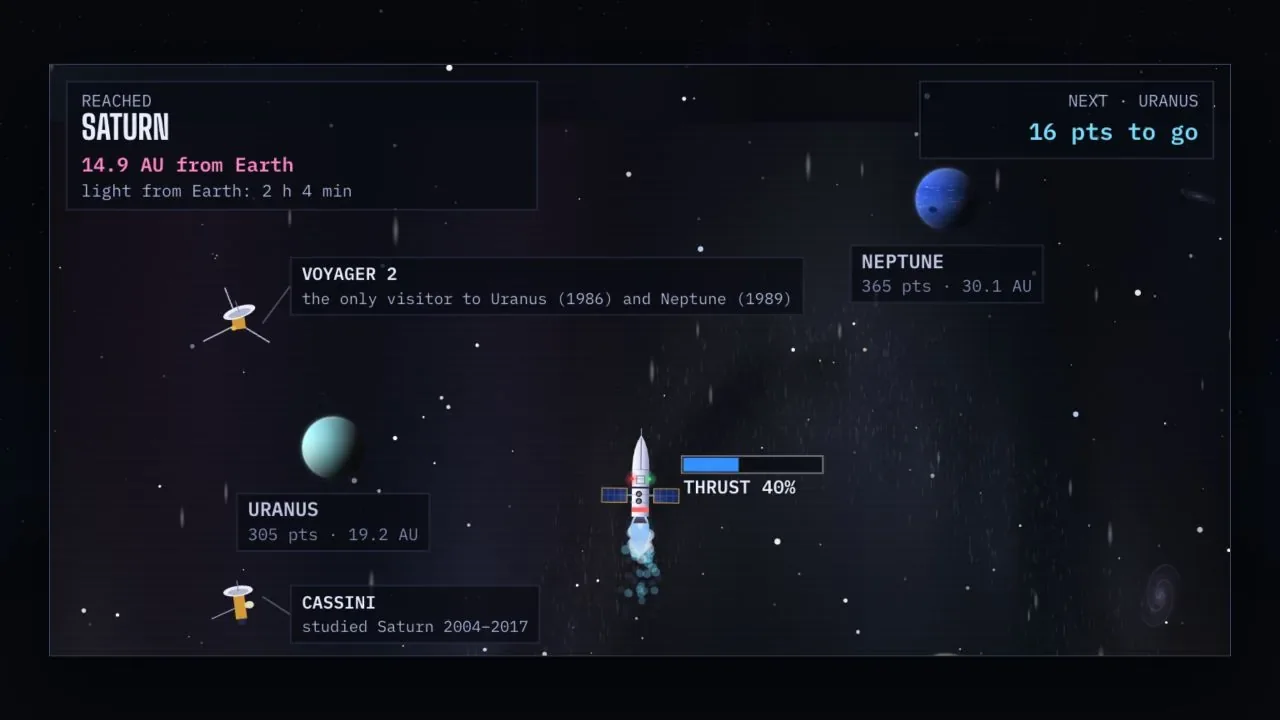
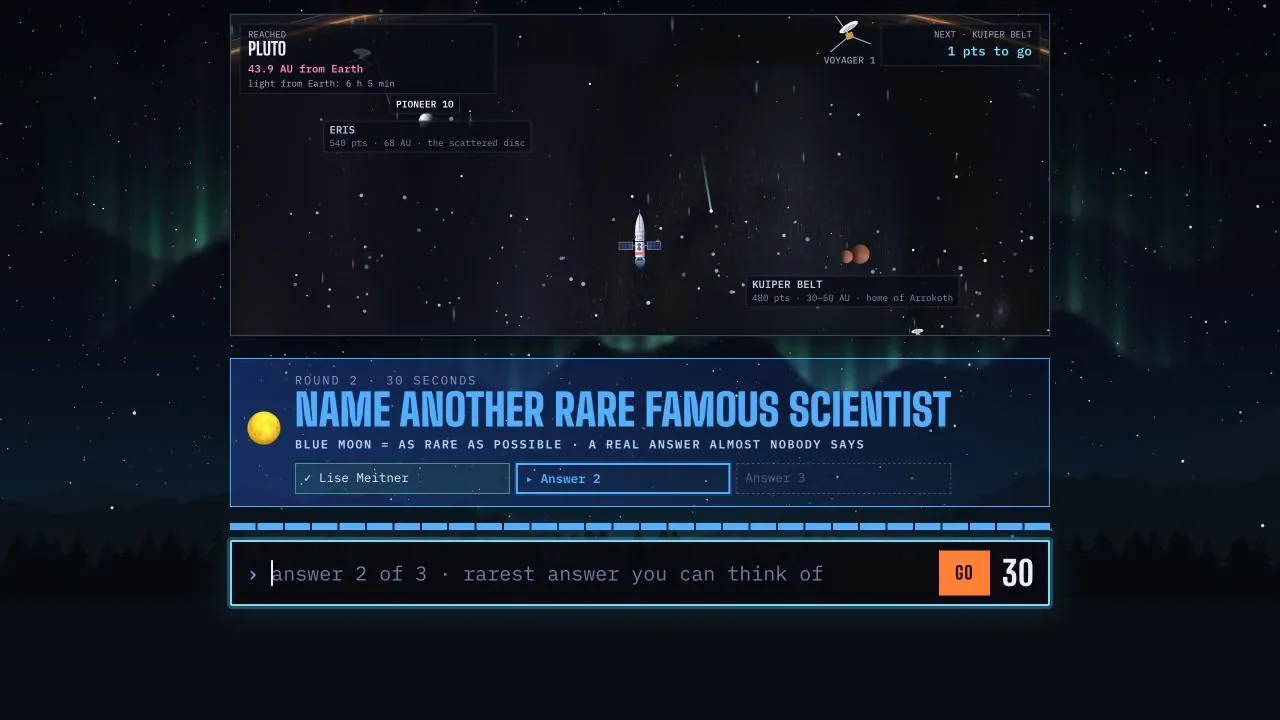
Common answers first, obscure ones next
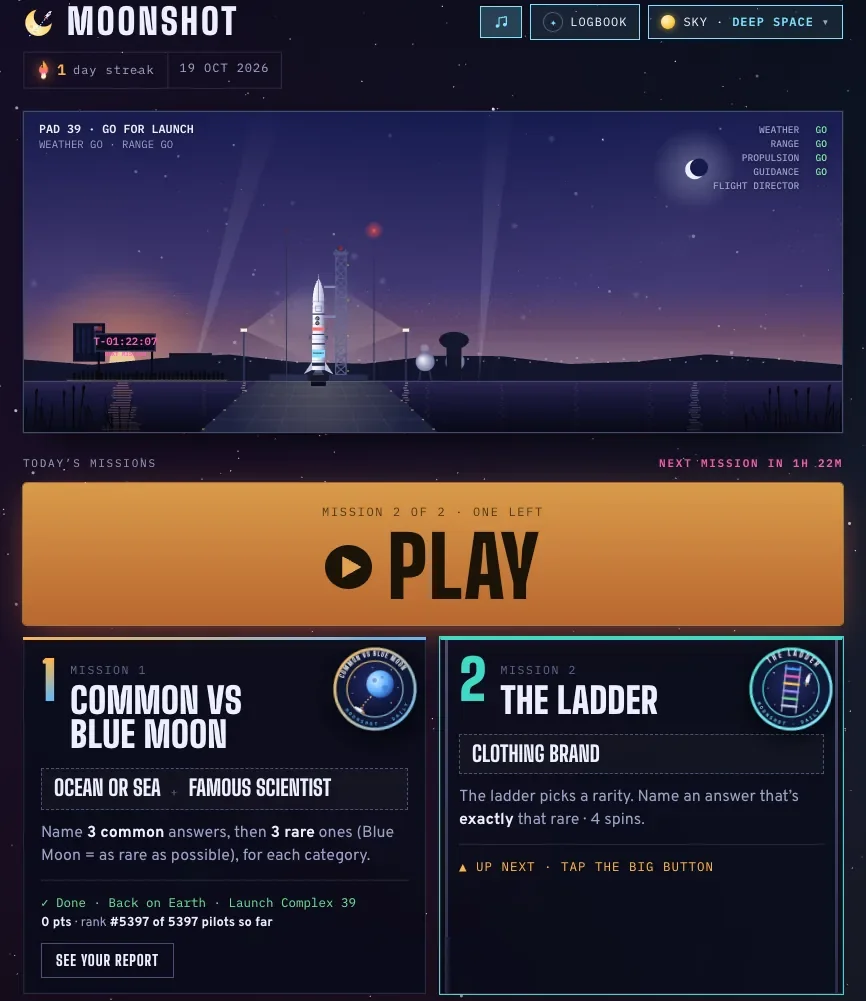
Common vs Blue Moon gives you two categories. You submit three common answers for each, followed by three rare answers for each: twelve timed slots altogether. The common round allows 15 seconds per answer, while the rare round gives you 30.
That reversal makes the format work. The first half rewards names that come immediately to mind; the second asks you to search the less obvious corners of the same subject. A category you know reasonably well can suddenly feel much harder once its most familiar answers are used up.
Answers occupy six rungs, from Common through Uncommon, Rare, Legendary and Mythic to Once in a Blue Moon. The last rung contains five hand-picked deep cuts for each category. The other rankings blend starting estimates with players' answers, so these labels are part of Moonshot's scoring system rather than an objective test of how obscure something is. Knowing a subject helps, but learning what the game considers rare is a separate skill.
The Ladder asks for a precise rarity level
The second daily mission, The Ladder, uses one category and four target rungs. Each answer gets 30 seconds, and the aim is to match the requested rarity exactly. An answer that would be excellent in the rare round can overshoot a more ordinary target here.
A bullseye is worth 100 base points, one rung away earns 40, and two rungs away earns 15, before timing and combo modifiers. In our clothing-brand session, our answer to an Uncommon target was rated Common for 40 points; a later Rare target produced a bullseye for 100. The feedback makes the distinction immediately clear.
This is the more demanding of the two formats because it asks you to estimate familiarity instead of pushing toward either extreme. It is also where the game's classifications can feel most arbitrary. You can know a perfectly valid answer and still misjudge its assigned rung.
Fast typing helps, but keep a backup answer
Type an answer and press Enter or select GO. Accepted answers advance the sequence automatically. Some short forms are understood: Pacific resolved to Pacific Ocean, and Newton to Isaac Newton during our run. Reusing an accepted answer was rejected.
The more consequential friction is the database. One attempted sea name was not recognized, and the game offered another try with no direct penalty. The countdown continued, however, so an unfamiliar spelling or an answer outside the list can still cost valuable time. Letting a slot expire records no answer for zero points and moves the mission onward.
Answer speed affects the final score, while qualifying hits can give the next answer a ×1.5 combo. A practical approach is to keep several distinct answers ready and switch quickly if one is rejected. In the common round, save your hesitation for later; in the rare round, balance an ambitious answer against one you are confident the game will recognize.
The landing report is worth reading
The rocket provides a satisfying picture of progress, passing planets and distant landmarks as your answers add distance. Your decisions happen in the answer box; the flight visualizes their results. The dark star field, aurora background and bright rarity colors give a small word game a strong sense of occasion.
The best presentation detail comes after landing. A paper-style report separates each answer's result, base worth, speed or combo modifier and final points. You can also expand the accepted-answer list to see what you missed. That makes a disappointing answer useful: you can understand the classification rather than staring at an unexplained total.
The free daily offering has a clear stopping point. After both missions, their buttons reopen your reports, and the homepage counts down to new missions. A logbook records flights and streak progress, with later ship designs shown as streak rewards. The site also advertises a paid Flight Pass for unlimited flights, crew play and duels; those features were not purchased or tested for this review.
Moonshot suits players who enjoy categories, quick recall and second-guessing what other people will say. Its strongest idea is making familiar knowledge serve opposite goals in the same session. The main reservation is that success depends on the game's word list and rarity judgments as well as your own knowledge. If that uncertainty sounds intriguing, the two daily missions make an engaging, compact routine.
Related daily puzzles
For more daily word and puzzle games, try Word Chain Daily Game or ClueRoll.