Wenda, Gray, and Sky sit in pieces beside a moving pool of water, waiting for players to drag their heads, torsos, arms, and legs into immediate trouble. In Sprunki Seven-Character Ragdoll Sandbox, also known as Sprunki Wenda & Gray Ragdoll Playground, players explore a single-screen physics playground built around character reactions, hazardous drop zones, and interactive props. There are no scoreboards, narrative sequences, or level progression systems. Instead, the focus remains on spawning familiar cast members, exposing them to environmental hazards, and watching their expressions adapt to food, fire, water, and blunt force.
The game originates from an ending-kit template initially created by wendawhitecat and later remixed by Ank. Despite carrying a historical "Happy Ending" title during early development, the simulation contains no actual narrative conclusion. Its enduring popularity—surpassing 290,000 plays on its original Castle release—stems from its unconstrained interaction model. Every character is constructed from five distinct physical pieces: a central head, two arms, and two legs. Because each limb rotates, falls, collides, and drags independently, an intact figure can instantly decompose into an unorganized heap of body parts when tossed across the platform.
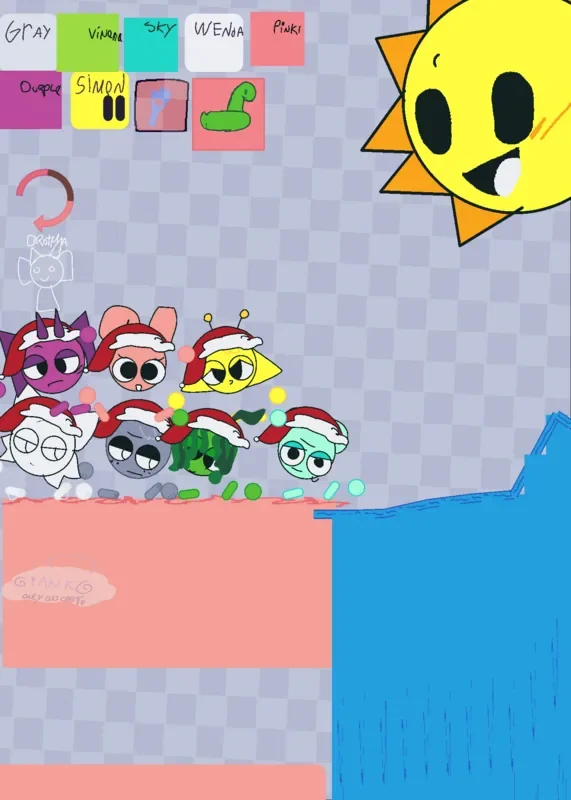 3 Game Screenshots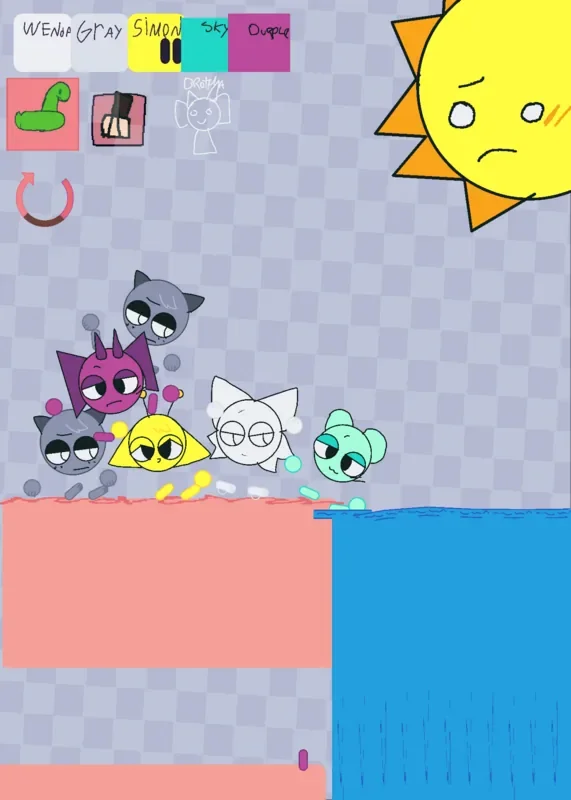
Spawning and Character Assemblies
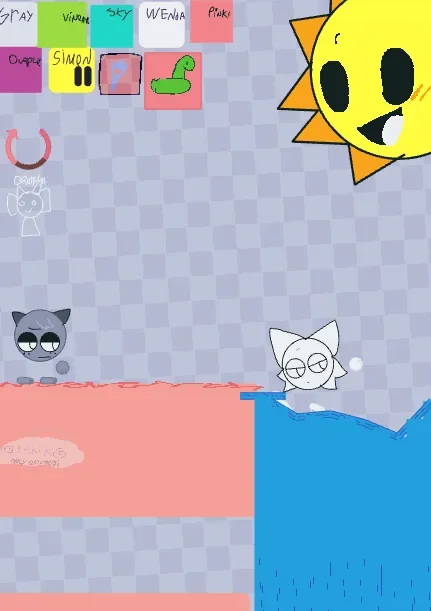
Seven colored buttons lined across the top of the interface allow players to spawn fresh figures at any moment:
- Gray
- Vineria
- Sky
- Wenda
- Pinki
- Durple
- Simon
Pressing any button immediately drops a complete set of limbs onto the safe starting ledge. Because the system enforces no maximum character limits or mandatory layout rules, players can assemble mixed groups or fill the starting ledge with identical copies. Community testing frequently leans into this unrestricted spawning, with players creating massive single-character swarms like "Durple armies" until the platform overflows. While the seven available cast members add distinctive color to the scene, players routinely express interest in seeing additional Sprunki characters added to the roster, frequently requesting figures such as Funbot, Raddy, Oren, and Jeven.
| Action | Input | Result |
|---|---|---|
| Spawn a Sprunki | Click or tap a named character button | Generates a new head, arms, and legs on the ledge |
| Reposition body part | Drag an individual limb or head | Moves or throws that specific ragdoll piece |
| Alter expression | Click or tap a character's head | Triggers a temporary visual facial reaction |
| Deploy active prop | Tap the central item control | Spawns the displayed tool, food item, or weapon |
| Reset the scene | Tap the red circular arrow icon | Restores the default three-character layout |
| Interact with blocks | Tap a cube on the platform | Attempts to flip or displace the block |
Props, Facial Feedback, and Environmental Hazards
Rather than displaying a traditional health bar or numerical damage gauge, the sandbox communicates physical condition through facial expressions. The item control menu cycles through several props, though its reliance on cryptic picture icons requires trial and error to identify each item's effect:
- Food and Drinks: Disappear when brought into contact with a character's head, triggering eating or drinking sound effects and changing the facial graphics to show consumption.
- Poisoned Food: Uses a visual presentation similar to standard food but degrades the target character's overall physical condition upon contact.
- Medkit: Restores injured or poisoned characters back to their baseline visual state, creating a complete damage-and-recovery testing loop.
- Weapons: Inflict physical damage only when thrown with sufficient velocity; gently resting a weapon against a limb produces no impact effect.
- Rope Tool: Latches onto the nearest available torso, allowing players to pull ragdolls across the room in a controlled motion rather than throwing loose limbs.
Beyond hand-held tools, the single-screen room contains four distinct environmental test zones. The safe spawning ledge sits above a pink quicksand section that catches falling body parts. Across the bottom of the room, animated water features a shifting surface that forms small waves along its border. Submerging body parts changes character expressions before eventually disintegrating the immersed limbs. In the upper-right corner, an oversized Mr. Sun serves as a high-heat hazard. Dragging a ragdoll into contact with Mr. Sun alters its appearance, emits particle effects, and destroys the touched body part.
Visual Presentation and Operational Boundaries
The visual presentation retains a distinct handmade aesthetic. Character selection labels are written directly onto colored tiles, the reset button sits alongside a faint background doodle, and the floor uses a simple checkered pattern. A handwritten tip on the interface openly notes that block-flipping interactions are "kinda broken," establishing honest expectations for the game's rougher physics collisions. Short audio effects accompany eating, drinking, splashes, strikes, and damage, backed by a brief background music loop.
Because all interactions occur on a single screen without alternate rooms, construction mechanics, saved scenes, or multiplayer modes, visual clutter quickly builds when multiple figures are spawned at once. Overlapping small limbs can make precise dragging awkward during chaotic experiments. For players seeking quick, accessible physics sandboxes on Fortcade, the simulation delivers an enjoyable venue for brief, unscripted experimentation, provided they do not expect a structured narrative ending or music-mixing gameplay.
![AY in Noggin's RL, GL Game Redux [ 40 Players ] game cover](https://fortcade.com/wp-content/uploads/2026/10/ay-in-noggin-s-rl-gl-game-redux-40-players-225x300.webp)