Twenty distinct character sprites step onto a red starting zone and begin drifting across a sun-baked desert toward a checkered finish line, completely unaware of thirty invisible mines buried along the path. AY in Minefield Run! Sunkers transforms a simple elimination premise into a nineteen-round automated spectator race where survival depends entirely on luck. Every contestant that crosses the rightmost green finish line secures safe passage to the next stage, while the last runner left wandering on the field is permanently eliminated.
Created by @Cadenboiz665, the game strips away direct steering in favor of randomized simulation. Pressing the green flag sets the roster in motion, but players do not guide individual steps or pick paths around hazards. Instead, entertainment comes from watching individual contestants navigate unpredictable explosions, sudden teleports, speed modifications, and frozen pauses that continuously reshuffle the leaderboard.
 3 Game Screenshots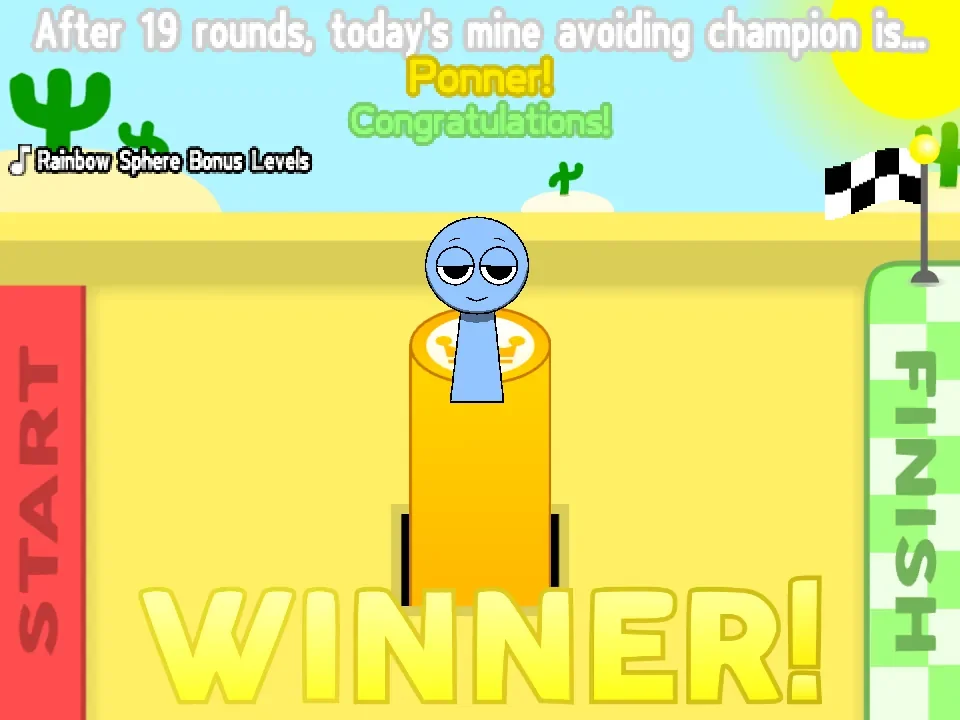
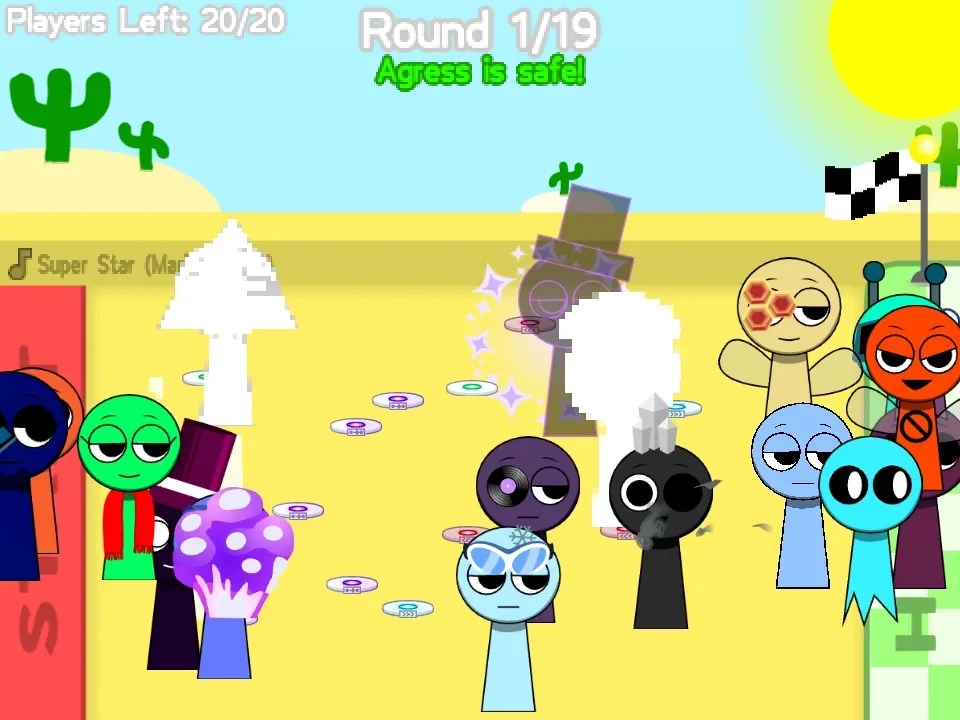
Tournament Mechanics and the Twenty-Runner Roster
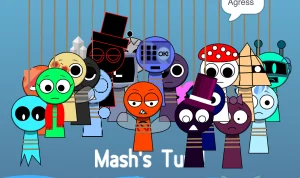
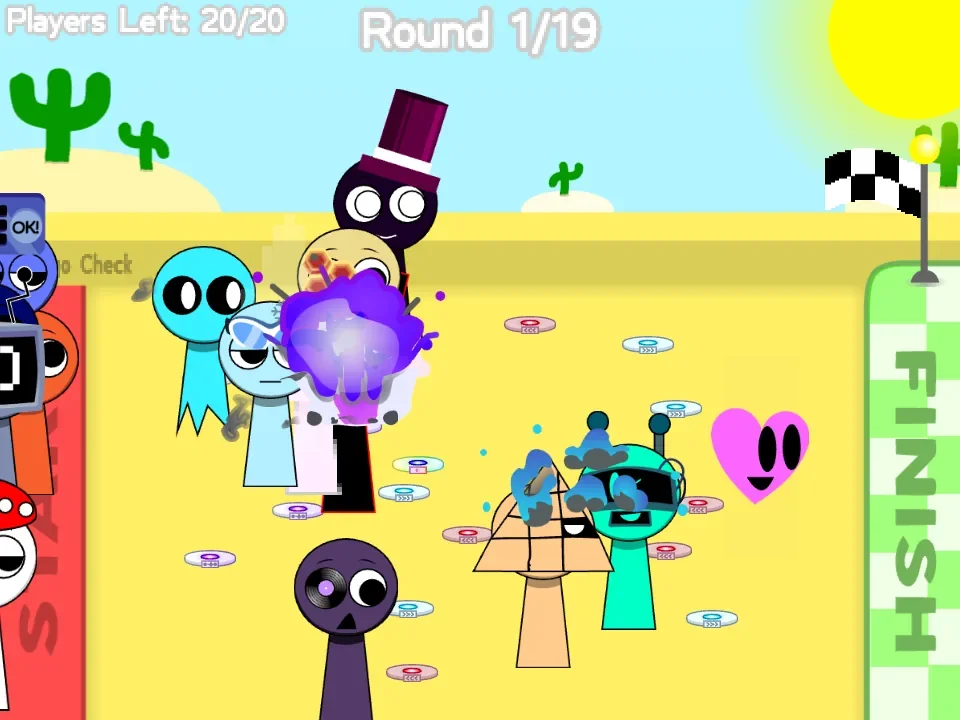
The tournament opens with an introductory screen detailing the format before placing twenty contestants into the desert arena. A persistent display tracks the active round alongside the remaining player count, while green on-screen text identifies each character who safely crosses the finish. The full lineup includes Crystalio, Stuck, Mash, Crasha, Plud, Hatter, Agress, Pirimod, Snow, Gunner, Ponner, Danny, Coder, TV, Ms. Fun Robot, Honee, Tina, Pina, Dash, and Mr. Heart. Distinct silhouettes, facial expressions, color schemes, and custom voice clips keep individual runners recognizable even when the track gets crowded.
Movement follows simple directional rules rather than deliberate pathfinding. Contestants head generally rightward from the red "START" banner toward the green "FINISH" marker, drifting at angled trajectories and bouncing off the top and bottom boundaries. Because their paths are unguided, a runner can approach the checkered line only to veer backward into unexploded territory. Once a character reaches safety, they halt near the finish while the remaining runners keep moving. The last character to arrive is eliminated, reducing the participant counter before the next round begins. This sequence repeats across nineteen total rounds until one survivor lands on a winner's podium, celebrated with confetti, music, and a custom victory animation.
Pacing demands patience because there are no manual skip features or fast-forward buttons. The opening round alone often takes roughly a minute to complete as twenty contestants stumble through hidden hazards or bounce off boundaries. If a contestant gets caught behind terrain bounces or repeated mine triggers, viewers must wait for the simulation to resolve itself naturally. However, because starting positions and movement angles reset every session, a runner knocked out in the first round of one tournament can easily survive deep into the next attempt.
Six Mine Variants and Field Dynamics
The desert field conceals thirty hidden mines placed at randomized positions between the start and finish lines. The ground initially appears empty, revealing a mine only when a contestant steps onto its coordinate. Upon contact, the mine triggers an animated disc, explosive flash, state-change effect, or sound cue.
The hazard pool contains six distinct mine variations with unequal spawn chances:
| Mine Type | Trigger Effect |
|---|---|
| Standard Mine | Launches the character into the air and sends them back toward the starting side |
| Speed Increase Mine | Permanently increases the character's movement speed for that attempt |
| Speed Decrease Mine | Reduces movement speed, increasing the risk of a late arrival and elimination |
| Teleport Mine | Fades the character out and relocates them to a random coordinate on the field |
| Pause Mine | Freezes the character in place for roughly three seconds |
| Invisibility Mine | Grants a temporary star-like state with glowing effects and protected movement |
Standard and speed-altering mines appear most frequently across the thirty slots, whereas teleport mines are less common, pause mines are rare, and only a single invisibility power-up exists per layout. This distribution ensures that physical setbacks remain frequent while still leaving room for unexpected reversals. A standard mine can instantly strip a leading runner of their advantage by throwing them back to the starting line, while a teleport mine can either erase progress or drop a trailing contestant right in front of the finish. Speed decreases stack their penalties over long rounds, making slowed characters far more vulnerable during close finishes.
Spectator Controls, Visual Details, and Technical Considerations
The control scheme is strictly administrative, limited to starting or stopping the simulation:
| Action | Input | Result |
|---|---|---|
| Start / Restart | Green Flag | Resets roster, generates random mine placement, and starts Round 1 |
| Stop Tournament | Red Stop Button | Immediately halts the simulation |
Although original project notes for Minefield Run describe analyzing opponent routes to choose a path, this Sunkers edition automates all contestant decision-making. Players looking at options on Fortcade should treat this title as an automated character race rather than an interactive steering challenge. Success or failure is decided entirely by hidden placement routines and random drift angles.
Visual and audio elements give each contestant distinct personality. Characters possess customized sprite states for walking, waiting, qualifying, defeat, mid-air launch, and victory. Explosions blossom across triggered coordinates, teleporting characters fade out with pixelated transitions, and the rare invisibility star lights up its recipient with bright visual flares. Audio cues match these visual shifts, combining character-specific voice clips for delight, disappointment, and launch reactions with a large, rotating background soundtrack.
Visual clarity suffers when character density builds up. With twenty contestants moving simultaneously, sprites regularly cluster along the arena boundaries and crowd the finish zone. These overlapping character stacks frequently obscure the active round counter, music label, and individual character positions, making it hard to tell who triggered a specific mine during busy moments. Additionally, because the underlying asset library contains extensive music tracks and sprite sheets, initial loading can be slow, occasionally throwing a browser load error before successfully rendering on a second attempt.
The appeal of the game relies on its unpredictable character outcomes and varied mine effects. While the lack of direct controls and missing speed toggles require a passive viewing style, watching favorites endure mid-air launches and sudden teleports provides continuous spectator interest across all nineteen rounds.