Despite the subdued expression on its lead character's face, Gray’s Sprunki Math Challenge abandons any pretense of a relaxed character showcase in favor of a fast arcade score attack. Developed by @UranusEarthStudios, the project places Gray directly in the center of a vertical playfield while numerical targets and operator-themed panels materialize around him. Players have only seconds to scan the board and pick a direction before a timer, collision, or score threshold abruptly ends the run.
 3 Game Screenshots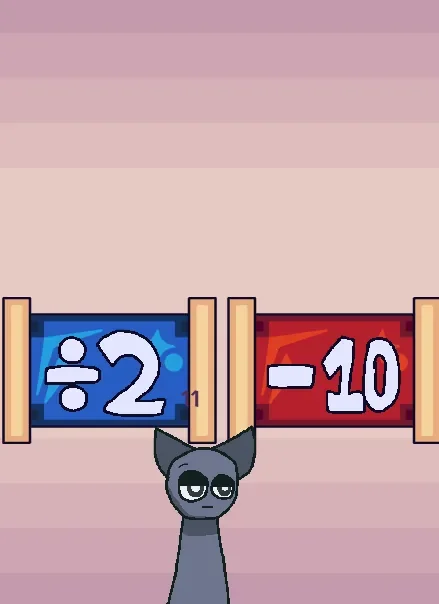

Fast Arithmetic Under a Subdued Facade
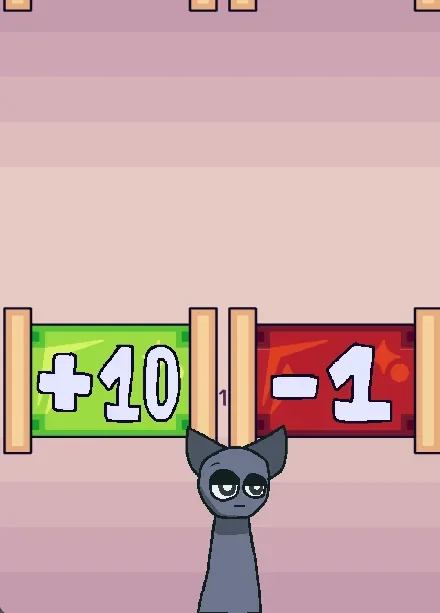
Gray serves as the primary visual anchor for the entire experience. His dark gray color palette and perpetually tired gaze create an intentional contrast with the high-tempo decision making required by the layout. While his design suggests a calm rhythm, the surrounding mechanics demand immediate reflexes. Supporting cast members from the broader fan universe—including Simon, Wenda, and Durple—appear through artwork and named elements across the interface. Though Gray receives the vast majority of on-screen focus during play, these extra characters anchor the game within its familiar community context.
The vertical, portrait-oriented layout keeps action tightly contained. Gray remains stationary in the middle while operator panels fill the upper portion of the display. A bright pink background provides strong contrast against the large green and red operator signs, ensuring that positive and negative modifiers remain distinct even when the clock is ticking down. Large, hand-drawn lettering dominates the screen whenever a run terminates, making the transition to the game-over screen impossible to miss. Animated poses and state transitions give each brief session visual personality beyond a standard quiz interface.
Tapping Panels and Managing Rapid Retries
Interacting with the playfield requires simple point-and-click or touch inputs. Rather than managing complex character positioning, players focus entirely on evaluating panel values under extreme time pressure.
| Action | Input | Result |
|---|---|---|
| Start a round | Tap or click the ready prompt | Begins the countdown |
| Choose a panel | Tap or click an on-screen math panel | Changes the current score or game state |
| Restart | Tap the circular-arrow button on the game-over screen | Attempts to begin another run |
| View rankings | Tap the leaderboard-style button when available | Opens the score ranking view |
The immediate risk-and-reward structure centers on colorful mathematical symbols, most notably prominent +10 and −1 indicators. Choosing green panels generally yields positive point gains or favorable state changes, whereas red panels introduce hazards or penalty deductions. Because rounds last only a few seconds, hesitation almost always results in a failed attempt. Players can tap the circular-arrow button on the game-over screen to immediately launch another attempt, or tap the leaderboard button to inspect high scores when available.
Math Vocabulary and Onboarding Friction
The arithmetic focus gives the project an identity distinct from typical character remixes. Addition and subtraction form the core interactive choices, but the surrounding visual assets suggest a wider mathematical vocabulary. Decorative elements reference multiplication, division, square roots, equality, randomness, and probability, framing the central field as a numerical playground.
However, the speed of each round introduces noticeable onboarding friction. A brief Fortcade welcome screen and initial countdown lead directly into the action without explaining how panel choices calculate final totals or trigger failure conditions. First-time players frequently see the game-over screen before recognizing why a specific panel deduction ended their run. Because the underlying scoring rules are not explicitly defined prior to playing, understanding the exact impact of each operator requires several consecutive restarts.
For players who enjoy quick trial-and-error cycles and high-score chasing, this brevity creates an addicting loop of rapid retries. For those seeking long campaigns, exploration, or clear tutorial guidance, the abrupt pace and minimal explanation present a real hurdle. Progression remains strictly tied to score optimization, leaving the core appeal centered entirely on how quickly one can process basic math modifiers under severe time constraints.



![AY in Noggin's RL, GL Game Redux [ 40 Players ] game cover](https://fortcade.com/wp-content/uploads/2026/10/ay-in-noggin-s-rl-gl-game-redux-40-players-225x300.webp)