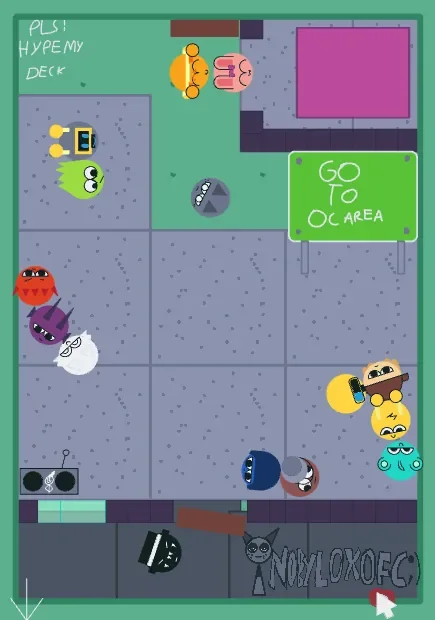
Sliding a large white cursor across a tiled courtyard full of fifteen roaming figures quickly turns an orderly floor into a tumbling pile of cartoon faces. In Sprunki Gray & Friends Ragdoll Playground, players abandon the conventional music-mixing interface of the original series to experiment with character collisions, physics interactions, and short synthetic sound triggers inside a contained sandbox. There are no timers counting down, points to accumulate, or failure states to avoid; the focus remains entirely on disturbing the crowd and watching how the cast responds.
Created by Nobybloxofc, the simulation replaces structured musical composition with open-ended collision experiments. The entire playground takes place within an enclosed hand-drawn courtyard that resembles a tiny neighborhood block, complete with pavement tiles, boundary walls, and a small bedroom section built into the upper corner. Fifteen familiar characters wander, rotate, and flock across this floor, creating unpredictable chain reactions whenever the player's cursor intervenes.
 3 Game Screenshots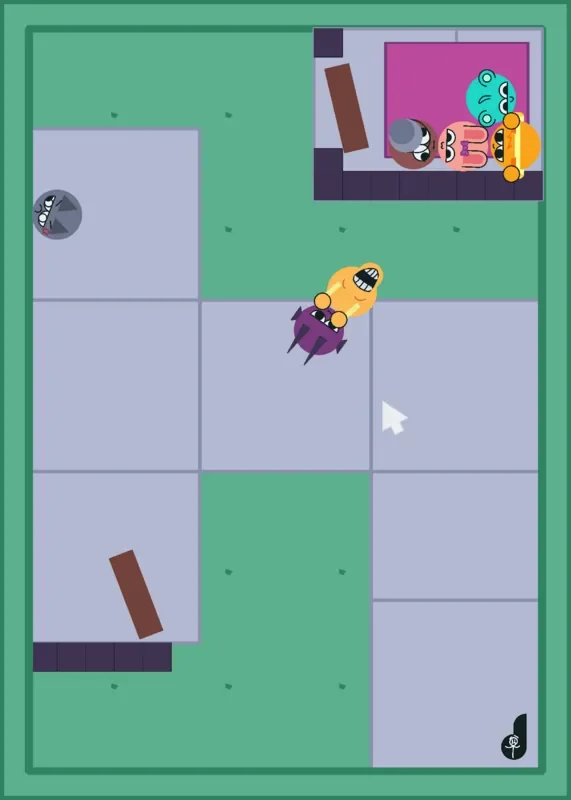
Guiding the Cursor and Herding the Cast
The white cursor acts as the player's physical presence inside the courtyard. Moving the mouse or dragging a finger across the screen draws nearby Sprunkis toward the cursor, causing some characters to give chase for several seconds after making contact. Direct interactions provide finer control: tapping any individual Sprunki momentarily alters their facial expression while playing a brief, distinct synthetic tone or sound effect.
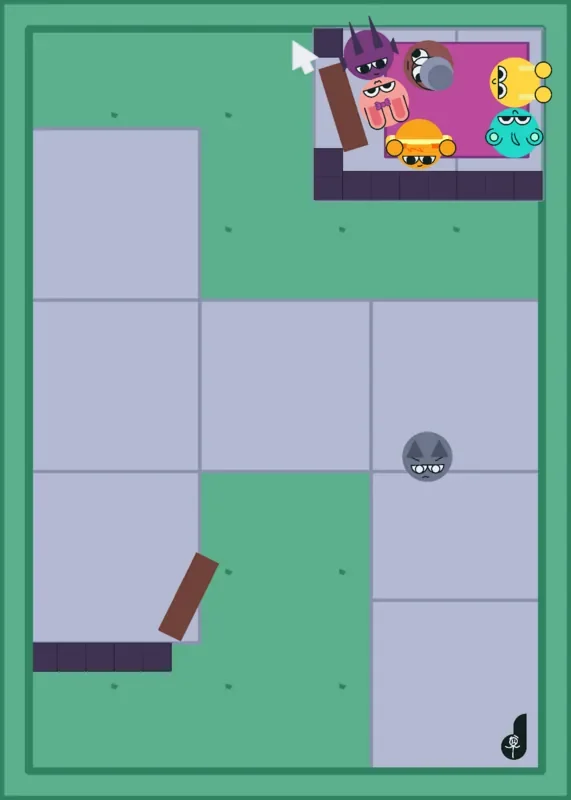
Gray serves as the functional anchor for the entire playground. When Gray collides with other cast members, the impact can trigger dramatic reaction poses, sudden bursts of acceleration, startled expressions, or temporary transformed frames. Brud, OWAKCX, Simon, and Wenda feature especially pronounced scare reactions upon bumping into Gray. Tapping Gray directly causes him to sprint away from the cursor rather than follow it, giving players a herding mechanic to push him toward specific groups.
These physics interactions have inspired emergent play styles among community members. Player feedback indicates that players frequently construct self-imposed goals using cursor nudges, such as herding vulnerable characters into the top-corner bedroom to create a designated safe zone away from Gray or Black. Observers also point out recurring moments where Oren and Pinki naturally wander into the bedroom together, triggering lighthearted community roleplay around their ongoing proximity.
| Action | Input | Result |
|---|---|---|
| Guide the white cursor | Move the mouse or slide a finger | Attract or collide with roaming characters |
| Activate a character | Click or tap the character | Triggers a brief expression change and individual sound tone |
| Redirect Gray | Tap Gray | Makes Gray move away from the cursor temporarily |
| Visit the OC area | Tap the green “GO TO OC AREA” sign | Opens the separate original-character room |
| Return to main cast | Tap the return control in the OC area | Restores the main Sprunki playground |
Courtyard Diversity and the Secondary OC Room
The main courtyard houses fifteen active Sprunkis simultaneously: Black, Brud, Durple, Fun Bot, Garnold, Gray, Jevin, Oren, OWAKCX, Pinki, Raddy, Simon, Sky, Tunner, and Wenda. Because everyone occupies the same space from the start rather than waiting in a menu tray, the environment feels active immediately. Physical proportions influence how characters move through collisions; Fun Bot's blocky rectangular body tumbles differently than rounder cast members, while Black's solid silhouette remains easily visible during congested floor piles. Brightly shaded characters like Oren, Pinki, Raddy, and Sky help players track individual trajectories when massive floor collisions scatter the crowd.
The sandbox intentionally favors disorder over neatness. Characters frequently overlap, press against perimeter walls, or gather in dense clusters in the corners. Without a dedicated reset button to restore initial positions, players must manually disturb crowding figures to clear the floor.
A prominent green sign reading "GO TO OC AREA" leads to a secondary room featuring ten original-character variants. These unnamed figures display distinct happy or angry designs with custom accessories and color schemes. Tapping an original character briefly shifts its expression before returning to its default state. While this secondary room lacks the physical collisions of the main courtyard, it serves as an extra visual gallery, with a clear return control that restores the primary playground.
Audiovisuals and Sandbox Limitations
The visual design uses a hand-drawn art style complete with pavement gridlines, wall boundaries, and the creator's signature along the lower border. Audio features a looping background song divided into three roughly 30-second segments, complemented by the short synthetic tones generated whenever a character is tapped. While these visual and acoustic cues make individual hits clear, repeated play can highlight the background audio loop's brevity, with some players reporting audio fatigue during longer sessions.
The primary limitation of the playground is its strict reliance on open-ended toy mechanics. The game contains no objective missions, unlockable roster slots, saveable arrangements, or multiplayer modes. Once players have observed Gray's transformations, tested character sound triggers, and visited the secondary OC room, replay value rests entirely on inventing new physical setups. As a casual web game on Fortcade, Sprunki Gray & Friends Ragdoll Playground succeeds best in short, relaxed play sessions where simple cursor inputs produce lively visual reactions.
![AY in Noggin's RL, GL Game Redux [ 40 Players ] game cover](https://fortcade.com/wp-content/uploads/2026/10/ay-in-noggin-s-rl-gl-game-redux-40-players-225x300.webp)