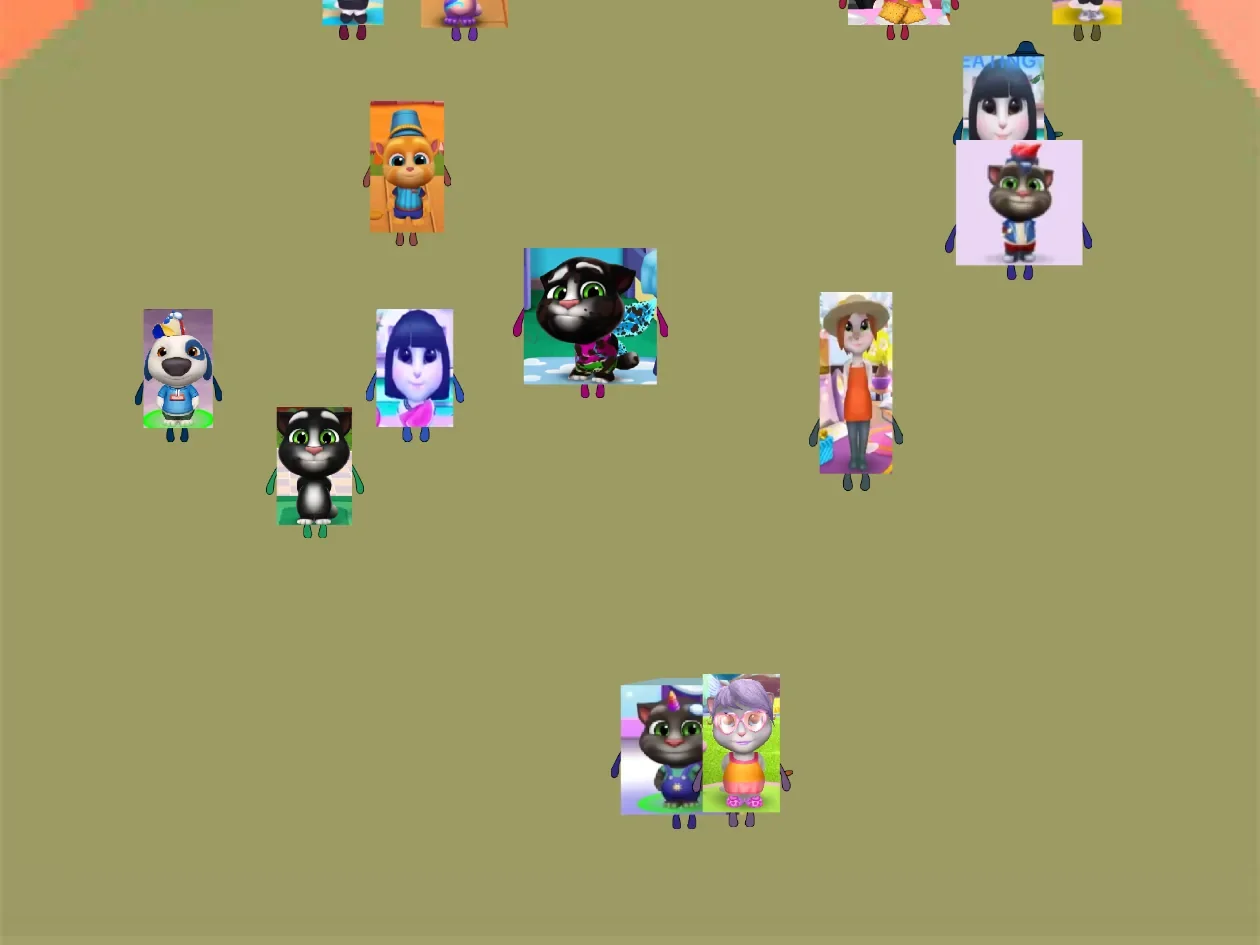
Fourteen custom characters drop into a sparse olive-colored room after a text-to-speech announcement explains the premise: whoever behaves well for the longest wins the contest. In AY In the Playing Behavior game Downstairs, created by @kaojones2017, the player assumes the role of a spectator rather than a participant. There are no movement keys, voting panels, power-ups, or strategic decisions. Instead, individual randomized timers dictate when each character misbehaves, receives a strike, and gets ejected from the floor.
Starting or restarting the simulation represents the player's only direct interaction. Although the game carries a public instruction reading "Add yourself!", the published build contains no interactive character creator or sprite customization tool. Entertainment comes entirely from following the shrinking roster, predicting which candidate will stay well-behaved, and watching how unpredictable timing reshuffles the survival order across repeated runs.
 3 Game Screenshots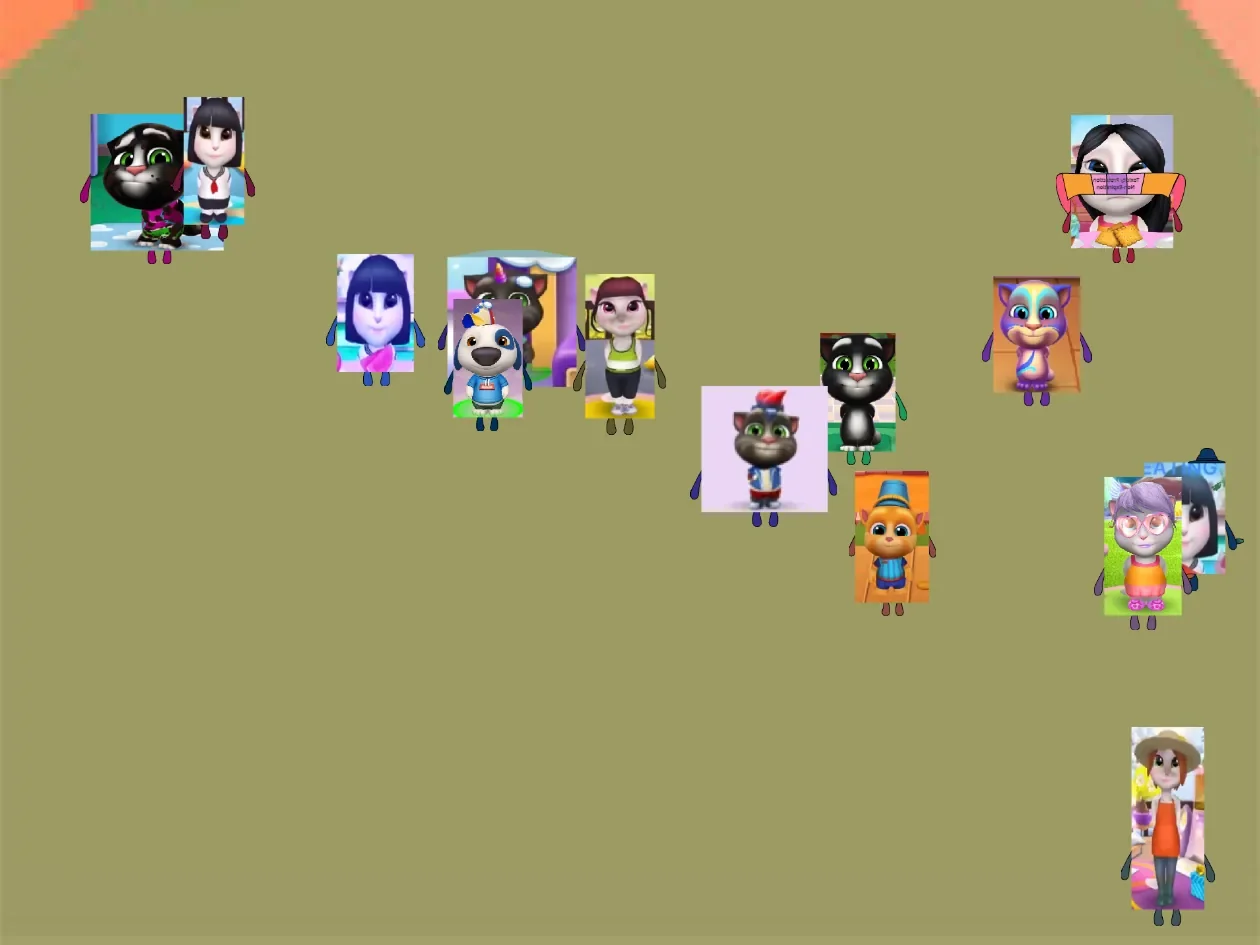
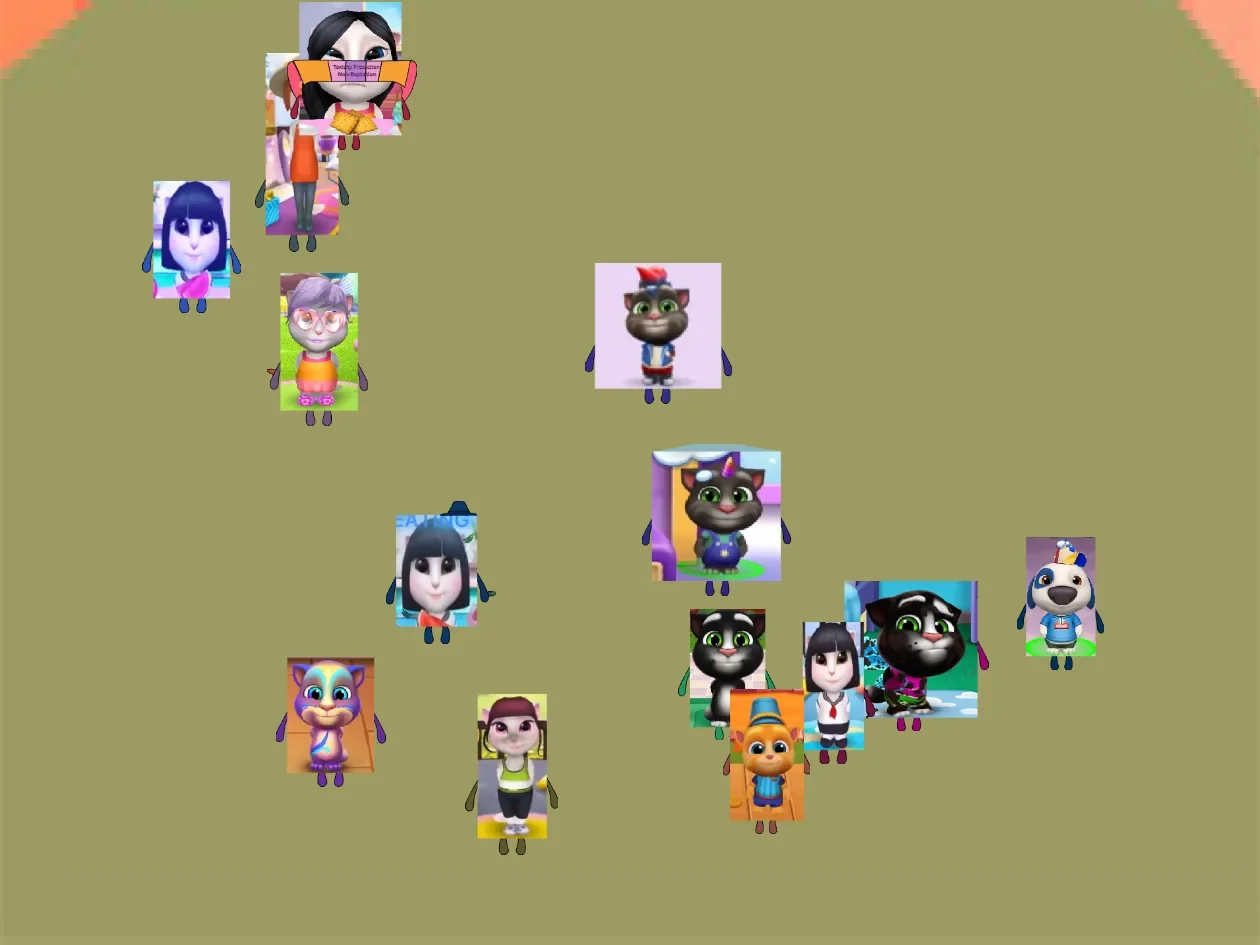
A Custom Roster in the Downstairs Room
The roster serves as the central feature of the contest, gathering fourteen distinct variants of recognizable talking-pet figures. The lineup features seven versions of Angela: Poppy Angela, Student Angela, Farmer Angela, Fitness Angela, Non-Toxic Angela, Cuba Angela, and Blue Poppy Angela. Five versions of Tom join the match—Clown Tom, Blue-White-Red Tom, Fined Tom, Gonium Tom, and Mandi Tom—alongside Cup Ginger and Cap Hank. All fourteen contestants spawn during the opening sequence, landing at separate horizontal positions before roaming across the floor, bouncing off boundary edges, and shifting direction.
Visual fidelity varies widely across the entrants. Some contestants feature detailed full-body visual assets, whereas others rely on recolored fan sprites or scaled image edits. The mismatched proportions and visual noise give the competition a sprawling, fan-assembled quality. Because characters move freely without collision boundaries against each other, heavy overlapping frequently occurs, particularly when multiple sprites cluster near the edges of the room. While this makes tracking individual survivors difficult during crowded moments, the distinct color schemes and costumes allow specific favorites to remain recognizable.
Explosive Eliminations and Random Timing
The core loop relies on individual countdowns assigned to each contestant. When a character's randomized timer reaches zero, movement halts immediately. The character is transferred from the active well-behaved group to the elimination list as the text-to-speech announcer calls out their name. The voice announcement specifies that the contestant received strikes for "mollifying each other" and sends them back to "Poppy Angela and Friends Bands."
Rather than simply fading away, departures trigger an elaborate visual and auditory knockout sequence. The penalised character rotates, launches directly toward the viewer, and smashes into the foreground with glass-breaking effects and screen impacts. The sprite then tumbles downward before vanishing in a series of layered explosions, accompanied by defeat calls, blaring alarms, crowd ambience, and suspenseful audio cues. These dramatic theatrical touches contrast sharply with the plain olive backdrop of the room. On web portals like Fortcade, this unexpected spectacle provides the experience with its most memorable payoffs, though the repetitive sequence follows the same visual beat for every departure.
Reaching a Winner Without Player Intervention
Because elimination timing is generated independently each round, survival sequences are entirely unpredictable. A match might see four contestants eliminated in rapid succession, followed by a long interval where the remaining group wanders aimlessly across the floor. Without skip buttons, fast-forward options, or speed controls, players must accept whatever pacing the random generator delivers.
The contest concludes naturally when only one character remains on the active roster. At that point, contestant movement stops completely, and the announcer formally crowns the lone survivor as the winner. The winning sprite stays on screen alone in the room, establishing a definite ending rather than looping endlessly. While the underlying project assets contain a secondary no-winner announcement for an empty board and a simplified falling animation, neither plays during standard operation. Ultimately, AY In the Playing Behavior game Downstairs succeeds as a casual, automated character tournament where chance alone dictates the outcome.