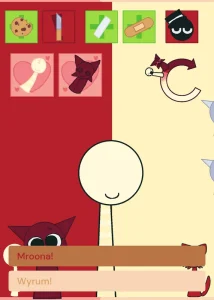
Wenda’s wide-eyed, cheerful smile and Gray’s permanently tired expression rest at the bottom of a narrow portrait arena, waiting to be dragged, fed, patched up, or struck with dropping tools. Content warnings apply for cartoon violence, blood splatter, distressed facial states, and detachable body parts, but there are no missions or survival timers to enforce a specific playstyle. Sprunki Wenda & Gray: Ragdoll Playground functions strictly as a compact character physics toy where player curiosity drives every interaction.
Originally created on Castle by Cherry0_0, the game isolates two recognizable figures inside a single interactive scene. Dragging either character by the head or torso pulls their connected limbs across the floor, while releasing them allows gravity to pull their individual simulated pieces into awkward piles or stacked poses. Because the simulation uses loose joint physics rather than a fully articulated skeletal rig, sudden dragging forces can stretch arrangements or detach pieces unexpectedly, turning simple positioning into unpredictable accidents.
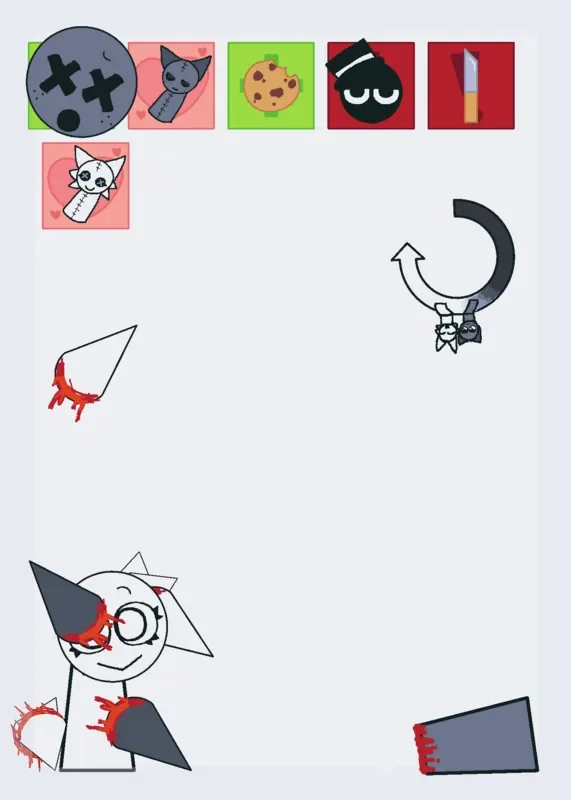 3 Game Screenshots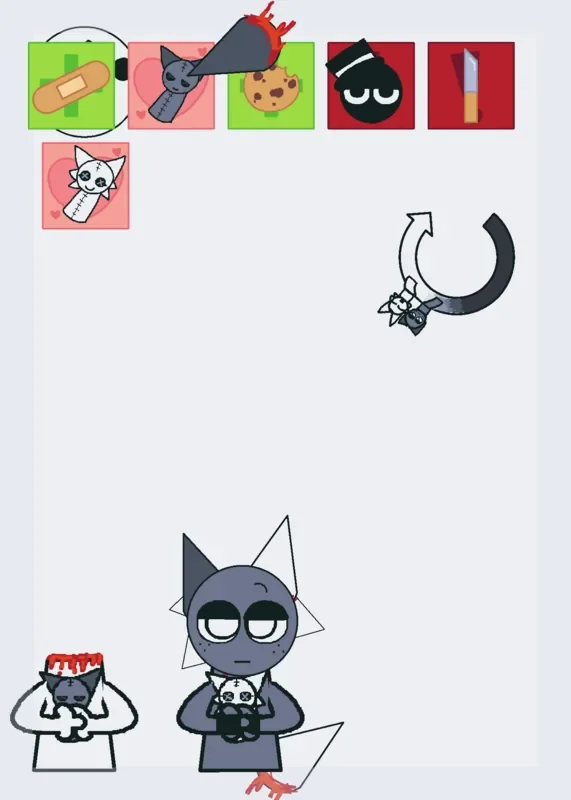
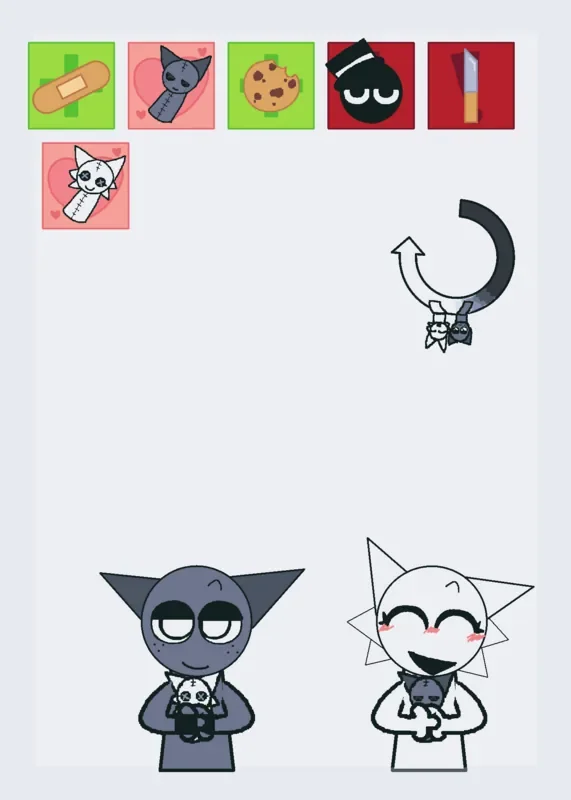
Dropping Knives, Cookies, and Alternate Figures
The depth of the arena depends almost entirely on six tool buttons positioned along the top toolbar. Tapping a tile drops an item from a fixed overhead coordinate or triggers an immediate global state change across both characters.
| Tool Tile | Player Input | Reaction and Outcome |
|---|---|---|
| Character Drag | Click or touch and hold a body part | Repositions and tilts character pieces through loose gravity physics |
| Character Dolls | Tap the Wenda or Gray doll icon | Drops a mini doll that transforms the matching character into an alternate visual state upon contact |
| Cookie | Tap the cookie icon | Spawns a cookie that triggers an eating reaction and adds body mass over repeated feedings |
| Knife | Tap the knife icon | Releases a falling blade that wounds heads, severs limbs, or lodges in body parts |
| Bandage | Tap the bandage icon | Drops a patch that converts wounded body parts into treated, stitched visual frames |
| Black Icon | Tap the Black character tile | Instantly forces both characters into alternate facial expressions |
| Scene Reset | Tap the rotating Wenda and Gray arrow | Spins briefly to restore default character positions, expressions, and intact bodies |
Item collisions produce distinct visual and mechanical chains. A knife striking Gray’s head transforms his half-lidded stare into an injured expression, leaving red impact marks and sometimes keeping the blade embedded at an awkward angle. Hits to limbs can detach arm or leg segments entirely, leaving bloodied pieces scattered across the ground. Cookies provide more than just a passing animation; repeated feedings expand a character's torso width and body weight, noticeably shifting how they slide and tilt when moved. Bandages apply patched textures to damaged areas alongside a short power-up chime, though full recovery often requires pressing the reset arrow rather than relying on individual bandages.
Joint Mechanics and Character Dynamics
The visual contrast between the two stars frames every experiment. Wenda’s stark white art style sits opposite Gray’s muted blue-gray tones, allowing players to read character positions even when both bodies collapse into a tangled pile. Unlabeled toolbar icons force players to discover functions through trial and error, particularly with the Black icon and the doll tiles, whose dropped figures vanish on contact while altering the target's visual state.
| Category | Rating | Judgment |
|---|---|---|
| Physics Playground | 3.5/5 | Loose collisions create funny poses, unpredictable falls, and detachable limbs |
| Character Reactions | 4/5 | Heads, torsos, and limbs respond with distinct visual states and sound effects |
| Controls | 3/5 | Dragging is straightforward, though fixed item drop points lower targeting precision |
| Content Depth | 2.5/5 | Six tools provide variety within a single scene, but lack broader progression |
| Visuals and Sound | 3.5/5 | Readable character line art combined with clear collision audio cues |
| Overall Experience | 3.5/5 | A focused, highly reactive character toy built for short physics experiments |
Handling the ragdolls reveals weak joint connections, as limbs and ears disconnect easily during standard movements. Community observations note that players frequently experiment with reattaching severed ears or swapping limbs between Wenda and Gray, testing whether detached parts can fit onto the opposite character. Player engagement naturally splits between sympathetic attempts to repair injured characters and playful dismemberment. However, because tools drop from fixed overhead locations rather than being manually aimable, targeting specific body parts requires dragging the characters directly beneath the drop zone prior to triggering an item.
Arena Limits and Toy-Box Scope
Sound design relies on quick, clear audio clips that reinforce physical impacts. Cookies crunch upon contact, character doll transformations trigger a brief voice line, and knives and bandages deliver quick synth effects. The standalone web page includes a Fortcade footer positioned below the play field, keeping the main arena completely identical to the original portrait release.
While the single-scene layout makes the game easy to jump into, rapid tool inputs and dense physics collisions can cause performance stutters or temporary freezes on certain devices. Without scores, unlockable gear, or enemy AI, the sandbox relies entirely on self-directed scenarios. Sprunki Wenda & Gray: Ragdoll Playground remains a straightforward, reactive physics toy whose detailed character damage states make it engaging for brief play sessions, even if its fixed drop points and lack of guidance limit longer engagement.